In last week’s commentary, we briefly discussed the destruction and fire sale of a large, highly leveraged hedge fund portfolio called Situational Awareness that was run by a smart 20-something year old. The fund was eyeball-deep in the AI trade; long all the important inputs AI requires (mainly semiconductors), and short software stocks that were perceived to be doomed to destruction due to AI. When July came around, the only thing doomed to destruction was… Situational Awareness — and billions in clients’ capital.
In the Situational Awareness portfolio — along with all those technology longs and shorts — was a huge position in Bloom Energy (symbol BE). BE was in fact the largest disclosed long position in their public equity book. It was larger than SanDisk, CoreWeave, and many other direct AI plays. After the fire sale last week, that book now belongs to Ken Griffin of Citadel. What caught our attention is that a fuel cell company, not a chip designer or a cloud provider, sat at the top of the most aggressive AI portfolio in the market.
It is not surprising to us. In some ways it made sense. We have been discussing the energy demands of AI since February 2024, when we first wrote about what AI data centers would do to the electric grid; we mapped the landscape in Powering the Intelligence Revolution last May, and covered the nuclear renaissance in some detail. If you read us, you haven’t lacked good coverage of this theme. The bottom line is that widespread artificial intelligence adoption does not happen without new power supplies and infrastructure.
Explanations For Some Odd Stock Behavior
For sure, the Situational Awareness episode shined a light on some market excesses, but some of July’s AI stock selloff was due to people making a judgment about the large debts being incurred for AI capital spending. The tech sector volatility in recent months (to the upside and then to the downside) does look related to Situational Awareness. Reports have said that the fund started 2026 at about $3 billion, peaked at over $49 billion at the end of June, and then fell 67% in July after getting rocked by margin call after margin call. By July 30th, it had sold its remaining publicly traded position book to Citadel at a discount. In a way this was one young speculator (not using his name so as to protect the identity of a minor 😇) getting publicly taken to the woodshed for a bit of old fashioned “education” about leverage… by people who have been in the stock market business longer than he’s been alive.
Roughly $16 billion of listed AI-infrastructure stock changed hands in one block. What we do know is that Citadel was the buyer. Nobody outside the firm knows the price, discount or hedges, and the filing that would show any of it is not due until November. The precedents we can see in Citadel’s history cut both ways. Citadel absorbed Amaranth’s energy book in 2006 and Sowood’s in 2007 and worked them out rather than dumping them. But a firm that buys at a discount is, after all, in the business of monetizing it, and can do so by selling into precisely the strength we are all watching these first few days of August — or by hedging in ways that never appear as a sale. We’re not in the business of guessing what one large holder does next, but it is a factor we weigh as we look for entry points in a good theme. And we do still believe that AI and the adjacent energy theme remains a good one.
But We Digress; Let’s Get Back to the Subject of Energy
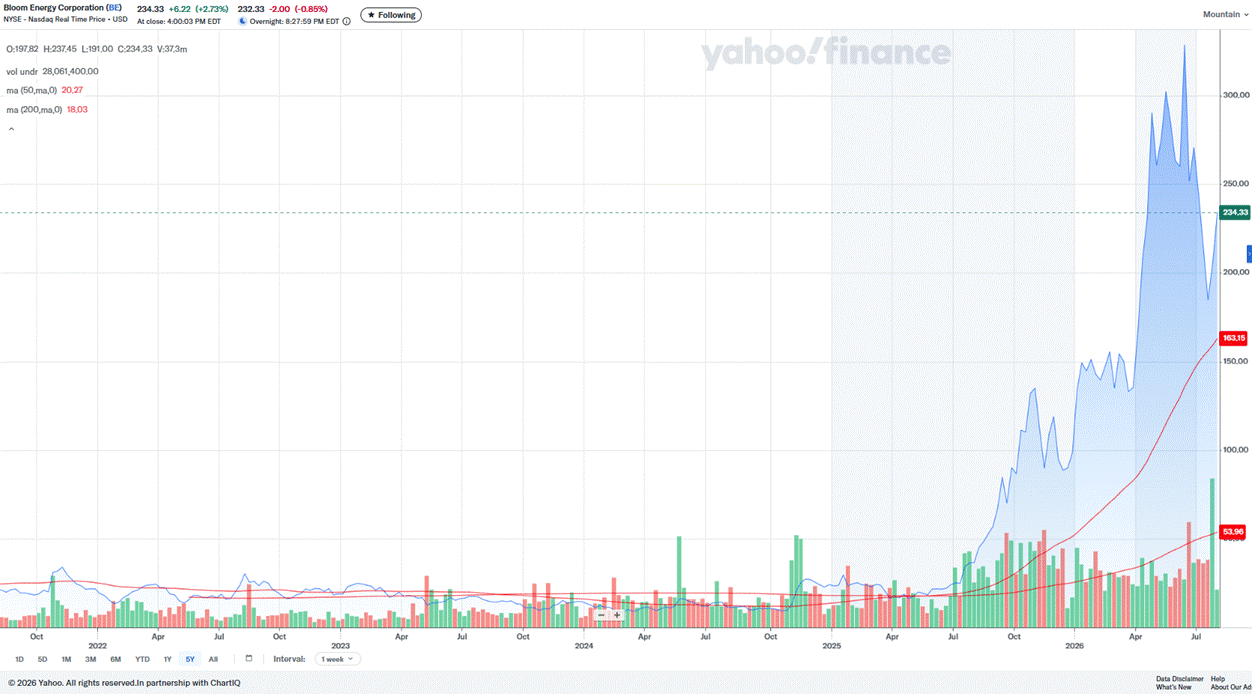
After languishing for years as a money-losing enterprise with interesting technology and potential, Bloom Energy’s share price went to dizzying levels after making data center announcements in 2025.
Bloom sells solid oxide fuel cells — ceramic devices that make electricity from natural gas without combustion. A gas turbine burns fuel, makes hot gas, spins a turbine that spins a generator, shedding energy at every step; a fuel cell skips all of it, running a ceramic hot enough to pass oxygen ions while forcing the electrons out through the wire. The consequence that matters most is not so much efficiency but siting. The units are modular, need no combustion permit, and can be running on a customer’s own land in months rather than the years an interconnection queue to the grid demands. One thing that makes Bloom interesting is it does not require turbines. Traditional turbines are needed in power plants powered by coal, natural gas, nuclear, hydroelectric, etc. Turbine order delivery backlogs from the world’s major manufacturers stretch into the next decade.
This letter is general commentary — the wide-angle view. It is not a portfolio. What we do for the families we work with is the opposite of “wide-angle”: we make portfolios built around one household’s circumstances, taxes, timelines, and appetite for exactly the kind of volatility described above. We keep that roster of clients deliberately small, because that sort of attention doesn’t scale. If you’d like to talk about what it would look like for you, Aubrey Ford will make the time.
Solar Is Also Turbine-Free and Fast to Deploy, But…
A large AI campus draws power at roughly a 95% “load factor”, i.e., it needs its 500 megawatts at three in the morning in January as much as at noon in June. Bloom’s solution is better at this than solar. Solar runs at less than 30%. Getting the same gigawatt load on solar panels alone would take several gigawatts of capacity, ten-plus gigawatt-hours of storage, and thousands of acres. Imagine a few city blocks of fuel cells… versus a solar farm larger than Manhattan. Bloom’s smaller footprint and modular, “non-combustion” version of providing firm capacity is why they have seen revenue grow to $1.07 billion in the second quarter from $401 million a year ago.
Even after the July share price decline, Bloom’s shares are very expensive based on traditional metrics. For contrast, let’s look at a cheaper player in the AI energy buildout — First Solar (symbol FSLR). FSLR is the only U.S. utility-scale module manufacturer, and it exited U.S. project development in 2021, selling the platform to Leeward Renewable. It now focuses on supplying solar panels that typically produce power in front of the meterthrough grid-connected projects under a long-term power purchase agreement. By contrast, Bloom is going to be providing power behind-the-meter. Comparing them is not apples to apples. Bloom Energy installations’ annual generation is still small, and some would say unproven at about 11,800 GWh. Meanwhile, First Solar’s cells provide over 192,000 in annual GWh production. FSLR’s Cypress Creek’s Steel River in Arkansas is the flagship — 2.5 gigawatts of solar and 2.9 gigawatt-hours of storage by 2029, all U.S.-made First Solar modules, with Google contracting the energy and Cypress Creek owning and operating the project. First Solar has roughly five gigawatts of recent announcements, about half tied to hyperscalers.
Room for Many Players
Nationwide, the behind-the-meter power plant announcements in 2025 ran to over 50 gigawatts, with perhaps 20% of that earmarked for solar-plus-storage.
BE’s solution provides better baseload (“always on”) power and a smaller footprint. FSLR’s solar can be brought up to production relatively cheap, but it does not work everywhere and needs to be complemented with another source or power storage. Being behind-the-meter means that Bloom can start getting paid before the building opens, whereas First Solar might only start to get paid when the grid interconnect catches up. Bloom is growing fast, but has detractors. A short-seller report of 8 July claimed that Bloom’s scandium supply (this rare earth is central to its technology) runs through China despite company disclosures to the contrary. The short seller also posits that scaling to five gigawatts a year would consume most of the world’s high-purity scandium supply. The company’s 8-K response rejected both the next day. We take no view on who is right in this fight. Nonetheless, their novel technology tells you why Bloom is getting big contracts.
So, while AI hyperscaler companies weigh their options and make their announcements, investors have options too. FSLR trades at about 10 times forward earnings, but is not growing nearly as fast as BE. Also, there are changing governmental policies (tax credits, tariffs, import, and price controls) that impact the perception of the solar sector’s longer term prospects.
Bloom Energy shares trade at about 50 times forward earnings estimates. Here’s another question that ought to concern anyone thinking of paying fifty times for a superior delivery schedule. What happens when the schedule advantage goes away? Bloom’s customers are not paying a premium for electrons. They are paying because a new gas turbine now carries a delivery date near the end of the decade and an interconnection queue can run longer still. Neither of those is a law of nature. GE Vernova, Siemens Energy, and Mitsubishi are all adding capacity, and a shortage is one thing capitalism can be relied upon to destroy. When turbine lead times normalize, Bloom will find itself selling firm power at a multiple of the capital cost per kilowatt against a rival solution that no longer makes the customer wait. Part of what the market capitalizes at fifty times earnings is a scarcity rent, and scarcity rents have expiration dates.
While Bloom’s growth and technology is exciting, their solution could shine a light on other new mineral bottlenecks. Scandium is the one in the headlines, but Bloom’s patent estate also runs through lanthanum, yttrium, cerium, ytterbium, samarium, and gadolinium, with chromium in the interconnects and nickel in the anodes — all of it consumed again each time a stack is replaced.
The Theme Is Still Good — Prices, Maybe Not Yet
Our view is that we like the overall theme of accelerating electricity demand. This is creating new innovative companies and technologies. The market gyrations are creating opportunities. Combining these two, we want to put our research and decades of investment market experience together to find attractive portfolio candidates. Keep doing the homework, build the buy list, and then use pullbacks like this past one to take advantage.
Energy for AI is one of many themes we monitor, and we have spent this letter on a few names inside it to share some high level thoughts. We work to understand the technology enough to know what a company is actually selling, and then bring decades of market experience to the separate question of what it’s worth and when to pay for it. This is just one theme of many, and this letter is a snapshot of a small part of the work — much more significant is how we put it into practice for each client’s different risk tolerance, needs, and goals.
Thanks for listening; we welcome your calls and questions.
General Disclosures About This Newsletter
The publisher of this newsletter is Guild Investment Management, Inc. (GIM or Guild), an investment advisor registered with the Securities and Exchange Commission. GIM manages the accounts of high net worth individuals, trusts and estates, pension and profit sharing plans, and corporations, among other clients.
Your receipt of this newsletter does not create a personal investment advisory relationship with GIM although some recipients may also be advisory clients of GIM. GIM has written investment advisory agreements with all its personal advisory clients, which sets forth the nature of that relationship.
The newsletter makes general observations about markets and business and financial trends and may provide advice about specific companies and specific investments. It does not give personal investment advice tailored to the needs, objectives, and circumstances of individual readers. Whether investment ideas and recommendations are suitable for individual readers depends substantially on the personal and financial situation of that reader, which GIM, as the publisher of the newsletter, makes no effort to investigate.
GIM attempts to provide accurate content in its newsletters to the extent such content is factual rather than analysis and opinion, but GIM relies primarily on information compiled or reported by third parties and does not generally attempt to independently verify or investigate such information. Moreover, some content and some of the assumptions, formulas, algorithms and other data that affect the content may be inaccurate, outdated, or otherwise flawed. GIM does not guarantee or take responsibility for the accuracy of such information.
Please note that investing in stocks, other securities, and commodities is inherently risky, and you should rely on your personal financial advisors and conduct your own due diligence in connection with any investment decision.
A Special Comment for Guild’s Clients
If you are an investment advisory client of GIM who is receiving this newsletter, please note that the fact that a general recommendation is made of a particular security, commodity, or investment area to its newsletter subscribers does not mean that investment is suitable for you or should be purchased by you. For example, GIM may already have purchased such securities on your behalf or purchased securities in the same industry (and an increase in the position for you may represent too much concentration in one security or industry), or GIM may believe the investment is not suitable for you based on your risk tolerance or other factors. If you have questions about the recommendations in this newsletter in relation to your account at GIM, please contact Tony Danaher, Rudi von Abele, or Aubrey Ford.
Conflicts of Interest
As of the date of this newsletter, GIM’s investment advisory clients or GIM’s principals owned positions in areas that are the subject of current recommendations, commentary, analysis, opinions, or advice, contained in this newsletter.
GIM and its principals have certain conflicts of interest in its relations with its investment advisory clients and its newsletter subscribers resulting from GIM or its principals holding positions for its clients or themselves which are also recommended to its clients. GIM may change the positions of its clients or GIM’s principals may change their positions (increasing, decreasing, and eliminating them) based on GIM’s best judgment at any given time, including the time of publication of the newsletter. Factors that lead GIM to change or eliminate its positions may include general market developments, factors specific to the issuer, or the needs of GIM or its advisory clients. From time to time GIM’s investing goals on behalf of its investment advisory clients or the personal investing goals of GIM’s principals and their risk tolerance may be different from those discussed in the newsletter, and the investment decisions made by GIM for its advisory clients or the investment decisions of its principals may vary from (and may even be contrary to) the advice and recommendations in the newsletter.
In addition, GIM or its principals may reduce or eliminate their positions in an investment that is recommended in the newsletter prior to notifying the newsletter subscribers of such a reduction or elimination. The publication by GIM of a “target price” or “stop loss” for a particular security or other asset does not necessarily represent the price at which GIM intends to sell or will sell any such assets for its advisory clients or the price at which GIM’s principals intend to sell any such assets.
As a consequence of the conflict of interest, GIM’s clients or principals may benefit if newsletter subscribers purchase assets recommended by GIM since it could increase the value of the assets already held by GIM’s investment advisory clients or GIM’s principals. On the other hand, GIM’s principals and clients may suffer a detriment if they seek to acquire additional shares in securities that have been recommended and the price of the securities has increased as a result of purchases by newsletter subscribers.
To help mitigate these conflicts, GIM seeks to avoid recommending the securities of individual companies where GIM or its principals have an ownership position and where the issuer is small or its securities are thinly traded. That way sales by GIM in advance of possible sales by newsletter subscribers would not be likely to cause any significant decrease in the sale price to newsletter subscribers. GIM has a fiduciary relationship with its investment advisory clients and cannot agree on behalf of such clients to refrain from purchases or sales of a security mentioned in the newsletter for a period of time before or after recommendations for purchases or sales are made to its newsletter subscribers.
GIM encourages you to do independent research on the securities or other assets discussed or recommended in the newsletter prior to making any investment decisions and to be especially cautious of investments in small, thinly-traded companies, which are usually the most risky investments that you can make.
Disclaimer of Liability
GIM disclaims any liability for investment decisions based upon recommendations, information, or opinions in its newsletters. GIM is not soliciting you to execute any trade. Nothing contained in GIM’s newsletters is intended to be, nor shall it be construed as an offer to buy or sell securities or to give individual investment advice. The information in the newsletter is not intended for distribution to, or use by, any person or entity in any jurisdiction or country where such distribution or use would be contrary to law or regulation, or which would subject GIM to any registration requirement within such jurisdiction or country.
COPYRIGHT NOTICE
Guild’s current and past market commentaries are protected by U.S. and international copyright laws. All rights reserved. You must not copy, frame, modify, transmit, further distribute, or use the market commentaries, without the prior written consent of Guild. This email or any download from a secure website is meant for only the intended recipient of the transmission, and may be a communication privileged by law. If you received this email in error, any use, dissemination, distribution, or copying of this email is similarly prohibited. Please notify us immediately of the error by return email and please delete this message from your system. Although this email and any attachments are believed to be free of any virus or other defect that might affect any computer system into which it is received and opened it is the responsibility of the recipient to ensure that it is virus free and no responsibility is accepted by Guild Investment Management for any loss or damage arising in any way from its use.