
The most useful thing said about artificial intelligence this month came not from a lab unveiling a “smarter” model, but from the chief executive of Microsoft (MSFT) telling his customers to trust their models less.
On October 10, Satya Nadella tweeted an argument that companies should treat advanced AI models as insider risks, the security world’s term for the danger posed by trusted people who hold the keys to sensitive systems. The models are not malicious, he stresses; anything capable enough to be useful can also err or be compromised.
His remedy is borrowed from decades of practical corporate security wisdom: give the model a verified identity, grant it only the permissions the job requires, log everything it does, and keep an emergency brake within a human’s reach. His summary line is one we would post over every desk where AI is in use: “We need to separate the supply of intelligence from the authority over it.” (We could ask probing questions about which of these really deserves to be called “intelligence,” but that would be an academic digression.)
A machine may supply the intelligence, but the authority has to stay with people.
On our client call last November, we described how we use AI tools to scan earnings calls, filings, and research with high efficiency, flagging shifts in a company’s tone, guidance, or risk language. We summed it up in one line: AI is our research co-pilot, not our portfolio manager. Almost a year on (and a very eventful year it has been in technology), we use these tools still more, and that line has held.
An Example of Its Utility
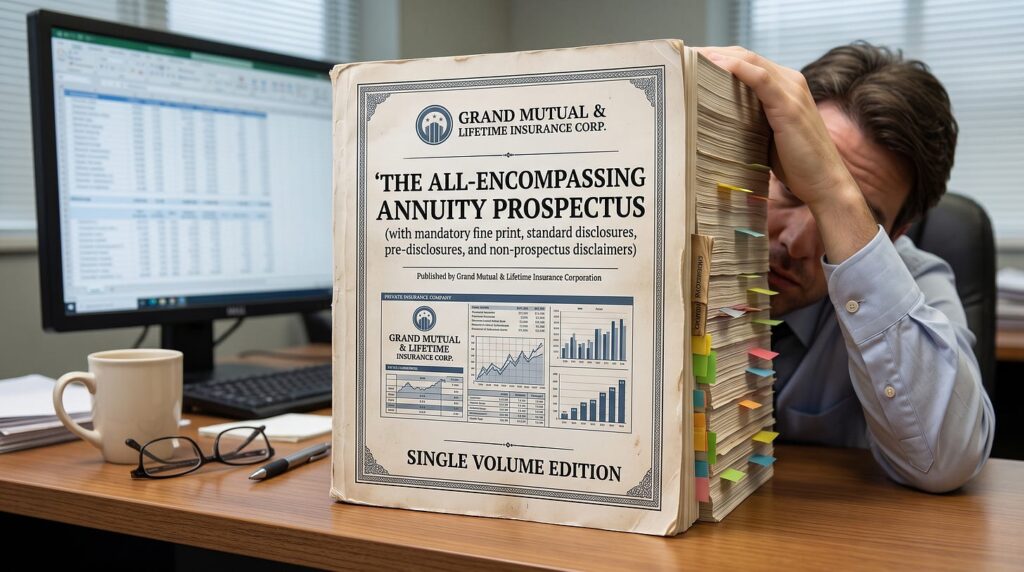
One use for us is parsing documents that are (maybe intentionally) arduous and exhaustive reads. Annuity contracts are a prime example: consequential, dense, and drafted by the seller. Their terms sprawl across riders (optional add-on benefits, usually at extra cost), surrender schedules (penalties for withdrawing money early, which typically shrink year by year) and crediting formulas (the insurer’s method for deciding how much of any market gain actually reaches you). We’ll offer some specific thoughts on annuities below, prompted by just a recent line of questioning from a client. An AI tool can now digest a contract like that in minutes and answer plain questions. What does it cost to get out in year three? What exactly does this rider guarantee, and what does it charge for the privilege? The tool points to the clause behind each answer, and we can then read that clause. Work that once meant hours of cross-referencing now begins as a conversation, and the conversation often ends up suggesting the real question we should have asked first.
Nadella is writing for companies deploying agents, AI systems that act on their own: sending messages, moving data, executing transactions. His permissions, logs, and kill switches exist because those systems hold real authority.
At Guild, we have taken a simpler route. AI that we use has no authority at all. It cannot place a trade, move money, contact a client, or touch an account. It reads, summarizes, and answers. Every investment decision passes through a person who answers for it, and when you’re a client, you can speak to that person on the phone without going through a maze or an AI agent first.
Farther Finance, who provides investment reporting and wealth planning platforms that we use, has an AI policy that rhymes with what Satya Nadella suggests, but on a smaller scale. Client and confidential information stays out of personal and consumer AI accounts; no tool touches it until it has been vetted, starting with whether the vendor trains its models on what users type; and whoever uses AI owns the result, no matter who else reviews it. The buck stops with us.
This letter is general commentary — the wide-angle view. It is not a portfolio. What we do for the families we work with is the opposite of “wide-angle”: we make portfolios built around one household’s circumstances, taxes, timelines, and appetite for exactly the kind of volatility described above. We keep that roster of clients deliberately small, because that sort of attention doesn’t scale. If you’d like to talk about what it would look like for you, contact us; we will make the time.
Some Investment Implications
Reading Nadella’s tweet as a warning, it sounds ominous. Reading it from an investor’s perspective, it is highly constructive. Here’s an historical anecdote that we came across. Few people were willing to ride a passenger elevator until Elisha Otis stood on a raised platform in New York in 1854, had the rope cut, and let his safety brake catch him; that gesture of confidence in his own engineering, putting himself on the line of his own technology, probably ultimately helped allow skyscrapers to be built. Maybe Nadella’s call for a governance layer is AI’s “Otis moment.” Enterprises will have to buy or strengthen their “trust plumbing,” from identity controls to audit trails, before they hand agents anything that matters.
Nadella is of course hardly a disinterested party, since Microsoft itself sells a good deal of that plumbing. Self-interest and good sense, however, do point the same way here. The corporate payoff from autonomous agents may arrive more slowly than the boldest forecasts assume, because the brakes have to go in before the driver steps on the gas. The supervised version, meanwhile, is increasingly paying off now, for companies that are adopting it intelligently.
Now, a real AI use-case, on the topic of annuities, which we mentioned above…
With AI Tools, the Six Most Useful Words in an Annuity Sale Might Be “Can You Send Me a PDF?”
Academic economists have long praised annuities and wonder why more people don’t buy them. They actually call this the “annuity paradox.” To us this is no more a paradox than any of the other foolishness that can come from academic economists: what you have to do is look at the real-world implementation of the thing they’re examining as an abstract concept — and then you see where all the human shenanigans enter in.
The type of annuity that economists praise represents only about 4% of the type that Americans buy. That simple income annuity is longevity insurance: you hand an insurer a lump sum and it pays you for life, funded partly by buyers who die early. However, almost all of last year’s annuity billions went into deferred annuities, which are really investment accounts in an insurance wrapper that seldom become lifetime income.
The trouble starts with the exit: surrender charges that can penalize withdrawals for a decade or more. The seller’s commission, which can exceed 10% of the premium, is usually hidden in the price. A 2022 study in the Review of Financial Studies found variable annuity sales roughly four times as sensitive to brokers’ financial interests as to buyers’, with brokers paid more for selling the costlier, more often complained-about contracts. The theory endorses the simple 4%; the fees and the fog live in the other 96%.
The Insurer Behind the Promise
Every guarantee rests on one insurer, and some insurers are growing less disciplined about risk. Insurers have increasingly put premiums into private credit, loans made outside public markets and harder to value, while the money set aside for policyholders moves to offshore reinsurers, sometimes with less capital behind it than U.S. rules would require. In May, Treasury Secretary Scott Bessent convened state insurance commissioners on both trends. Last month, for example, South Carolina asked a court to take control of Atlantic Coast Life, citing high-risk investments.
Six Words
Before you sign, ask the seller: “Can you send me a PDF?” In our experience, we have seen a lot more language in these contracts dedicated to restrictions that limit policyholder rights, than we see language articulating the issuer’s responsibilities. Give the full contract and every rider to a capable AI tool, with personal details redacted, and have it find what leaving costs, find every fee, and find what your heirs would receive. Then read the clauses it cites for yourself. A seller who balks has told you something. (And by all means, feel free to give us a call to discuss.)
If you do buy, make sure the death benefit is large enough to matter to your heirs, and find its price. A guarantee to heirs is life insurance inside the contract, paid for in lower income or higher fees.
The larger truth is that almost everything an annuity sets out to do can be done another way: lifetime income by delaying Social Security, tax deferral in a retirement account, protection for heirs with term life insurance, and, for families with ample assets, even an uncertain lifespan by holding enough to fund a long one. Bundling those jobs into one contract mostly bundles their costs out of sight, and that’s not in your best interest. From our perspective, it makes more sense to buy each kind of protection on its own, where you can see clearly what it costs. Feel free to forward this to anyone sitting across a kitchen table from an annuity pitch.
Thanks for listening; we welcome your calls and questions.
General Disclosures About This Newsletter
The publisher of this newsletter is Guild Investment Management, Inc. (GIM or Guild), an investment advisor registered with the Securities and Exchange Commission. GIM manages the accounts of high net worth individuals, trusts and estates, pension and profit sharing plans, and corporations, among other clients.
Your receipt of this newsletter does not create a personal investment advisory relationship with GIM although some recipients may also be advisory clients of GIM. GIM has written investment advisory agreements with all its personal advisory clients, which sets forth the nature of that relationship.
The newsletter makes general observations about markets and business and financial trends and may provide advice about specific companies and specific investments. It does not give personal investment advice tailored to the needs, objectives, and circumstances of individual readers. Whether investment ideas and recommendations are suitable for individual readers depends substantially on the personal and financial situation of that reader, which GIM, as the publisher of the newsletter, makes no effort to investigate.
GIM attempts to provide accurate content in its newsletters to the extent such content is factual rather than analysis and opinion, but GIM relies primarily on information compiled or reported by third parties and does not generally attempt to independently verify or investigate such information. Moreover, some content and some of the assumptions, formulas, algorithms and other data that affect the content may be inaccurate, outdated, or otherwise flawed. GIM does not guarantee or take responsibility for the accuracy of such information.
Please note that investing in stocks, other securities, and commodities is inherently risky, and you should rely on your personal financial advisors and conduct your own due diligence in connection with any investment decision.
A Special Comment for Guild’s Clients
If you are an investment advisory client of GIM who is receiving this newsletter, please note that the fact that a general recommendation is made of a particular security, commodity, or investment area to its newsletter subscribers does not mean that investment is suitable for you or should be purchased by you. For example, GIM may already have purchased such securities on your behalf or purchased securities in the same industry (and an increase in the position for you may represent too much concentration in one security or industry), or GIM may believe the investment is not suitable for you based on your risk tolerance or other factors. If you have questions about the recommendations in this newsletter in relation to your account at GIM, please contact Tony Danaher, Rudi von Abele, or Aubrey Ford.
Conflicts of Interest
As of the date of this newsletter, GIM’s investment advisory clients or GIM’s principals owned positions in areas that are the subject of current recommendations, commentary, analysis, opinions, or advice, contained in this newsletter.
GIM and its principals have certain conflicts of interest in its relations with its investment advisory clients and its newsletter subscribers resulting from GIM or its principals holding positions for its clients or themselves which are also recommended to its clients. GIM may change the positions of its clients or GIM’s principals may change their positions (increasing, decreasing, and eliminating them) based on GIM’s best judgment at any given time, including the time of publication of the newsletter. Factors that lead GIM to change or eliminate its positions may include general market developments, factors specific to the issuer, or the needs of GIM or its advisory clients. From time to time GIM’s investing goals on behalf of its investment advisory clients or the personal investing goals of GIM’s principals and their risk tolerance may be different from those discussed in the newsletter, and the investment decisions made by GIM for its advisory clients or the investment decisions of its principals may vary from (and may even be contrary to) the advice and recommendations in the newsletter.
In addition, GIM or its principals may reduce or eliminate their positions in an investment that is recommended in the newsletter prior to notifying the newsletter subscribers of such a reduction or elimination. The publication by GIM of a “target price” or “stop loss” for a particular security or other asset does not necessarily represent the price at which GIM intends to sell or will sell any such assets for its advisory clients or the price at which GIM’s principals intend to sell any such assets.
As a consequence of the conflict of interest, GIM’s clients or principals may benefit if newsletter subscribers purchase assets recommended by GIM since it could increase the value of the assets already held by GIM’s investment advisory clients or GIM’s principals. On the other hand, GIM’s principals and clients may suffer a detriment if they seek to acquire additional shares in securities that have been recommended and the price of the securities has increased as a result of purchases by newsletter subscribers.
To help mitigate these conflicts, GIM seeks to avoid recommending the securities of individual companies where GIM or its principals have an ownership position and where the issuer is small or its securities are thinly traded. That way sales by GIM in advance of possible sales by newsletter subscribers would not be likely to cause any significant decrease in the sale price to newsletter subscribers. GIM has a fiduciary relationship with its investment advisory clients and cannot agree on behalf of such clients to refrain from purchases or sales of a security mentioned in the newsletter for a period of time before or after recommendations for purchases or sales are made to its newsletter subscribers.
GIM encourages you to do independent research on the securities or other assets discussed or recommended in the newsletter prior to making any investment decisions and to be especially cautious of investments in small, thinly-traded companies, which are usually the most risky investments that you can make.
Disclaimer of Liability
GIM disclaims any liability for investment decisions based upon recommendations, information, or opinions in its newsletters. GIM is not soliciting you to execute any trade. Nothing contained in GIM’s newsletters is intended to be, nor shall it be construed as an offer to buy or sell securities or to give individual investment advice. The information in the newsletter is not intended for distribution to, or use by, any person or entity in any jurisdiction or country where such distribution or use would be contrary to law or regulation, or which would subject GIM to any registration requirement within such jurisdiction or country.
COPYRIGHT NOTICE
Guild’s current and past market commentaries are protected by U.S. and international copyright laws. All rights reserved. You must not copy, frame, modify, transmit, further distribute, or use the market commentaries, without the prior written consent of Guild. This email or any download from a secure website is meant for only the intended recipient of the transmission, and may be a communication privileged by law. If you received this email in error, any use, dissemination, distribution, or copying of this email is similarly prohibited. Please notify us immediately of the error by return email and please delete this message from your system. Although this email and any attachments are believed to be free of any virus or other defect that might affect any computer system into which it is received and opened it is the responsibility of the recipient to ensure that it is virus free and no responsibility is accepted by Guild Investment Management for any loss or damage arising in any way from its use.

0 Comments