
Surprisingly, in a humanoid robot, the brain is the cheapest part. Artificial intelligence is what suddenly made human-shaped machines more than a comedy shtick or a Jetsons joke, yet by Bank of America’s estimate the computer that runs one, together with its cameras and sensors, will account for only about 14% of the cost of its parts in 2030. The joints, motors, and hands that make it move will account for about 70%. (Of the last 16%, 4% is the energy system, including the battery, and the rest is miscellaneous.) Much of that expense will be for precision-manufactured components that are not trivial to produce.
That contrast between where the general public thinks the opportunity lies, and where analysis suggests it really lies, reminds us of the entire AI buildout itself. The spectacle and financial media circus of the hyperscalers and the frontier labs’ IPOs may be sexy, but it’s deeper in the guts of the buildout, in energy, components, networking, etc., that the more interesting and actionable themes may reside.
Here Come the Humanoids
For decades, industrial robots have been bolted to the floor and programmed to do one job very efficiently, very reliably, and forever. What has changed is the arrival of a new kind of AI that researchers call a “vision-language-action” model: built like ChatGPT, but answering in movements instead of words. Show it a bin of parts, say what you want, and it works out how to move its arms and fingers to do it.
What does a humanoid cost the company that buys one, and when does it pay off? Pilot-stage humanoids cost $90,000 to $100,000 apiece in parts alone, by Bank of America’s count, and UBTech’s sold for about $105,000 on average last year. The robot is rarely the whole bill: installing conventional factory robots, with their safety gear and programming, has long cost two to four times the machine itself, though humanoids should need less, since they fit spaces built for people. Against that, an American factory production worker costs an employer about $38 an hour with benefits, per the Bureau of Labor Statistics, or roughly $77,000 a year on a single shift.
Our rough arithmetic, assuming $200,000 all in and $10,000 a year of upkeep: a robot that keeps pace with one worker on one shift pays for itself in about three years and earns an 8% return on the money in about three and a half. At half the pace, it takes seven years to break even and nearly eleven to earn that return, longer than anyone yet knows a humanoid will last. Agility said in 2024 that its rented robots pay back in under two years; Bank of America, more cautious, says high prices, uncertain savings, and costly repairs still make compelling paybacks hard to achieve. Cheaper robots will change the math fast: at the $20,000 to $30,000 Elon Musk says Optimus will cost once it’s being manufactured at scale (and remember his track record of “optimism” on such metrics!), with the same setup costs, payback falls to between about a year and a half and four years.
Real implementation is underway, in early stages: over eleven months at BMW’s Spartanburg plant, Figure’s robots, one at a time with a spare rotating in to recharge, helped build about 30,000 X3s. Agility’s Digit moved more than 100,000 shipping totes for GXO Logistics last year and is in trials at Amazon (AMZN). Hyundai Motor, whose group controls Boston Dynamics, plans to build 30,000 Atlas robots a year by 2028. Tesla has turned its Model S and X line in Fremont over to Optimus manufacturing, but has yet to unveil the third-generation robot it promised for early this year.
But still, the scale is still tiny, especially compared to the potential market.
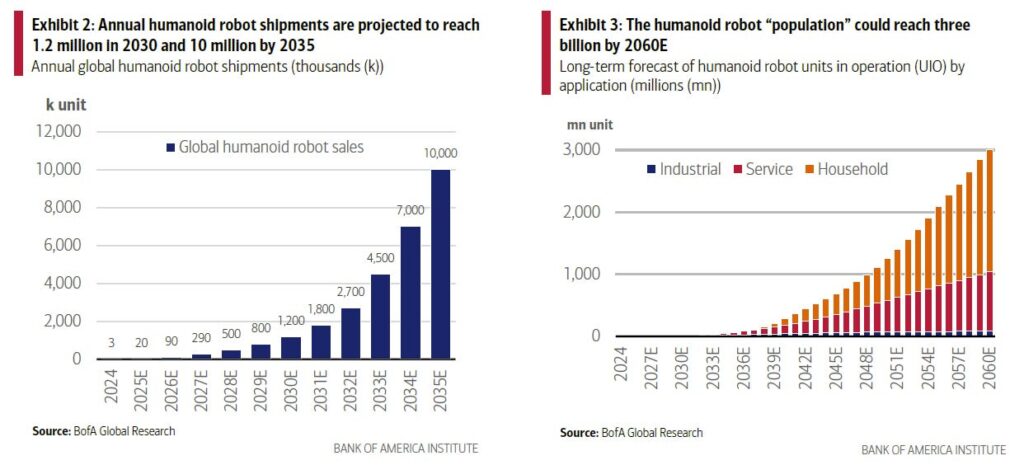
Omdia, a research firm, counted 13,317 humanoids shipped worldwide in 2025. The two volume leaders, AgiBot and Unitree, are Chinese, and less than 10% of Unitree’s 2025 revenue came from industrial applications. In August, Goldman Sachs raised its forecast for 2035 shipments more than fourfold, to about 6.5 million units; Morgan Stanley sees a $5 trillion market by 2050.
Humanoids now do real work, but by the dozen rather than the thousand; this is still the phase in which press releases are more aggressive than purchase orders.
Brains
Even as data centers attract political heat, AI is also moving to “the edge,” industry shorthand for running on the device itself rather than in the distant data centers, or “cloud,” where chatbots live. A robot catching a falling box cannot endure data latency in a round trip to a server farm, or freeze when the wi-fi drops, so its model is trained in a data center and then runs on a computer inside the robot. Google released an on-robot version of its model last year for exactly those reasons, and Figure says its model runs entirely on chips in the robot. For the brain makers this cuts both ways. Every robot needs its own computer, a sale per machine, which promises eye-watering volumes; but those chips must be small, frugal with power, and cheap. NVIDIA, Qualcomm, AMD, and Tesla’s own chip designers all want the job.
Muscles and Magnets
If the brain is the cheap part, the expensive part is everything that moves. Each joint needs an actuator, the robot’s equivalent of a muscle: an electric motor, a gearbox to multiply its force, sensors to report its position. Actuators make up around half the cost of manufacturing a humanoid, according to Schaeffler (SHA0.DE), the German bearing maker.
A humanoid can have up to 70 motorized joints, each with its own motor-control electronics, and Morgan Stanley categorizes chipmakers such as Texas Instruments (TXN) and Infineon (IFX.DE) under the body, not the “brain.” These joints include specific elements that are challenging tasks for precision manufacturing: for example, the “strain-wave gear,” a thin steel cup that flexes to deliver large gear reductions with almost no slack, and the “planetary roller screw,” which turns a motor’s spin into the push that straightens a knee.
Then come the magnets (and here, please remember all our previous discussion of rare earths, which above all are important for magnet manufacture). High-performance motors use neodymium magnets laced with dysprosium or terbium.
As we’ve discussed in our AI-infrastructure letters, the constraint has moved from code to atoms. The bottleneck for humanoid robots is specific precision machining products and rare-earth magnets, rather than “intelligence.”
This letter is general commentary — the wide-angle view. It is not a portfolio. What we do for the families we work with is the opposite of “wide-angle”: we make portfolios built around one household’s circumstances, taxes, timelines, and appetite for exactly the kind of volatility described above. We keep that roster of clients deliberately small, because that sort of attention doesn’t scale. If you’d like to talk about what it would look like for you, Aubrey Ford will make the time.
Owning It
Pure-plays are thin on the ground. Agility is coming to market through a blank-check merger with Churchill Capital Corp XI (CCXI) at $2.5 billion; if this deal closes, it will be the only public pure-play U.S. humanoid robotics company. UBTech Robotics (9880.HK) delivered more than 1,000 humanoids last year, still lost money, and is down about 40% this year. Unitree (688836.SS) has given back more than half of its debut-day peak, and in June the Pentagon put it on its list of Chinese military companies, a step that could eventually lead to a ban on Americans buying the shares. Our suggestion from this summer’s SpaceX offering holds: don’t be someone else’s exit liquidity, the buyer who lets early holders cash out near the top.
We would rather own the companies that sell gears, motors, chips, sensors, and magnets to every robot maker, bought where the robot business still comes nearly free, than bet on which robot wins.
Here are some names to investigate; never let it be said that we didn’t give you some homework. We have left out mainland Chinese companies: many are hard for U.S. investors to buy, and Washington keeps labeling Chinese robot and sensor makers as military companies, a step that can end in a ban on owning them.
Precision Motion
- Harmonic Drive Systems (6324.T): has made strain-wave gears, a 1950s American invention, in Japan since 1970 and leads the world in them. Humanoids are a few percent of sales; the shares, at some 75 times expected earnings, price in far more. Right business, full price.
- Nabtesco (6268.T): its RV reducers, a sturdier kind of precision gear, turn the heavy joints of most large industrial robots, about 60% of that market by its own count. Humanoids are a newly named target.
- Schaeffler (SHA0.DE): the German bearing giant is both buyer and supplier. It will put thousands of robots from Britain’s Humanoid to work, sells roller-screw actuators, and plans cheaper strain-wave gears from 2027. Valued at about a quarter of annual sales.
- SKF (SKF-B.ST): the Swedish bearing maker, founded in 1907, formed a venture in July with Leaderdrive, China’s leading strain-wave gear maker, to supply humanoid joint components from China. SKF holds 60%.
- Hyundai Mobis (012330.KS): Hyundai’s auto-parts arm. Boston Dynamics, which will buy its actuators for Atlas, is its first robotics customer. About seven times expected earnings.
- MinebeaMitsumi (6479.T): the leading maker of miniature ball bearings, by its own count, and a big maker of small motors. With Harmonic Drive it built a robot finger that can lift five kilograms. About 15 times expected earnings.
- NSK (6471.T): a century-old Japanese bearing and ball-screw maker, developing humanoid joint actuators with Taiwan’s Delta Electronics for a 2028 launch.
- Regal Rexnord (RRX): a U.S. motor maker that owns Kollmorgen, a veteran supplier of robot servo motors. Management counted about $40 million of humanoid orders last year but only about $1 million in the first quarter: promising, and lumpy.
- Laifual Drive (3952.HK): a Chinese strain-wave gear maker, listed in Hong Kong in June and already second in its home market.
Body Electronics
- Texas Instruments (TXN): the Dallas analog-chip maker publishes motor-control designs for humanoid joints and, since March, a design pairing its radar sensors with NVIDIA’s robot computer.
- Infineon (IFX.DE): Germany’s largest chipmaker, strong in power chips, sells a complete humanoid motor-control chip set. Its chief executive says humanoid chips “could become a growth market like” today’s AI data centers.
- NXP (NXPI): the Dutch maker of car and factory processors released humanoid designs in March that link joint motor control to NVIDIA’s robot computer.
- Analog Devices (ADI): a precision-sensing specialist building motion, position, force, and depth sensing for humanoids around NVIDIA’s Jetson Thor.
Eyes and Touch
- Sony (SONY): took about half of the world’s image-sensor revenue last year, per Yole Group, and is now courting AI-powered robots as a market for its sensors.
- Cognex (CGNX): a machine-vision pioneer since 1981, whose cameras and software inspect parts and read barcodes on production lines, with about $1 billion of sales last year. It is adding robot depth cameras by buying RealSense, spun out of Intel, for about $500 million.
- LG Innotek (011070.KS): the Korean camera-module maker supplies Figure and is co-developing the vision system for Boston Dynamics’ next Atlas, with TDK (6762.T) adding sensors for robot “eyes” and “skin.”
- Samsung Electro-Mechanics (009150.KS): Samsung’s components arm said it would begin mass production of high-resolution humanoid sensing modules in the third quarter, for a customer it has not named.
- Novanta (NOVT): owns ATI Industrial Automation, a veteran maker of the force sensors that let a robot feel how hard it is pushing, and says it works with “pretty much everybody” in humanoids.
- Vishay Precision Group (VPG): a maker of strain gauges and force sensors. Earlier this year its first humanoid customer formally named it a supplier for a production ramp due in the second half.
- Melexis (MELE.BR): the Belgian automotive-sensor maker sells a fingertip touch sensor for robot hands and booked four robotics design wins last quarter.
Magnets
- MP Materials (MP): mines rare earths at Mountain Pass, California, and is building American magnet plants with a Pentagon stake, a ten-year price floor, and an Apple contract behind it.
- Lynas Rare Earths (LYC.AX): the biggest producer of separated rare earths outside China, and the first outside China to separate dysprosium and terbium, the heavy rare earths that keep motor magnets strong when hot.
- JL Mag (6680.HK): the world’s largest rare-earth magnet maker, by its own count. Its robot and servo-motor sales nearly doubled in the first half, and a “world-renowned” tech company it won’t name has picked it to make robot motor rotors.
- USA Rare Earth (USAR): commissioning a magnet plant in Stillwater, Oklahoma, with federal grants and loans behind it; no robot customers yet.
And last but not least:
Brains
- NVIDIA (NVDA): the AI-chip leader sells the Jetson Thor robot computer and gives away its GR00T humanoid models.
- Qualcomm (QCOM): the smartphone-chip leader has a rival robot processor, and its venture arm backs Figure.
- Alphabet (GOOGL): Google DeepMind’s Gemini Robotics models have been shown running the Apollo robot of Apptronik, which Google also backs, and are headed for Boston Dynamics’ Atlas.
- Arm (ARM): licenses the processor designs inside Jetson Thor.
Diluted exposure: Toyota (TM), Tesla (TSLA), Hyundai Motor (005380.KS), and Amazon (AMZN), where humanoids are one bet inside a much bigger business.
Remember: it’s an exciting theme — even if there’s nothing actionable to buy this week… or this month.
Thanks for listening; we welcome your calls and questions.
General Disclosures About This Newsletter
The publisher of this newsletter is Guild Investment Management, Inc. (GIM or Guild), an investment advisor registered with the Securities and Exchange Commission. GIM manages the accounts of high net worth individuals, trusts and estates, pension and profit sharing plans, and corporations, among other clients.
Your receipt of this newsletter does not create a personal investment advisory relationship with GIM although some recipients may also be advisory clients of GIM. GIM has written investment advisory agreements with all its personal advisory clients, which sets forth the nature of that relationship.
The newsletter makes general observations about markets and business and financial trends and may provide advice about specific companies and specific investments. It does not give personal investment advice tailored to the needs, objectives, and circumstances of individual readers. Whether investment ideas and recommendations are suitable for individual readers depends substantially on the personal and financial situation of that reader, which GIM, as the publisher of the newsletter, makes no effort to investigate.
GIM attempts to provide accurate content in its newsletters to the extent such content is factual rather than analysis and opinion, but GIM relies primarily on information compiled or reported by third parties and does not generally attempt to independently verify or investigate such information. Moreover, some content and some of the assumptions, formulas, algorithms and other data that affect the content may be inaccurate, outdated, or otherwise flawed. GIM does not guarantee or take responsibility for the accuracy of such information.
Please note that investing in stocks, other securities, and commodities is inherently risky, and you should rely on your personal financial advisors and conduct your own due diligence in connection with any investment decision.
A Special Comment for Guild’s Clients
If you are an investment advisory client of GIM who is receiving this newsletter, please note that the fact that a general recommendation is made of a particular security, commodity, or investment area to its newsletter subscribers does not mean that investment is suitable for you or should be purchased by you. For example, GIM may already have purchased such securities on your behalf or purchased securities in the same industry (and an increase in the position for you may represent too much concentration in one security or industry), or GIM may believe the investment is not suitable for you based on your risk tolerance or other factors. If you have questions about the recommendations in this newsletter in relation to your account at GIM, please contact Tony Danaher, Rudi von Abele, or Aubrey Ford.
Conflicts of Interest
As of the date of this newsletter, GIM’s investment advisory clients or GIM’s principals owned positions in areas that are the subject of current recommendations, commentary, analysis, opinions, or advice, contained in this newsletter.
GIM and its principals have certain conflicts of interest in its relations with its investment advisory clients and its newsletter subscribers resulting from GIM or its principals holding positions for its clients or themselves which are also recommended to its clients. GIM may change the positions of its clients or GIM’s principals may change their positions (increasing, decreasing, and eliminating them) based on GIM’s best judgment at any given time, including the time of publication of the newsletter. Factors that lead GIM to change or eliminate its positions may include general market developments, factors specific to the issuer, or the needs of GIM or its advisory clients. From time to time GIM’s investing goals on behalf of its investment advisory clients or the personal investing goals of GIM’s principals and their risk tolerance may be different from those discussed in the newsletter, and the investment decisions made by GIM for its advisory clients or the investment decisions of its principals may vary from (and may even be contrary to) the advice and recommendations in the newsletter.
In addition, GIM or its principals may reduce or eliminate their positions in an investment that is recommended in the newsletter prior to notifying the newsletter subscribers of such a reduction or elimination. The publication by GIM of a “target price” or “stop loss” for a particular security or other asset does not necessarily represent the price at which GIM intends to sell or will sell any such assets for its advisory clients or the price at which GIM’s principals intend to sell any such assets.
As a consequence of the conflict of interest, GIM’s clients or principals may benefit if newsletter subscribers purchase assets recommended by GIM since it could increase the value of the assets already held by GIM’s investment advisory clients or GIM’s principals. On the other hand, GIM’s principals and clients may suffer a detriment if they seek to acquire additional shares in securities that have been recommended and the price of the securities has increased as a result of purchases by newsletter subscribers.
To help mitigate these conflicts, GIM seeks to avoid recommending the securities of individual companies where GIM or its principals have an ownership position and where the issuer is small or its securities are thinly traded. That way sales by GIM in advance of possible sales by newsletter subscribers would not be likely to cause any significant decrease in the sale price to newsletter subscribers. GIM has a fiduciary relationship with its investment advisory clients and cannot agree on behalf of such clients to refrain from purchases or sales of a security mentioned in the newsletter for a period of time before or after recommendations for purchases or sales are made to its newsletter subscribers.
GIM encourages you to do independent research on the securities or other assets discussed or recommended in the newsletter prior to making any investment decisions and to be especially cautious of investments in small, thinly-traded companies, which are usually the most risky investments that you can make.
Disclaimer of Liability
GIM disclaims any liability for investment decisions based upon recommendations, information, or opinions in its newsletters. GIM is not soliciting you to execute any trade. Nothing contained in GIM’s newsletters is intended to be, nor shall it be construed as an offer to buy or sell securities or to give individual investment advice. The information in the newsletter is not intended for distribution to, or use by, any person or entity in any jurisdiction or country where such distribution or use would be contrary to law or regulation, or which would subject GIM to any registration requirement within such jurisdiction or country.
COPYRIGHT NOTICE
Guild’s current and past market commentaries are protected by U.S. and international copyright laws. All rights reserved. You must not copy, frame, modify, transmit, further distribute, or use the market commentaries, without the prior written consent of Guild. This email or any download from a secure website is meant for only the intended recipient of the transmission, and may be a communication privileged by law. If you received this email in error, any use, dissemination, distribution, or copying of this email is similarly prohibited. Please notify us immediately of the error by return email and please delete this message from your system. Although this email and any attachments are believed to be free of any virus or other defect that might affect any computer system into which it is received and opened it is the responsibility of the recipient to ensure that it is virus free and no responsibility is accepted by Guild Investment Management for any loss or damage arising in any way from its use.

0 Comments