
*If the Earnings Pan Out
Last Thursday’s precipitous decline saw the S&P 500 close at its cheapest valuation in three years, yet we’d still hesitate to affirm that valuation was a bargain. The index traded at 17.7 times the earnings analysts expect over the next twelve months, according to FactSet; that’s the lowest forward price/earnings multiple (what investors pay for each dollar of profit) since November 2023, and well under the ten-year average of 19.1. But the catch is in how it got there: stock prices were up about 7% for the year at that point, while the earnings forecast underneath them had risen almost 34%. In a nutshell, the market is “cheap” only if that forecast comes true.
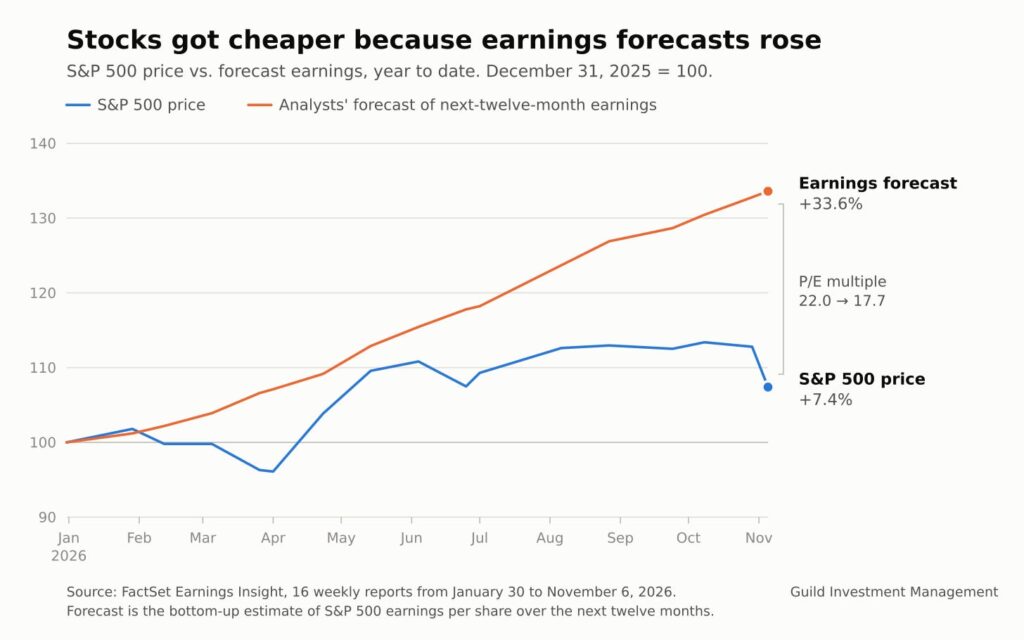
Robust Profit Growth
Profits have indeed had a remarkable year. With most companies reported, third-quarter earnings are running about 31% above last year’s, the third straight quarter of growth above 25%, and analysts expect another 16% in 2027.
Analysts tend to be too hopeful, of course, especially after a few years of bull market and in the throes of an industrial revolution that’s rewarding its economic epicenters with spectacular growth. Over the last 25 years, analysts’ forecasts at the start of a year typically ran about 6% above what companies went on to earn. That average is pulled up by a few very large overestimations. The two largest were 2001, when forecasts proved 36% too high, and 2008, when they proved 43% too high. Both came at the end of long profit booms. The second followed a four-year period, 2003 through 2006, in which analysts kept raising their numbers to keep up with results — as they have this year.
At its peak in October 2007 the S&P 500 traded at about 15 times expected earnings, cheaper than today. The price looked sensible, and the index still fell by more than half, because the earnings it was measured against never arrived. In short, a “low” multiple on a record forecast is only as cheap as the forecast is correct.
The Road to 7,000
Larry Jeddeloh of TIS Group, a strategist we read closely, wrote on Monday that the S&P 500 “should trade back toward 7,000 for starters.” That is about 7% below Tuesday’s close of 7,521 and about 10% below October’s record, which would make it an ordinary “correction” (the market’s term for a 10% decline from a peak).
Larry gets there by way of war, liquidity, and a loss of confidence. To us, there is a simpler and less alarming path that gets us there that does not require geopolitically derived chaos: profit growth this strong is hard to maintain. Trim the forecast by FactSet’s average 6% miss and today’s multiple rises from about 18 to about 19, which is the ten-year average, and the discount is gone. At 7,000 the index would trade at just under 18 times the trimmed figure. If forecasts need to slip only in line with their long-run tendency, 7,000 is roughly where “cheap” starts to be correct. And of course, there is another item in the mix… inflation and rising rates.
Inflation
Inflation has run hotter than the market expected. Investors began the year pricing in two interest-rate cuts from the Federal Reserve; in September they got the first increase since 2023. On Tuesday the government reported that consumer prices rose 0.4% in October from September, with the core measure (which leaves out food and energy) up 0.3% for a third straight month. Futures markets now treat a second increase in December as a near certainty, and one Fed governor has said a half-point move should be considered. The ten-year Treasury yield is back at about 5%.
A Treasury paying 5% competes favorably, in many minds, with a stock market whose expected earnings come to about 5.5% of its price. A Fed that is raising rates might also be slow to come to the market’s aid. BofA’s economists argued after October’s strong jobs report that investors should count on less of the “policy put” — Wall Street’s shorthand for the Fed easing if stocks fall far enough.
Company managements are saying much the same. By Jefferies’ tally of third-quarter calls, they cited inflation, higher rates and supply constraints as reasons for near-term caution, even as three in four stayed upbeat about 2027.
This letter is general commentary — the wide-angle view. It is not a portfolio. What we do for the families we work with is the opposite of “wide-angle”: we make portfolios built around one household’s circumstances, taxes, timelines, and appetite for exactly the kind of volatility described above. We keep that roster of clients deliberately small, because that sort of attention doesn’t scale. If you’d like to talk about what it would look like for you, contact us; we will make the time.
Jettison Huang
This morning Jensen Huang resigned as chief executive, president, and director of Nvidia (NVDA), the company he co-founded 33 years ago. As recently as Sunday the board had expressed confidence in him, despite reports of a relationship with a suspected Chinese intelligence operative that drew inquiries from the FBI and Congress. What ended it came on Wednesday, when The New York Times reported a second relationship, with a senior Nvidia executive who reported directly to him, which made it the company’s business as well as his own. The board met Wednesday to weigh removing him, and by this morning he was gone. Chief financial officer Colette Kress is interim CEO while the board searches inside and outside the company, and the shares fell about 10% before the open.
We’ll leave the soap opera to others. An ultra-enthusiastic, charismatic founder’s reign usually ends one way or another, and this is how Jensen’s ended. What matters for investors is what leaves with him. Huang was the AI boom’s chief dealmaker and chief cheerleader. He struck the partnerships, often investing in the very customers that buy Nvidia’s chips, and he sold the vision from the stage. We expect deal and decision-making will be slower, with more deliberation. We expect the deal structures to change, with fewer arrangements in which Nvidia finances its own customers, and less ‘aggressive’ commitments all round. Some companies might see immediate gains. Broadcom (AVGO), which designs custom AI chips for the largest cloud companies, may benefit as those customers hedge their reliance on a single supplier. There are others who stand to benefit from internal turmoil at Nvidia, but we do expect the overall AI spending cycle to run more slowly than it has… which is one more grain of salt on next year’s earnings forecasts.
AI’s Productivity Gains Are Measurable, So It’s Not Going Away
However, a counterpoint: double-digit growth could repeat if productivity keeps improving. This week brought stronger evidence that it will.
Morgan Stanley’s strategists ran roughly 18,000 earnings-call and conference transcripts through an AI language model, looking for companies that put a number on what AI has done for them. Over the past twelve months, 44% of S&P 500 companies cited at least one measurable benefit, up from 32% a year earlier. The share citing a direct financial effect, meaning costs saved or revenue gained, rose from 16% to 26%. Financial companies are furthest along, at two in three. The companies that report such numbers most consistently have also seen their earnings forecasts rise faster than the rest of the index.
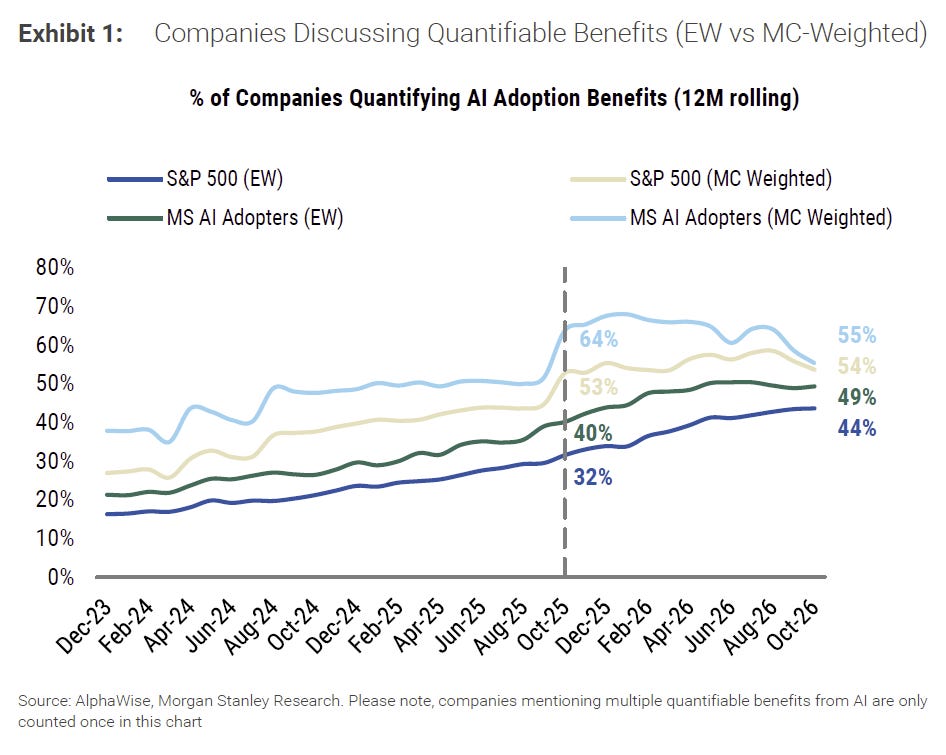
In 1999, the internet’s payoff was mostly a promise. AI’s is now appearing in reported results, well beyond the largest technology companies: so far this quarter, the other 493 companies in the index are growing earnings faster than those seven, the so-called “Magnificent Seven,” which FactSet says would be a first since 2022. Costs are being counted as well: the share of companies discussing what AI costs them nearly tripled from a year earlier, to 22%, and Morgan Stanley is careful to call the measurement of returns “early.”
Still, more than four in ten large companies are now putting numbers on AI’s payoff, which is an argument in favor of continued earnings strength.
Implications
The large earnings misses of 2001 and 2008 took recessions to produce, and an economy that added 165,000 jobs in October, with unemployment at 4.1%, is not recessionary, or headed visibly in such a direction. If a correction comes, we expect the ordinary kind, and that kind is congenial to long-term investors. In the meantime, with the Fed’s policy rate just under 4% and likely to rise, cash and short-term Treasuries pay while the forecasts are tested and afford dry powder to take advantage of a deeper correction if one occurs.
Thanks for listening; we welcome your calls and questions.
General Disclosures About This Newsletter
The publisher of this newsletter is Guild Investment Management, Inc. (GIM or Guild), an investment advisor registered with the Securities and Exchange Commission. GIM manages the accounts of high net worth individuals, trusts and estates, pension and profit sharing plans, and corporations, among other clients.
Your receipt of this newsletter does not create a personal investment advisory relationship with GIM although some recipients may also be advisory clients of GIM. GIM has written investment advisory agreements with all its personal advisory clients, which sets forth the nature of that relationship.
The newsletter makes general observations about markets and business and financial trends and may provide advice about specific companies and specific investments. It does not give personal investment advice tailored to the needs, objectives, and circumstances of individual readers. Whether investment ideas and recommendations are suitable for individual readers depends substantially on the personal and financial situation of that reader, which GIM, as the publisher of the newsletter, makes no effort to investigate.
GIM attempts to provide accurate content in its newsletters to the extent such content is factual rather than analysis and opinion, but GIM relies primarily on information compiled or reported by third parties and does not generally attempt to independently verify or investigate such information. Moreover, some content and some of the assumptions, formulas, algorithms and other data that affect the content may be inaccurate, outdated, or otherwise flawed. GIM does not guarantee or take responsibility for the accuracy of such information.
Please note that investing in stocks, other securities, and commodities is inherently risky, and you should rely on your personal financial advisors and conduct your own due diligence in connection with any investment decision.
A Special Comment for Guild’s Clients
If you are an investment advisory client of GIM who is receiving this newsletter, please note that the fact that a general recommendation is made of a particular security, commodity, or investment area to its newsletter subscribers does not mean that investment is suitable for you or should be purchased by you. For example, GIM may already have purchased such securities on your behalf or purchased securities in the same industry (and an increase in the position for you may represent too much concentration in one security or industry), or GIM may believe the investment is not suitable for you based on your risk tolerance or other factors. If you have questions about the recommendations in this newsletter in relation to your account at GIM, please contact Tony Danaher, Rudi von Abele, or Aubrey Ford.
Conflicts of Interest
As of the date of this newsletter, GIM’s investment advisory clients or GIM’s principals owned positions in areas that are the subject of current recommendations, commentary, analysis, opinions, or advice, contained in this newsletter.
GIM and its principals have certain conflicts of interest in its relations with its investment advisory clients and its newsletter subscribers resulting from GIM or its principals holding positions for its clients or themselves which are also recommended to its clients. GIM may change the positions of its clients or GIM’s principals may change their positions (increasing, decreasing, and eliminating them) based on GIM’s best judgment at any given time, including the time of publication of the newsletter. Factors that lead GIM to change or eliminate its positions may include general market developments, factors specific to the issuer, or the needs of GIM or its advisory clients. From time to time GIM’s investing goals on behalf of its investment advisory clients or the personal investing goals of GIM’s principals and their risk tolerance may be different from those discussed in the newsletter, and the investment decisions made by GIM for its advisory clients or the investment decisions of its principals may vary from (and may even be contrary to) the advice and recommendations in the newsletter.
In addition, GIM or its principals may reduce or eliminate their positions in an investment that is recommended in the newsletter prior to notifying the newsletter subscribers of such a reduction or elimination. The publication by GIM of a “target price” or “stop loss” for a particular security or other asset does not necessarily represent the price at which GIM intends to sell or will sell any such assets for its advisory clients or the price at which GIM’s principals intend to sell any such assets.
As a consequence of the conflict of interest, GIM’s clients or principals may benefit if newsletter subscribers purchase assets recommended by GIM since it could increase the value of the assets already held by GIM’s investment advisory clients or GIM’s principals. On the other hand, GIM’s principals and clients may suffer a detriment if they seek to acquire additional shares in securities that have been recommended and the price of the securities has increased as a result of purchases by newsletter subscribers.
To help mitigate these conflicts, GIM seeks to avoid recommending the securities of individual companies where GIM or its principals have an ownership position and where the issuer is small or its securities are thinly traded. That way sales by GIM in advance of possible sales by newsletter subscribers would not be likely to cause any significant decrease in the sale price to newsletter subscribers. GIM has a fiduciary relationship with its investment advisory clients and cannot agree on behalf of such clients to refrain from purchases or sales of a security mentioned in the newsletter for a period of time before or after recommendations for purchases or sales are made to its newsletter subscribers.
GIM encourages you to do independent research on the securities or other assets discussed or recommended in the newsletter prior to making any investment decisions and to be especially cautious of investments in small, thinly-traded companies, which are usually the most risky investments that you can make.
Disclaimer of Liability
GIM disclaims any liability for investment decisions based upon recommendations, information, or opinions in its newsletters. GIM is not soliciting you to execute any trade. Nothing contained in GIM’s newsletters is intended to be, nor shall it be construed as an offer to buy or sell securities or to give individual investment advice. The information in the newsletter is not intended for distribution to, or use by, any person or entity in any jurisdiction or country where such distribution or use would be contrary to law or regulation, or which would subject GIM to any registration requirement within such jurisdiction or country.
COPYRIGHT NOTICE
Guild’s current and past market commentaries are protected by U.S. and international copyright laws. All rights reserved. You must not copy, frame, modify, transmit, further distribute, or use the market commentaries, without the prior written consent of Guild. This email or any download from a secure website is meant for only the intended recipient of the transmission, and may be a communication privileged by law. If you received this email in error, any use, dissemination, distribution, or copying of this email is similarly prohibited. Please notify us immediately of the error by return email and please delete this message from your system. Although this email and any attachments are believed to be free of any virus or other defect that might affect any computer system into which it is received and opened it is the responsibility of the recipient to ensure that it is virus free and no responsibility is accepted by Guild Investment Management for any loss or damage arising in any way from its use.

0 Comments