
The stock market may be a discounting mechanism, but the traders can get things “wrong.” They can discount the future as they think it should be, position accordingly, then have to adjust when said future looks different.
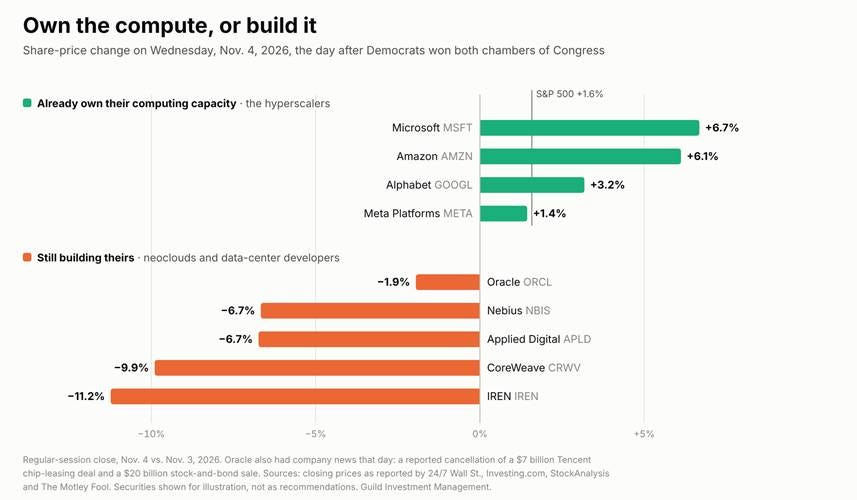
Tuesday’s U.S. voting put the brakes on Washington, and by the opening bell on Wednesday, the market had reached what seems like a sensible understanding of the effects on AI. The companies that already own their computing capacity rose, and the ones that still need to build it fell. Democrats took both chambers of Congress. By the count of J.P. Morgan’s Michael Cembalest, this is only the sixth time since 1910 that a President’s party has lost control of both at once. They flipped Senate seats as far afield as Kansas and Texas, and won governorships in Texas, Georgia, and Ohio, which are among the country’s largest markets for planned data-center construction.
Some of Wednesday’s initial rally would have happened whoever won. Investors had hedged to insure against a known event, and once it passed, the hedges came off. That was an outcome-agnostic clearing event, now in the rearview mirror: we are past the big pothole. The differential within the AI trade is likely meaningful. Wednesday’s initial bounce in the indexes looks less meaningful than today’s broad selloff, which signifies a major shift in expectations and sentiment.
Markets needed to correct what is overpriced, overhyped, and over-owned. In the portfolios we manage, we have purposefully avoided high-multiple stocks and sectors, meaning those priced at the richest multiples of their earnings, for exactly this reason. A correction like this is normal, even healthy — as long as the economy holds up, the Fed doesn’t overtighten, and the most grandiose dreams of those voters infatuated with socialism don’t come near realization.
On the other hand, the President’s statement that he will accept the results removes the risk of a contested aftermath, and that is bullish in itself (although truth be told, it is sad that this concession is even newsworthy). Further, a prolonged war with Iran has become less likely. The war has been badly disruptive, from oil and shipping costs to inflation, and even the Vice President took to X to blame the losses on it.
Checks and Balances
Looking at the voting constructively, we see it as a vote for checks and balances, and as evidence that the system — contrary to declarations about its decrepitude — is actually working as designed. This was a vote against inflation and against the President (cue the eternal wisdom of James Carville — “it’s the economy, stupid” — who has however made himself persona non grata with the current insurgents among the Democrats). Prices topped the list of grievances: since the Iran war began in February, retail gasoline is up roughly 40% and diesel roughly two-thirds. Polling of independents showed unease about corruption. In fact, corruption and fraud were cited by voters in all parties as being important, whether it is financial theft, voter fraud, or public officials’ emphasis on self-enrichment over governing.
However, this was not a vote for higher taxes. Democrats lack a veto-proof Senate, and BofA’s economists see a much higher hurdle for broad corporate or wealth-tax increases than for health-care fixes. And of course, in two years, voters get to apply another check. This was much more a referendum on prices and conduct than a mandate to tax.
The Dollar, and Everyone Else
The dollar fell about half a percent overnight and gold rallied big. It is too early to see a trend developing, but one could expect most currencies to keep firming against the dollar as markets price in a Washington that can neither spend nor deregulate as freely. A softer dollar helps gold, which climbed back above $4,100 this morning, and possibly bitcoin. The future for the overall cryptocurrency space in the U.S. is cloudy. Democrats’ ire at the extent of Trump family enrichment via cryptocurrencies might adversely affect regulatory progress on digital assets, but several of the new Democrat legislators are known to be favorable to better crypto regulation.
If the dollar decline were to continue it will also be a slight positive for global liquidity, because much of the world borrows in dollars and a cheaper dollar makes those debts lighter. That is good for emerging markets, and good for Ottawa and Beijing, which can now negotiate with a President whose domestic leverage just shrank.
This letter is general commentary — the wide-angle view. It is not a portfolio. What we do for the families we work with is the opposite of “wide-angle”: we make portfolios built around one household’s circumstances, taxes, timelines, and appetite for exactly the kind of volatility described above. We keep that roster of clients deliberately small, because that sort of attention doesn’t scale. If you’d like to talk about what it would look like for you, contact us; we will make the time.
AI: Slower Growth, Wider Moats
The real AI risk lies in statehouses rather than in Congress. Nearly every major local ballot measure opposing data centers passed. Cembalest estimates that the incoming governors could “pause” 37.5 of the 96 gigawatts expected to come online in 2028, and attach conditions to another 15 (a gigawatt is roughly what one large nuclear reactor produces). Next year’s capacity is mostly under construction already and largely safe.
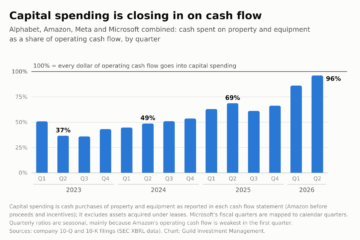
That is probably bad for AI growth, and not great for the chipmakers whose order books depend on new buildings. But it is good for those who already own their compute. When new capacity gets scarce, existing capacity gets more valuable. Wednesday morning’s trading drew the line in exactly that place. The “neoclouds” fell sharply: companies such as CoreWeave and Nebius, which rent out AI computing power and must keep building to grow. The restrictions also hand the hyperscalers something many of their shareholders have wanted for months: an excuse to curtail spending that nobody can blame on management. Their lenders, who have watched AI commitments pile up largely off balance sheet, would not object either.
So perhaps expect somewhat slower U.S. data center buildout overall, but higher price/earnings multiples (what investors pay for each dollar of profit) for the builders who can still get permits. We’d expect also a migration of some data center construction to other political jurisdictions with solid regulatory environments, congenial climates, and abundant land and energy — here’s looking at you, Alberta. Around the rest of the world, there is probably excitement that they might be able to get into the AI race a little cheaper if they are not competing with unconstrained U.S. demand. Expect AI compute spending to be redirected, but not disappear.
What Else Changes
Unfortunately we can probably expect more “lawfare”: subpoenas, hearings, and investigations could take up (too) much of Washington’s energy for two years. Those who grumble about this should remember something once said about living by the sword and perishing by the sword. As we’ve commented before when the other side was doing it, we devoutly hope that this trend of scorched-earth political reprisals will not become the operative baseline in the United States as it is in so many dysfunctional regions of the world, but recent history does not encourage us. On the plus side, gridlock costs some growth and removes some risk, a trade long-term investors can live with even if they’re not ecstatically happy about it.
Expect a partial reversal of America First policy directions. Solar stocks jumped by double digits in early trading on Wednesday while European defense shares fell, and we expect defense to lag here too once the new majority controls appropriations. Expect GDP growth to slow from last quarter’s annualized pace of better than 3% as the data-center boom cools. However, none of that amounts to a recession call. Investors must not become so enthralled with speculation about a distant future that they ignore real and present dynamics. The long-term trajectory is always something to consider, but not at the expense of seeing the economic trends that are much more forcefully operative in the near term, and AI is in the last analysis a juggernaut that politicians can work to slow but will never successfully thwart.
Gold had a good day yesterday, and gold-mining shares a much better one. GDX, an exchange-traded fund of the largest miners, rose about 9%, roughly three times the metal’s own gain. Several Democratic priorities are expensive, from Medicare for All, which would extend government health insurance to every age, to more power for organized labor. Little of that agenda can become law over a presidential veto in the next two years, but gold says the market has already started thinking about that potential invoice.
Oil fell more than 8% as traders bet that the new Congress, which expects to invoke the War Powers Resolution in January, will push the administration toward an early settlement with Iran. Cheaper oil helps consumers and the inflation numbers right away. The costs come later. A settlement that lets Iran sell its oil freely would also fund its proxy militias. An American step back from Israel would leave Europe and much of the Middle East with far larger defense bills of their own.
On the AI front, we think it’s worth noting that a slower U.S. buildout might help the hyperscalers’ cash flow, but strangling the industry would hand ground to China in a technology race that neither party can afford to lose.
As mentioned above (and in previous letters), we prefer to avoid the very high valuation, momentum-hyped stocks, and we have lots of Treasury bills and cash in reserve to take advantage of excess weakness. That being said, expectations about the future are being reset. The markets are speaking, and we are listening. We are also researching and looking for those next best opportunities.
Thanks for listening; we welcome your calls and questions.
General Disclosures About This Newsletter
The publisher of this newsletter is Guild Investment Management, Inc. (GIM or Guild), an investment advisor registered with the Securities and Exchange Commission. GIM manages the accounts of high net worth individuals, trusts and estates, pension and profit sharing plans, and corporations, among other clients.
Your receipt of this newsletter does not create a personal investment advisory relationship with GIM although some recipients may also be advisory clients of GIM. GIM has written investment advisory agreements with all its personal advisory clients, which sets forth the nature of that relationship.
The newsletter makes general observations about markets and business and financial trends and may provide advice about specific companies and specific investments. It does not give personal investment advice tailored to the needs, objectives, and circumstances of individual readers. Whether investment ideas and recommendations are suitable for individual readers depends substantially on the personal and financial situation of that reader, which GIM, as the publisher of the newsletter, makes no effort to investigate.
GIM attempts to provide accurate content in its newsletters to the extent such content is factual rather than analysis and opinion, but GIM relies primarily on information compiled or reported by third parties and does not generally attempt to independently verify or investigate such information. Moreover, some content and some of the assumptions, formulas, algorithms and other data that affect the content may be inaccurate, outdated, or otherwise flawed. GIM does not guarantee or take responsibility for the accuracy of such information.
Please note that investing in stocks, other securities, and commodities is inherently risky, and you should rely on your personal financial advisors and conduct your own due diligence in connection with any investment decision.
A Special Comment for Guild’s Clients
If you are an investment advisory client of GIM who is receiving this newsletter, please note that the fact that a general recommendation is made of a particular security, commodity, or investment area to its newsletter subscribers does not mean that investment is suitable for you or should be purchased by you. For example, GIM may already have purchased such securities on your behalf or purchased securities in the same industry (and an increase in the position for you may represent too much concentration in one security or industry), or GIM may believe the investment is not suitable for you based on your risk tolerance or other factors. If you have questions about the recommendations in this newsletter in relation to your account at GIM, please contact Tony Danaher, Rudi von Abele, or Aubrey Ford.
Conflicts of Interest
As of the date of this newsletter, GIM’s investment advisory clients or GIM’s principals owned positions in areas that are the subject of current recommendations, commentary, analysis, opinions, or advice, contained in this newsletter.
GIM and its principals have certain conflicts of interest in its relations with its investment advisory clients and its newsletter subscribers resulting from GIM or its principals holding positions for its clients or themselves which are also recommended to its clients. GIM may change the positions of its clients or GIM’s principals may change their positions (increasing, decreasing, and eliminating them) based on GIM’s best judgment at any given time, including the time of publication of the newsletter. Factors that lead GIM to change or eliminate its positions may include general market developments, factors specific to the issuer, or the needs of GIM or its advisory clients. From time to time GIM’s investing goals on behalf of its investment advisory clients or the personal investing goals of GIM’s principals and their risk tolerance may be different from those discussed in the newsletter, and the investment decisions made by GIM for its advisory clients or the investment decisions of its principals may vary from (and may even be contrary to) the advice and recommendations in the newsletter.
In addition, GIM or its principals may reduce or eliminate their positions in an investment that is recommended in the newsletter prior to notifying the newsletter subscribers of such a reduction or elimination. The publication by GIM of a “target price” or “stop loss” for a particular security or other asset does not necessarily represent the price at which GIM intends to sell or will sell any such assets for its advisory clients or the price at which GIM’s principals intend to sell any such assets.
As a consequence of the conflict of interest, GIM’s clients or principals may benefit if newsletter subscribers purchase assets recommended by GIM since it could increase the value of the assets already held by GIM’s investment advisory clients or GIM’s principals. On the other hand, GIM’s principals and clients may suffer a detriment if they seek to acquire additional shares in securities that have been recommended and the price of the securities has increased as a result of purchases by newsletter subscribers.
To help mitigate these conflicts, GIM seeks to avoid recommending the securities of individual companies where GIM or its principals have an ownership position and where the issuer is small or its securities are thinly traded. That way sales by GIM in advance of possible sales by newsletter subscribers would not be likely to cause any significant decrease in the sale price to newsletter subscribers. GIM has a fiduciary relationship with its investment advisory clients and cannot agree on behalf of such clients to refrain from purchases or sales of a security mentioned in the newsletter for a period of time before or after recommendations for purchases or sales are made to its newsletter subscribers.
GIM encourages you to do independent research on the securities or other assets discussed or recommended in the newsletter prior to making any investment decisions and to be especially cautious of investments in small, thinly-traded companies, which are usually the most risky investments that you can make.
Disclaimer of Liability
GIM disclaims any liability for investment decisions based upon recommendations, information, or opinions in its newsletters. GIM is not soliciting you to execute any trade. Nothing contained in GIM’s newsletters is intended to be, nor shall it be construed as an offer to buy or sell securities or to give individual investment advice. The information in the newsletter is not intended for distribution to, or use by, any person or entity in any jurisdiction or country where such distribution or use would be contrary to law or regulation, or which would subject GIM to any registration requirement within such jurisdiction or country.
COPYRIGHT NOTICE
Guild’s current and past market commentaries are protected by U.S. and international copyright laws. All rights reserved. You must not copy, frame, modify, transmit, further distribute, or use the market commentaries, without the prior written consent of Guild. This email or any download from a secure website is meant for only the intended recipient of the transmission, and may be a communication privileged by law. If you received this email in error, any use, dissemination, distribution, or copying of this email is similarly prohibited. Please notify us immediately of the error by return email and please delete this message from your system. Although this email and any attachments are believed to be free of any virus or other defect that might affect any computer system into which it is received and opened it is the responsibility of the recipient to ensure that it is virus free and no responsibility is accepted by Guild Investment Management for any loss or damage arising in any way from its use.


0 Comments