
Putting the Blue vs Red vote aside, November 3 could have been described as a data center referendum. While the public backlash against data center development is real, voting within the U.S. Senate may end up mattering more. On November 3, voters sided against data centers in all but one of roughly 40 local ballot measures; but on November 9, the Senate voted 73–25 to take up the Bipartisan American Affordability and Jobs Act (BAAJA), the most ambitious overhaul of federal permitting rules in decades.
The first vote got the headlines, but the second could do far more to shape the next decade of American energy and AI deployment.
The backlash was more against local impact than the technology itself. The ballot results are meaningful, to be sure; the margins were lopsided, and the concerns cut across party lines. But when we look at what drove that sentiment, we see that the main complaint was less about the buildings themselves than about the electricity bills. Rising electricity prices fueled much of the opposition (and secondarily, worries about water use and other local impacts).
What Is BAAJA About?
When a big energy project needs federal approval, the process runs largely through the National Environmental Policy Act (NEPA), a 1970 law requiring agencies to study the environmental impact of what they approve. NEPA rarely kills a project outright. Its power is delay: opponents can sue for years after a permit is granted, and a judge can cancel the permit while a case drags on.
BAAJA could cut the time allowed to sue from as long as six years to 150 days. It generally stops judges from canceling permits or halting construction over a flawed review; instead, the agency gets up to 180 days to fix the problem while work continues. The bill also limits states’ ability to block interstate pipelines and power lines, makes permits harder for a future administration to revoke, and lets Federal regulators approve major interstate power lines that states have stalled. Wind developers and pipeline companies — not ordinarily thought of as policy bedfellows — both support it, because lawsuits have stalled and frustrated both of them. The bill wouldn’t decide what America builds, but it would influence how long building takes, and whether a permit, once granted, stays granted.
The Bottleneck
This has therefore been a litigation problem, not so much a regulatory-overreach problem as such. The paperwork itself has already gotten faster: a typical federal environmental review completed in 2024 took about 2.2 years, down from 3.1 years in 2017–2020, according to Columbia University researchers. The longer delays come afterward, in the courts and in the line to connect to the power grid.

According to Lawrence Berkeley National Laboratory, the typical U.S. power plant or battery completed in 2025 waited 61 months, just over five years, between asking to connect to the grid and switching on. In 2008 the wait was just 22 months. Grid operators must study whether each new plant would overload the lines, and a flood of applications, many of them speculative, has swamped those studies. If the grid proves too weak, projects can wait years for upgrades. BAAJA requires grid operators to plan across regional borders, penalizes speculative applicants who clog the queue, and charges new power lines to the customers who benefit.
There is certainly an element of competition with China that’s operative here. Research firm SemiAnalysis estimates China has more than 24 gigawatts of data centers running, against about 56 in the United States, with 50 more under construction or announced. America’s lead is real, but the question is whether it can build fast enough to keep it.
Where the Two Votes Meet
BAAJA requires each data center’s owner to pay for the transmission lines that serve it, instead of spreading the cost to everyone else. That directly addresses the voters’ main grievance, and it could win back some of the public goodwill developers seemed to have lost on Election Day.
An aside, since a common objection is that data centers are leaving the grid anyway: it’s accurate to say thatsome are trying. Tired of the waiting line, developers increasingly plan to build their own power plants on-site, or “behind the meter,” in industry jargon — that means, power paid for by the operator, not by the public. The energy research firm Cleanview counts about 30% of planned U.S. data center capacity heading that way, and about three-quarters of the on-site equipment it could identify burns natural gas. But this is still mostly just aspirational: BloombergNEF finds only about 2 gigawatts of on-site gas generation actually running at data centers worldwide, and many of these sites will lean on the grid for backup or until a connection arrives. The Columbia researchers argue that faster grid connections, more than pricing rules, are what keep big users on the shared grid, where BAAJA will make them pay their share.
The Financial Impact Is Real
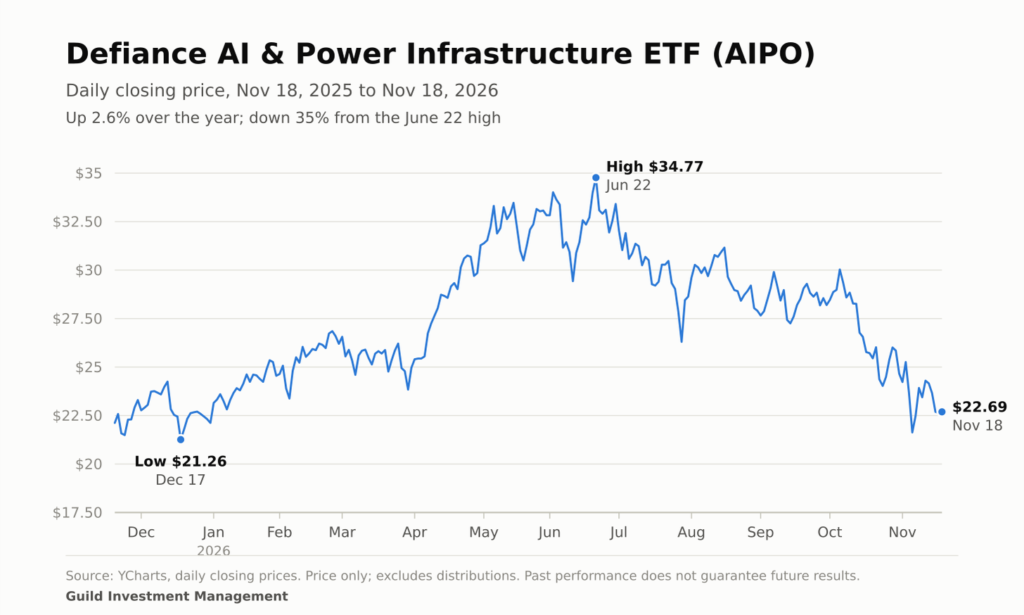
The energy research firm Enverus expects the largest cloud companies to spend roughly $5 trillion on capital projects from 2026 through 2030, and Cleanview estimates an AI data center can bring in $10 million to $12 million a year per megawatt. Every month shaved off a grid connection brings that revenue forward. Lower legal risk should also make long-lived infrastructure cheaper to finance: a pipeline or power line built to run for decades is worth more when a court or a future administration can no longer strand it halfway through construction.
If the bill passes, the clearest winners are the companies building the physical grid: transmission developers and makers of transformers and high-voltage cable. Power lines need metal, so a real buildout also supports copper and aluminum, consistent with our view of industrial commodities as genuine diversifiers. Natural gas gains on and off the grid: from limits on state pipeline vetoes, from the on-site plants described above, and from the grid queue itself, where gas capacity rose 86% in 2025. Geothermal and nuclear benefit too. Utilities are a more mixed story, facing new competition for regional power lines.
This letter is general commentary — the wide-angle view. It is not a portfolio. What we do for the families we work with is the opposite of “wide-angle”: we make portfolios built around one household’s circumstances, taxes, timelines, and appetite for exactly the kind of volatility described above. We keep that roster of clients deliberately small, because that sort of attention doesn’t scale. If you’d like to talk about what it would look like for you, contact us; we will make the time.
Of course, none of this is assured. Speaker Mike Johnson says he believes the House has the votes, and President Trump supports the bill, but members of both parties object to parts of it, and if it is not law by January 3, it dies. Nor do faster permits ease the shortages of turbines and transformers. If the bill fails, anything already permitted, built, and connected becomes more valuable still. If BAAJA passes, the backlash may look less like the end of the build-out than advertised.
Thanks for listening; we welcome your calls and questions.
General Disclosures About This Newsletter
The publisher of this newsletter is Guild Investment Management, Inc. (GIM or Guild), an investment advisor registered with the Securities and Exchange Commission. GIM manages the accounts of high net worth individuals, trusts and estates, pension and profit sharing plans, and corporations, among other clients.
Your receipt of this newsletter does not create a personal investment advisory relationship with GIM although some recipients may also be advisory clients of GIM. GIM has written investment advisory agreements with all its personal advisory clients, which sets forth the nature of that relationship.
The newsletter makes general observations about markets and business and financial trends and may provide advice about specific companies and specific investments. It does not give personal investment advice tailored to the needs, objectives, and circumstances of individual readers. Whether investment ideas and recommendations are suitable for individual readers depends substantially on the personal and financial situation of that reader, which GIM, as the publisher of the newsletter, makes no effort to investigate.
GIM attempts to provide accurate content in its newsletters to the extent such content is factual rather than analysis and opinion, but GIM relies primarily on information compiled or reported by third parties and does not generally attempt to independently verify or investigate such information. Moreover, some content and some of the assumptions, formulas, algorithms and other data that affect the content may be inaccurate, outdated, or otherwise flawed. GIM does not guarantee or take responsibility for the accuracy of such information.
Please note that investing in stocks, other securities, and commodities is inherently risky, and you should rely on your personal financial advisors and conduct your own due diligence in connection with any investment decision.
A Special Comment for Guild’s Clients
If you are an investment advisory client of GIM who is receiving this newsletter, please note that the fact that a general recommendation is made of a particular security, commodity, or investment area to its newsletter subscribers does not mean that investment is suitable for you or should be purchased by you. For example, GIM may already have purchased such securities on your behalf or purchased securities in the same industry (and an increase in the position for you may represent too much concentration in one security or industry), or GIM may believe the investment is not suitable for you based on your risk tolerance or other factors. If you have questions about the recommendations in this newsletter in relation to your account at GIM, please contact Tony Danaher, Rudi von Abele, or Aubrey Ford.
Conflicts of Interest
As of the date of this newsletter, GIM’s investment advisory clients or GIM’s principals owned positions in areas that are the subject of current recommendations, commentary, analysis, opinions, or advice, contained in this newsletter.
GIM and its principals have certain conflicts of interest in its relations with its investment advisory clients and its newsletter subscribers resulting from GIM or its principals holding positions for its clients or themselves which are also recommended to its clients. GIM may change the positions of its clients or GIM’s principals may change their positions (increasing, decreasing, and eliminating them) based on GIM’s best judgment at any given time, including the time of publication of the newsletter. Factors that lead GIM to change or eliminate its positions may include general market developments, factors specific to the issuer, or the needs of GIM or its advisory clients. From time to time GIM’s investing goals on behalf of its investment advisory clients or the personal investing goals of GIM’s principals and their risk tolerance may be different from those discussed in the newsletter, and the investment decisions made by GIM for its advisory clients or the investment decisions of its principals may vary from (and may even be contrary to) the advice and recommendations in the newsletter.
In addition, GIM or its principals may reduce or eliminate their positions in an investment that is recommended in the newsletter prior to notifying the newsletter subscribers of such a reduction or elimination. The publication by GIM of a “target price” or “stop loss” for a particular security or other asset does not necessarily represent the price at which GIM intends to sell or will sell any such assets for its advisory clients or the price at which GIM’s principals intend to sell any such assets.
As a consequence of the conflict of interest, GIM’s clients or principals may benefit if newsletter subscribers purchase assets recommended by GIM since it could increase the value of the assets already held by GIM’s investment advisory clients or GIM’s principals. On the other hand, GIM’s principals and clients may suffer a detriment if they seek to acquire additional shares in securities that have been recommended and the price of the securities has increased as a result of purchases by newsletter subscribers.
To help mitigate these conflicts, GIM seeks to avoid recommending the securities of individual companies where GIM or its principals have an ownership position and where the issuer is small or its securities are thinly traded. That way sales by GIM in advance of possible sales by newsletter subscribers would not be likely to cause any significant decrease in the sale price to newsletter subscribers. GIM has a fiduciary relationship with its investment advisory clients and cannot agree on behalf of such clients to refrain from purchases or sales of a security mentioned in the newsletter for a period of time before or after recommendations for purchases or sales are made to its newsletter subscribers.
GIM encourages you to do independent research on the securities or other assets discussed or recommended in the newsletter prior to making any investment decisions and to be especially cautious of investments in small, thinly-traded companies, which are usually the most risky investments that you can make.
Disclaimer of Liability
GIM disclaims any liability for investment decisions based upon recommendations, information, or opinions in its newsletters. GIM is not soliciting you to execute any trade. Nothing contained in GIM’s newsletters is intended to be, nor shall it be construed as an offer to buy or sell securities or to give individual investment advice. The information in the newsletter is not intended for distribution to, or use by, any person or entity in any jurisdiction or country where such distribution or use would be contrary to law or regulation, or which would subject GIM to any registration requirement within such jurisdiction or country.
COPYRIGHT NOTICE
Guild’s current and past market commentaries are protected by U.S. and international copyright laws. All rights reserved. You must not copy, frame, modify, transmit, further distribute, or use the market commentaries, without the prior written consent of Guild. This email or any download from a secure website is meant for only the intended recipient of the transmission, and may be a communication privileged by law. If you received this email in error, any use, dissemination, distribution, or copying of this email is similarly prohibited. Please notify us immediately of the error by return email and please delete this message from your system. Although this email and any attachments are believed to be free of any virus or other defect that might affect any computer system into which it is received and opened it is the responsibility of the recipient to ensure that it is virus free and no responsibility is accepted by Guild Investment Management for any loss or damage arising in any way from its use.

0 Comments