
Figures are as of October 29, 2026. Microsoft’s and Alphabet’s include their September-quarter reports; Amazon’s third-quarter results are not yet reflected.
Higher borrowing costs are changing who pays for the AI buildout much more than they are changing how much gets built. The Fed raised rates in September for the first time since 2023 and held them steady on October 28, though two officials voted for another increase. Still, we think the Fed is a smaller part of the story than obsessive “Fedwatching” would suggest. Michael Howell, whose liquidity research we have drawn on before, argues that the policy rate itself has become a poor gauge of how “tight” money really is. His point is that when the real economy draws in capital, less is left over for financial markets, and his measures show that the flow of liquidity into markets has been falling since late last year. The AI buildout is one of the largest draws on capital in the economy today. Even so, analysts expect the four largest spenders, Alphabet, Amazon, Meta, and Microsoft, to keep increasing their capital spending sharply next year.
The Largest Borrowers
Stated simply, the four giants can absorb higher rates. All carry high investment-grade credit ratings, and their operating profits cover their interest costs many times over. They are building because they expect the new capacity to earn well above what it costs; a company expecting that kind of return will pay an extra point of interest and keep building anyway. In practice, these companies simply pay the modestly wider spreads (the extra yield lenders demand over Treasuries), and we expect them to keep borrowing about as much as they had planned, with their eyes on the prize of a once-in-a-century industrial and economic transformation.
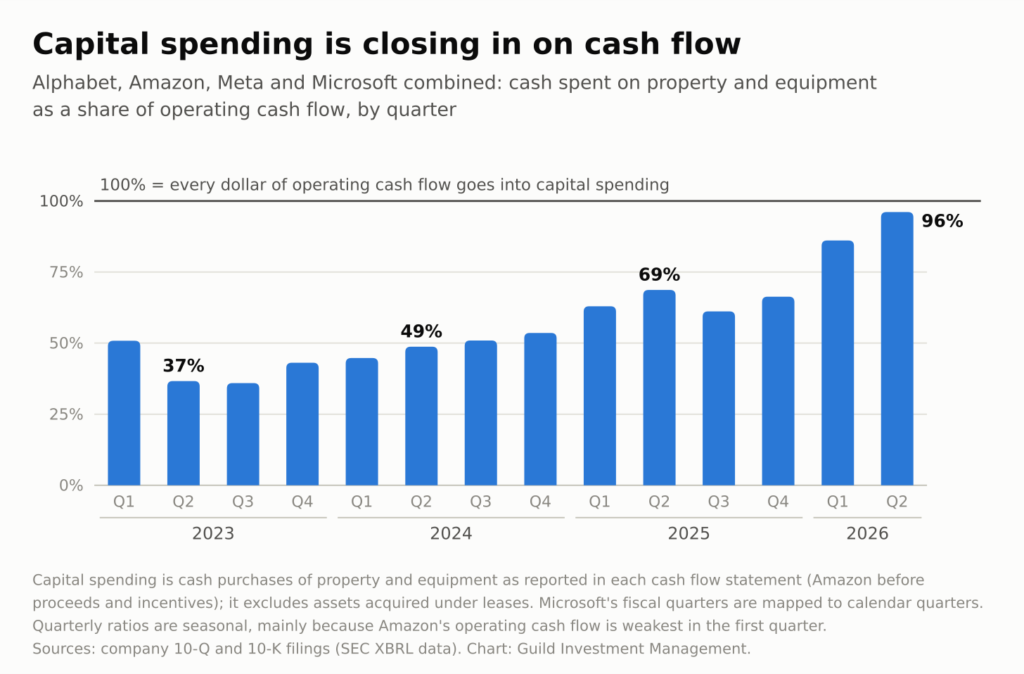
Three of the four are now spending more cash than their businesses produce. Alphabet’s free cash flow (cash from operations minus spending on buildings and equipment) was negative $9.1 billion in the third quarter, its second negative quarter in a row. The company has bought back no stock this year, its long-term debt has nearly tripled since December to $125 billion, and since June it has raised about $62 billion by selling stock and convertible preferred shares, including $10 billion from Berkshire Hathaway. Meta’s free cash flow turned negative in the third quarter, and on October 26 it priced about $37.5 billion of new common and convertible preferred stock. Amazon spent $7.6 billion more than it generated over the twelve months through June.
Again, for the four largest spenders, higher rates may modestly raise the cost of borrowing, but that alone won’t reduce what they plan to spend.
Owning, Renting, or Both
The four pay for their data centers in different ways, which is why free cash flow alone can give the wrong impression. Alphabet owns most of what it builds, so its spending shows up in its cash flow right away. Microsoft has stayed cash-positive. It produced about $67 billion of free cash flow in the fiscal year that ended in June and another $18.6 billion in the September quarter, has taken on no new debt, and is still buying back shares. It has also signed $365 billion of data-center leases that have not yet started, up $35 billion in three months, and committed more than $60 billion to “neoclouds,” the specialist companies that rent out AI computing capacity. Meta owns some of its data centers, leases others, and borrows through joint ventures.
Leasing lets Microsoft pay for data centers over time instead of up front, but someone still has to borrow the money to build them. Usually that is the landlord or the neocloud, and both are generally weaker credits than Microsoft. Microsoft’s free cash flow stays positive partly because its landlords are doing the borrowing. Microsoft’s finance chief all but said so on the company’s October 28 earnings call. “There is a form of financing called leasing,” Amy Hood told analysts, “and we have been using that one as a vehicle.” She added that Microsoft has not yet tapped the debt markets but “will access additional sources of funding when we believe it is attractive to do so.”
This letter is general commentary — the wide-angle view. It is not a portfolio. What we do for the families we work with is the opposite of “wide-angle”: we make portfolios built around one household’s circumstances, taxes, timelines, and appetite for exactly the kind of volatility described above. We keep that roster of clients deliberately small, because that sort of attention doesn’t scale. If you’d like to talk about what it would look like for you, contact us; we will make the time.
The Smaller Borrowers
Below the four giants are lower-rated cloud companies, the “neoclouds,” and the developers who build data centers for lease. Most have lower credit ratings, shorter records of profitability, and far less room to absorb higher interest costs. Oracle is a different case. It is not a neocloud, but one of the world’s premier technology companies, active across many areas of technology, and an aggressive one at that. It has borrowed heavily to build data centers, and in July S&P cut its credit rating to one notch above junk. For companies like these, higher rates are more likely to have an impact on how much they build. Execution is a risk as well: Microsoft said on October 28 that some of the computing capacity it rents from outside providers has slipped into the first half of 2027.
The credit market is already treating them differently. Howell notes that the gap between yields on the lowest-rated junk bonds and the highest-rated corporate bonds has widened by more than four percentage points since April, which he reads as an early warning that liquidity is tightening. He also stresses that shifts like this happen gradually, and that strong growth and earnings can keep supporting markets in the meantime. We expect weaker borrowers to lean more on secured financing, meaning loans backed by specific assets such as chips or by lease payments from the top-rated cloud companies, and to need more support from the strongest companies in the form of contracts and guarantees. Smaller borrowers will still be able to raise money, but increasingly on the strength of the giants’ contracts with them.
What It Means for Investors
Money for the buildout is available, but what it costs depends heavily on who is borrowing. For investors, a few consequences follow.
The first is that the buildout continues. The four giants account for the bulk of AI capital spending, so suppliers of chips, memory, power equipment, and electrical gear should stay busy through 2027. That is consistent with our view that the scarce inputs for AI are now physical ones, such as power and equipment.
The second is that shareholders of the largest companies are bearing more of the cost. Alphabet and Meta spent most of the past decade buying back stock and reducing their share counts. Both are now issuing shares.
The third concerns credit. Lending to the giants, or against their leases, carries far less risk than lending unsecured to the companies that depend on them, and we expect the market to price that difference more sharply as the cycle matures. This stage of the cycle, like our own long-standing preference, favors quality, strong balance sheets, and reliable cash flow over heavily indebted companies.
Looking Ahead to 2028
Despite the market wobbles that some ascribe to mounting credit concerns, the giants are not in financial trouble. They are spending heavily because they expect demand for computing to exceed supply for years. They view AI and its buildout as a once-in-a-century opportunity that began only a few years ago, and demand is still accelerating. The data center buildout has scaled rapidly since 2024: capital spending by the four largest spenders was about $150 billion in 2023 and, on the companies’ latest guidance, should reach about $730 billion in 2026.
A harder test may arrive in 2028, if consensus forecasts showing capital spending growth slowing to about 11% turn out to be accurate (and we stress that this is an “if”). By then we should know whether the smaller borrowers took on debt they can truly carry.
True, markets have plenty to worry about right now: the war with Iran and oil near $100 a barrel, inflation running near 3%, a Fed that began raising rates again in September, midterm elections on November 3, a heavy week of big tech earnings, and growing doubts about when AI spending will pay off. None of it has dried up the money behind the AI buildout. Alphabet, Amazon, Meta, and Microsoft generated about $660 billion of operating cash in the twelve months through June, and Alphabet and Meta have raised or lined up nearly $100 billion from stock sales since June. This is why, jitters notwithstanding, we think the market still has legs, as long as liquidity keeps flowing rather than shrinking. Clearly, the financing for SpaceX, Anthropic, and the many other stock sales by established companies relocates the liquidity available for stocks, and causes jockeying among them as investors sell some shares to raise the capital to buy the new offerings. Foreign investors have financed a great deal of U.S. growth. They come to buy parts of U.S. companies on our stock markets because U.S. technology, and the corporate earnings growth it creates, are by far the most impressive in the world.
How long will that liquidity continue to seek out the U.S. rather than other countries?
We believe the U.S. will continue to attract it as long as U.S. companies deliver fast growth and strong results without too much volatility. Clearly, a lack of liquidity would cause great volatility. Remember that the world runs on a debt cycle, and debt creation, not money supply, is the key to liquidity. Repo rates (the cost of the short-term loans, backed by securities such as Treasuries, that fund much of the financial system) and government Treasury issuance have become more important than money supply. Short-term interest rates remain extremely important in determining worldwide liquidity, and higher interest rates on debt and repos also cut corporate profits.
A Note on Anthropic’s IPO Filing
Anthropic’s prospectus, filed October 26, shows revenue of $16.3 billion in the first half of 2026, up from $1.2 billion a year earlier, and its first positive half-year of operating cash flow. (The $80.7 billion net loss is mostly a non-cash charge on convertible securities.) Our concerns lie elsewhere. Nearly half of revenue arrives through the cloud marketplaces of Amazon, Google, and Microsoft, which are also its investors, suppliers, and competitors. Revenue is mostly usage-based, and much of it is not under long-term contract, while its computing commitments reportedly run to hundreds of billions of dollars through 2045. Public buyers would get shares in a controlled company, with the co-founders holding 50.1% of the vote. IPO talk of $1.5 trillion to $2 trillion implies up to about 60 times first-half revenue at an annual rate. Put simply, this is among the most extreme valuations we have seen in more than 50 years of investing.
Many of the other criticisms of so-called circular financing (in which suppliers invest in the customers that buy from them) and of debt offerings by tech companies to build out AI infrastructure are partly fear-based. As long as selling AI services and equipment generates cash flow, building AI infrastructure is an intelligent investment. If that cash flow shrinks because of price competition or weak sales, the entire structure could come unwound. So far, fortune has favored the bold. Future events could change that, but it is not obvious whether or when they will.
A Highly Anticipated IPO (for Early Investors)
There will be no shortage of demand for Anthropic’s shares when they start to trade next month. Investors and users want to participate. Index builders will want to include it, and index investors are price- and valuation-agnostic. Under rules adopted this year, the stock could enter the Nasdaq-100 within 15 trading days and Russell indexes within five, although its losses keep it out of the S&P 500 for now. There is one consideration that we think is important for a buyer of the stock. The company’s filing shows that it has raised about $141 billion in all of its previous financings, and that it still had about $132 billion in cash and short-term investments at the end of June. So, if it does not need the money from new share issuance, why go public? Is it that earlier investors “need” to sell? If you “need” to own it, just be aware that you are someone else’s exit strategy.
Thanks for listening; we welcome your calls and questions.
General Disclosures About This Newsletter
The publisher of this newsletter is Guild Investment Management, Inc. (GIM or Guild), an investment advisor registered with the Securities and Exchange Commission. GIM manages the accounts of high net worth individuals, trusts and estates, pension and profit sharing plans, and corporations, among other clients.
Your receipt of this newsletter does not create a personal investment advisory relationship with GIM although some recipients may also be advisory clients of GIM. GIM has written investment advisory agreements with all its personal advisory clients, which sets forth the nature of that relationship.
The newsletter makes general observations about markets and business and financial trends and may provide advice about specific companies and specific investments. It does not give personal investment advice tailored to the needs, objectives, and circumstances of individual readers. Whether investment ideas and recommendations are suitable for individual readers depends substantially on the personal and financial situation of that reader, which GIM, as the publisher of the newsletter, makes no effort to investigate.
GIM attempts to provide accurate content in its newsletters to the extent such content is factual rather than analysis and opinion, but GIM relies primarily on information compiled or reported by third parties and does not generally attempt to independently verify or investigate such information. Moreover, some content and some of the assumptions, formulas, algorithms and other data that affect the content may be inaccurate, outdated, or otherwise flawed. GIM does not guarantee or take responsibility for the accuracy of such information.
Please note that investing in stocks, other securities, and commodities is inherently risky, and you should rely on your personal financial advisors and conduct your own due diligence in connection with any investment decision.
A Special Comment for Guild’s Clients
If you are an investment advisory client of GIM who is receiving this newsletter, please note that the fact that a general recommendation is made of a particular security, commodity, or investment area to its newsletter subscribers does not mean that investment is suitable for you or should be purchased by you. For example, GIM may already have purchased such securities on your behalf or purchased securities in the same industry (and an increase in the position for you may represent too much concentration in one security or industry), or GIM may believe the investment is not suitable for you based on your risk tolerance or other factors. If you have questions about the recommendations in this newsletter in relation to your account at GIM, please contact Tony Danaher, Rudi von Abele, or Aubrey Ford.
Conflicts of Interest
As of the date of this newsletter, GIM’s investment advisory clients or GIM’s principals owned positions in areas that are the subject of current recommendations, commentary, analysis, opinions, or advice, contained in this newsletter.
GIM and its principals have certain conflicts of interest in its relations with its investment advisory clients and its newsletter subscribers resulting from GIM or its principals holding positions for its clients or themselves which are also recommended to its clients. GIM may change the positions of its clients or GIM’s principals may change their positions (increasing, decreasing, and eliminating them) based on GIM’s best judgment at any given time, including the time of publication of the newsletter. Factors that lead GIM to change or eliminate its positions may include general market developments, factors specific to the issuer, or the needs of GIM or its advisory clients. From time to time GIM’s investing goals on behalf of its investment advisory clients or the personal investing goals of GIM’s principals and their risk tolerance may be different from those discussed in the newsletter, and the investment decisions made by GIM for its advisory clients or the investment decisions of its principals may vary from (and may even be contrary to) the advice and recommendations in the newsletter.
In addition, GIM or its principals may reduce or eliminate their positions in an investment that is recommended in the newsletter prior to notifying the newsletter subscribers of such a reduction or elimination. The publication by GIM of a “target price” or “stop loss” for a particular security or other asset does not necessarily represent the price at which GIM intends to sell or will sell any such assets for its advisory clients or the price at which GIM’s principals intend to sell any such assets.
As a consequence of the conflict of interest, GIM’s clients or principals may benefit if newsletter subscribers purchase assets recommended by GIM since it could increase the value of the assets already held by GIM’s investment advisory clients or GIM’s principals. On the other hand, GIM’s principals and clients may suffer a detriment if they seek to acquire additional shares in securities that have been recommended and the price of the securities has increased as a result of purchases by newsletter subscribers.
To help mitigate these conflicts, GIM seeks to avoid recommending the securities of individual companies where GIM or its principals have an ownership position and where the issuer is small or its securities are thinly traded. That way sales by GIM in advance of possible sales by newsletter subscribers would not be likely to cause any significant decrease in the sale price to newsletter subscribers. GIM has a fiduciary relationship with its investment advisory clients and cannot agree on behalf of such clients to refrain from purchases or sales of a security mentioned in the newsletter for a period of time before or after recommendations for purchases or sales are made to its newsletter subscribers.
GIM encourages you to do independent research on the securities or other assets discussed or recommended in the newsletter prior to making any investment decisions and to be especially cautious of investments in small, thinly-traded companies, which are usually the most risky investments that you can make.
Disclaimer of Liability
GIM disclaims any liability for investment decisions based upon recommendations, information, or opinions in its newsletters. GIM is not soliciting you to execute any trade. Nothing contained in GIM’s newsletters is intended to be, nor shall it be construed as an offer to buy or sell securities or to give individual investment advice. The information in the newsletter is not intended for distribution to, or use by, any person or entity in any jurisdiction or country where such distribution or use would be contrary to law or regulation, or which would subject GIM to any registration requirement within such jurisdiction or country.
COPYRIGHT NOTICE
Guild’s current and past market commentaries are protected by U.S. and international copyright laws. All rights reserved. You must not copy, frame, modify, transmit, further distribute, or use the market commentaries, without the prior written consent of Guild. This email or any download from a secure website is meant for only the intended recipient of the transmission, and may be a communication privileged by law. If you received this email in error, any use, dissemination, distribution, or copying of this email is similarly prohibited. Please notify us immediately of the error by return email and please delete this message from your system. Although this email and any attachments are believed to be free of any virus or other defect that might affect any computer system into which it is received and opened it is the responsibility of the recipient to ensure that it is virus free and no responsibility is accepted by Guild Investment Management for any loss or damage arising in any way from its use.


0 Comments