
Both parties are fighting over how to slice the pie. But growth and technology decide its size, and Washington, as usual, is late.
In our view, the most consequential contest on November 3 is fundamentally not between the two major U.S. political parties, but rather, between the ideologies inside each of them: between those who want to grow the economy and those who just want to re-slice what’s already there.
Across the pond, two days before U.S. voters go to the polls, several hundred antique cars built before 1905 will leave Hyde Park for Brighton to mark 130 years since the Emancipation Run. That re-enactment/celebration (not really a race) has been going on since 1927, and originally celebrated Parliament’s raising the speed limit from 4 to 14 miles an hour and ending the rule that a man had to walk ahead of every car with a red flag. That rule dated back to the 1865 “Red Flag Act,” originally written for steam traction engines. The first motor cars simply inherited this rule; regulation lagged behind technology for a long, painful period.

Politics does catch up with technology… eventually. But the waiting is expensive, particularly in terms of lost growth opportunities, when regulation fails to support — or actively dampens — innovation. This year, the “re-slicer” brigade has some extra ammunition: an oil shock that has kept gasoline and diesel expensive for months, and energy price inflation generally has become a pain-point for consumers across the U.S.
Both parties are campaigning on “affordability.” Both parties are pointing fingers in the direction of the fastest growing segment of the economy’s energy demands as part of the problem.
The Pie: Slice It or Grow It?
There are two platforms to present to voters that can make them feel richer. One grows the economy: rules that make it cheaper to build, invest, and hire, such as letting companies write off new equipment immediately, giving faster permits, greenlighting more power plants and housing, and making clear rules for new technology. The other re-slices the economy: higher taxes at the top (although they always seem to trickle quite a ways down from the top), caps on prices, rent freezes, rules that punish ownership, regulations designed to keep a lid on “excess” prosperity… and the evergreen idea of sending the bill to someone else, often someone in the future.
Arthur Okun, Lyndon Johnson’s chief economist and no one’s idea of a free-market zealot, likened redistribution to carrying water in a leaky bucket. Some always spills along the way, through administrative cost, reduced savings and investment, and blunted incentives (we’d add capital flight). Growth, on the other hand, may not spread evenly, but it has no such leak, and it compounds. At 2% real growth per year, you can achieve a doubling of living standards in about 35 years. At 1% real growth, it would take about 70 years to do the same. Going even further, that 2% real growth, if allowed to compound, can triple living standards in 56 years, and quadruple living standards in the same 70 years it takes a 1% rate just to double it. Growth-limiting policies equal lost generations.
This letter is general commentary — the wide-angle view. It is not a portfolio. What we do for the families we work with is the opposite of “wide-angle”: we make portfolios built around one household’s circumstances, taxes, timelines, and appetite for exactly the kind of volatility described above. We keep that roster of clients deliberately small, because that sort of attention doesn’t scale. If you’d like to talk about what it would look like for you, contact us; we will make the time.
Output Is Not the Problem
Real GDP grew at a 2.2% annualized rate in the second quarter, and the Atlanta Fed’s tracking model puts the third quarter near 3.6% annualized (granted, that tracking measure has a wide error band around it). Prices are the problem. A broad gauge of what Americans pay increased at a 5.6% annualized rate in the second quarter, and electricity in September cost 4.4% more than a year earlier. It is when prices go up, and the pie feels smaller, that voters are more vulnerable to the re-slicer agenda.
As it happens, both parties are handing out knives to carve up economic spoils. On the left, “democratic socialists” unseated two more moderate New York congressmen in June primaries. Californians will be voting on a “one-time” (permit us a hearty LOL) 5% tax on the net worth of the state’s billionaires. On the right, the President has called for a 10% cap on credit-card interest rates, borrowing an idea from Senators Bernie Sanders and Josh Hawley. Additionally, the Federal Government has decided to take equity stakes in 31 companies by the Cato Institute’s count, a tool the country once kept for emergencies like 2008 (and that for decades would have been considered unthinkable by politicians in both parties).
We also see both political parties have politicians taking more pragmatic, pro-growth positions within them. Some policies that encourage growth have received bipartisan backing such as the tax law change that made immediate write-offs for equipment permanent. And then there is California’s Governor Newsom. While not exactly a pro-growth hero, he opposes the billionaire tax. Perhaps this is just smart politicking, considering where his Presidential campaign war-chest will get a lion’s share of its gold. Newsom would rather tax billionaires nationally, which we think is equally foolish, but he makes a correct point: “Wealth is movable, and it shops for the state with the lowest taxes.”
Redistribution divides this year’s pie; growth decides the size in future years.
Washington’s lateness to intelligent and effective regulation seems to be baked in to its processes. Legislators write rules for the technology they understand, which is usually the previous one.
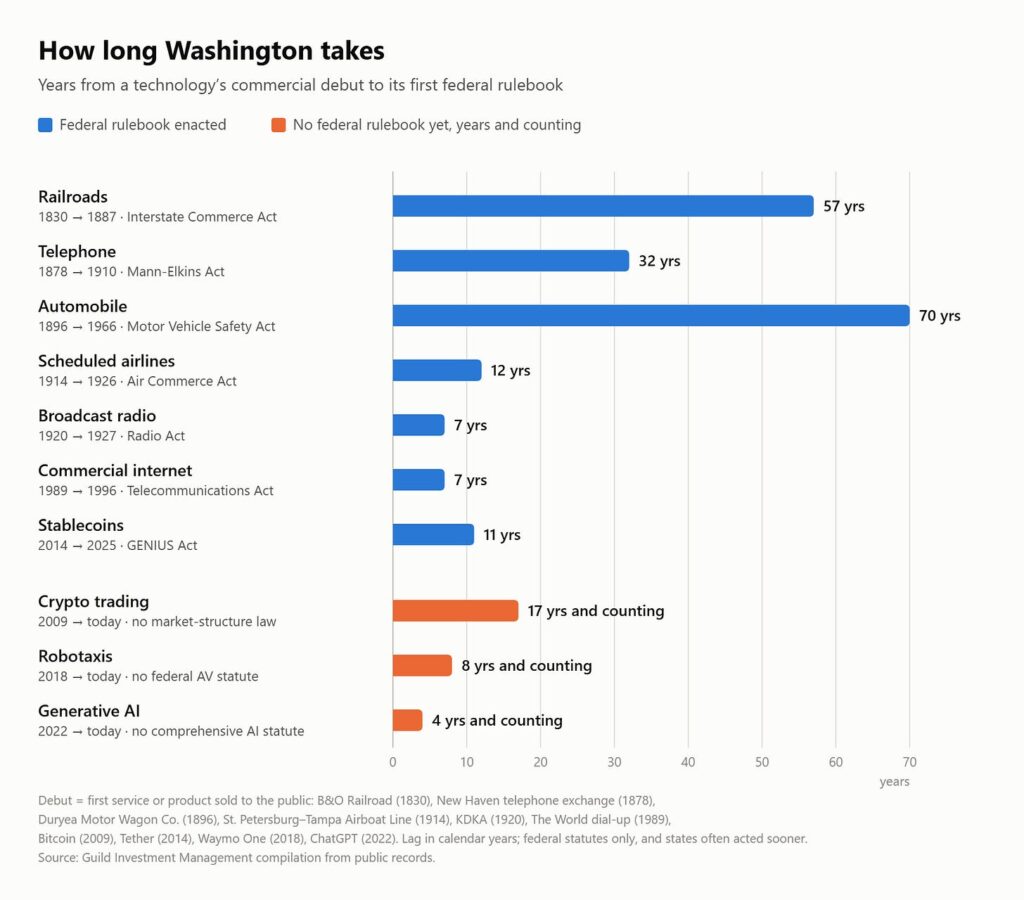
Why Follow the Red Flag?
Artificial intelligence is one case. Congress has twice declined to replace state AI laws with a single national standard, the White House asked again in March, and a bipartisan House draft that would pause state rules on how AI models are built had not been formally introduced as of midsummer. Nearly four years after ChatGPT, America has a patchwork of state rules and none from Congress.
The power grid is another case. Data centers have (arguably) driven up electricity demand, power bills have followed, and some candidates in both parties are now campaigning against the buildings themselves; one Republican Senate candidate has proposed a one-year moratorium. Sound familiar? A moratorium is a man with a red flag.
Crypto showcases the whole cycle. For years Washington regulated it by lawsuit rather than by rule. Then last year’s GENIUS Act wrote real rules for stablecoins —digital dollars redeemable one-for-one — and the market answered: stablecoin supply stood near $308 billion in August, up 14% from a year earlier and almost entirely dollar-denominated (please note that there is a geopolitical dimension here). But the sequel to GENIUS has stalled. In September the Senate declined even to open debate on the CLARITY Act, the rulebook for everything else, after fights over banks’ push to keep stablecoin issuers from paying yield, and over ethics limits on officials’ crypto interests, the President’s and his family’s included. “Clarity,” once again, will be arriving way later than the transformative technology itself, in the meantime leaving innovators in uncharted waters without a compass.
There’s progress, too, though. An Energy Department pilot program brought four advanced test reactors to criticality, a self-sustaining chain reaction that does not yet produce electricity, about a year after it opened for applications, beating its own goal. In June, Federal regulators ordered grid operators to revise or justify their rules for connecting data centers, and both parties are converging on the sensible answer to power bills: make the biggest new users pay their own way or build their own plants. The common thread is rule-writers who understand how things get built and who consult the people building them. That is a case for business experience in government, not for government as shareholder. As Cato points out, a Federal stake in one company quietly tells investors that every unbacked rival is the riskier bet. We believe the economy needs more lawmakers who have taken business risk, built something, met a payroll… and fewer career academics, or politicians who are more accomplished at cashing taxpayer-funded checks than anything else.
Building Portfolios for More Growth, While Also Being Prepared for More Redistribution
It’s highly uncertain, of course, but current polls point toward divided government. Democrats lead the generic ballot, which asks voters which party they want running Congress, by about nine points in the RealClearPolitics average. A split Congress makes large Federal moves in either direction unlikely and pushes the action toward statehouses, regulators, and courts. Markets have generally coped: the S&P 500 has risen in the 12-month period after every midterm since 1946.
Re-slicing first bites in specific places. Credit card issuers’ shares fell in January when the rate cap was floated. Regulated utilities with heavy household exposure face pressure to hold rates down wherever power bills are a campaign issue. Healthcare is another specific area where there is no shortage of pols who favor slicing the pie and carrying red flags… over encouraging the industry to innovate and grow supply.
It is not just industries. Here in California, Proposition 3 would make permanent the higher income-tax rates voters first approved in 2012, which now apply above roughly $361,000 of income for single filers and $721,000 for joint filers and would otherwise expire in 2031. The billionaire tax reaches far fewer people, but the Legislative Analyst’s Office expects it to raise tens of billions up front and then to cut income-tax receipts by hundreds of millions a year as taxpayers “adjust” (i.e., flee)… in a state where the top 1% already pays nearly half the income tax. It will be interesting to see how this “bites” if it passes.
Regardless of the November 3 result, we see continued opportunity in areas where government rules have yet to be codified and demand continues unabated: AI-driven innovations, electrical power, grid equipment and on-site generation for the largest users, nuclear, and the dollar-stablecoin rails the GENIUS Act made legal (meanwhile, the rest of crypto still awaits its rulebook).
We are aware of “political beta.” “Beta” measures how much a stock swings with the market; “political beta” then might be how much it swings with Washington, and it runs highest where company fortunes depend on a government stake, an exemption, or a tariff. That exposure does not appear on a balance sheet, can sometimes only be gleaned from a conference call, and can reverse with one election or one ruling. Stocks like that should be held only with a very attentive attitude. Perhaps it is best to own businesses that need nothing from Washington but clear rules, but to be wary of those that need a favor or are living on entrenched political connections.
Thanks for listening; we welcome your calls and questions.
General Disclosures About This Newsletter
The publisher of this newsletter is Guild Investment Management, Inc. (GIM or Guild), an investment advisor registered with the Securities and Exchange Commission. GIM manages the accounts of high net worth individuals, trusts and estates, pension and profit sharing plans, and corporations, among other clients.
Your receipt of this newsletter does not create a personal investment advisory relationship with GIM although some recipients may also be advisory clients of GIM. GIM has written investment advisory agreements with all its personal advisory clients, which sets forth the nature of that relationship.
The newsletter makes general observations about markets and business and financial trends and may provide advice about specific companies and specific investments. It does not give personal investment advice tailored to the needs, objectives, and circumstances of individual readers. Whether investment ideas and recommendations are suitable for individual readers depends substantially on the personal and financial situation of that reader, which GIM, as the publisher of the newsletter, makes no effort to investigate.
GIM attempts to provide accurate content in its newsletters to the extent such content is factual rather than analysis and opinion, but GIM relies primarily on information compiled or reported by third parties and does not generally attempt to independently verify or investigate such information. Moreover, some content and some of the assumptions, formulas, algorithms and other data that affect the content may be inaccurate, outdated, or otherwise flawed. GIM does not guarantee or take responsibility for the accuracy of such information.
Please note that investing in stocks, other securities, and commodities is inherently risky, and you should rely on your personal financial advisors and conduct your own due diligence in connection with any investment decision.
A Special Comment for Guild’s Clients
If you are an investment advisory client of GIM who is receiving this newsletter, please note that the fact that a general recommendation is made of a particular security, commodity, or investment area to its newsletter subscribers does not mean that investment is suitable for you or should be purchased by you. For example, GIM may already have purchased such securities on your behalf or purchased securities in the same industry (and an increase in the position for you may represent too much concentration in one security or industry), or GIM may believe the investment is not suitable for you based on your risk tolerance or other factors. If you have questions about the recommendations in this newsletter in relation to your account at GIM, please contact Tony Danaher, Rudi von Abele, or Aubrey Ford.
Conflicts of Interest
As of the date of this newsletter, GIM’s investment advisory clients or GIM’s principals owned positions in areas that are the subject of current recommendations, commentary, analysis, opinions, or advice, contained in this newsletter.
GIM and its principals have certain conflicts of interest in its relations with its investment advisory clients and its newsletter subscribers resulting from GIM or its principals holding positions for its clients or themselves which are also recommended to its clients. GIM may change the positions of its clients or GIM’s principals may change their positions (increasing, decreasing, and eliminating them) based on GIM’s best judgment at any given time, including the time of publication of the newsletter. Factors that lead GIM to change or eliminate its positions may include general market developments, factors specific to the issuer, or the needs of GIM or its advisory clients. From time to time GIM’s investing goals on behalf of its investment advisory clients or the personal investing goals of GIM’s principals and their risk tolerance may be different from those discussed in the newsletter, and the investment decisions made by GIM for its advisory clients or the investment decisions of its principals may vary from (and may even be contrary to) the advice and recommendations in the newsletter.
In addition, GIM or its principals may reduce or eliminate their positions in an investment that is recommended in the newsletter prior to notifying the newsletter subscribers of such a reduction or elimination. The publication by GIM of a “target price” or “stop loss” for a particular security or other asset does not necessarily represent the price at which GIM intends to sell or will sell any such assets for its advisory clients or the price at which GIM’s principals intend to sell any such assets.
As a consequence of the conflict of interest, GIM’s clients or principals may benefit if newsletter subscribers purchase assets recommended by GIM since it could increase the value of the assets already held by GIM’s investment advisory clients or GIM’s principals. On the other hand, GIM’s principals and clients may suffer a detriment if they seek to acquire additional shares in securities that have been recommended and the price of the securities has increased as a result of purchases by newsletter subscribers.
To help mitigate these conflicts, GIM seeks to avoid recommending the securities of individual companies where GIM or its principals have an ownership position and where the issuer is small or its securities are thinly traded. That way sales by GIM in advance of possible sales by newsletter subscribers would not be likely to cause any significant decrease in the sale price to newsletter subscribers. GIM has a fiduciary relationship with its investment advisory clients and cannot agree on behalf of such clients to refrain from purchases or sales of a security mentioned in the newsletter for a period of time before or after recommendations for purchases or sales are made to its newsletter subscribers.
GIM encourages you to do independent research on the securities or other assets discussed or recommended in the newsletter prior to making any investment decisions and to be especially cautious of investments in small, thinly-traded companies, which are usually the most risky investments that you can make.
Disclaimer of Liability
GIM disclaims any liability for investment decisions based upon recommendations, information, or opinions in its newsletters. GIM is not soliciting you to execute any trade. Nothing contained in GIM’s newsletters is intended to be, nor shall it be construed as an offer to buy or sell securities or to give individual investment advice. The information in the newsletter is not intended for distribution to, or use by, any person or entity in any jurisdiction or country where such distribution or use would be contrary to law or regulation, or which would subject GIM to any registration requirement within such jurisdiction or country.
COPYRIGHT NOTICE
Guild’s current and past market commentaries are protected by U.S. and international copyright laws. All rights reserved. You must not copy, frame, modify, transmit, further distribute, or use the market commentaries, without the prior written consent of Guild. This email or any download from a secure website is meant for only the intended recipient of the transmission, and may be a communication privileged by law. If you received this email in error, any use, dissemination, distribution, or copying of this email is similarly prohibited. Please notify us immediately of the error by return email and please delete this message from your system. Although this email and any attachments are believed to be free of any virus or other defect that might affect any computer system into which it is received and opened it is the responsibility of the recipient to ensure that it is virus free and no responsibility is accepted by Guild Investment Management for any loss or damage arising in any way from its use.



0 Comments