Very little has happened in markets these past few weeks that will alter the trajectory of artificial intelligence; a lot has happened regarding the financial market frenzy surrounding it. Here are three items:
- Credit spreads are widening on the largest technology companies.
- A Chinese AI lab released a very good model at a fraction of the cost of the U.S. frontier labs.
- A very large, levered hedge fund run by a smart 20-something year old gambler (that was very long semiconductor stocks and very short software stocks) got taught a lesson about margin debt.
What is that list? It is just a sample of how when markets are very extended and priced for perfection, anything can trigger a repricing toward something closer to the historical norm and underlying realities. What media, especially financial media, like to spin as an oncoming crisis is often just normalization (not always — but usually). Enthusiasm ran ahead of arithmetic, as it always does when something exciting is going on, but if enthusiasm is the hare, arithmetic is the tortoise that ultimately wins the race, boring, sensible, and inexorable.
We started saying some eight months ago that things get choppy when the market mindset moves “from cheerleader to auditor,” and we see that happening. An auditor arrives not necessarily because a business is failing, but just because it’s time for someone to check the numbers.
A Gap Between Companies’ Reporting and the Economy
Here’s some number-checking that shows something noteworthy. S&P 500 as-reported earnings per share — the GAAP figure companies file, not the tidier “operating” number — have compounded at roughly 14% annualized for three years. The Commerce Department’s tally of what American non-financial companies actually earned over the same span, built from tax data rather than from SEC filings, has compounded at about 5% annualized. OK: some of that gap is benign; earnings per share rise when companies retire shares, and further, the index is 500 of the largest winners while the national accounts count every corporation in the country, including the ones losing to those 500 stars.
However, two points.
First, the national accounts don’t treat unrealized gains as profit, but company announcements and regulatory filings do. For illustration, Alphabet’s second-quarter results carried a large mark-up on its private holdings — Bank of America identifies stakes in Anthropic and SpaceX as the revaluations that have been flattering index earnings for several quarters now. According to Bank of America’s analysis, Google’s unrealized gains added twelve percentage points to S&P 500 year-over-year earnings growth for the quarter: 36% reported, 24% without it. Alphabet sold nothing. It re-marked what it already owned. Markets fluctuate; the mark was struck at June 30 valuations, and SpaceX has fallen roughly a third since that date — it now trades below the price at which it came public in June. Nothing improper happened; that is simply how quarter-end accounting works. But the same mechanism runs in reverse, so marks that lifted earnings on the way up, will subtract on the way down.
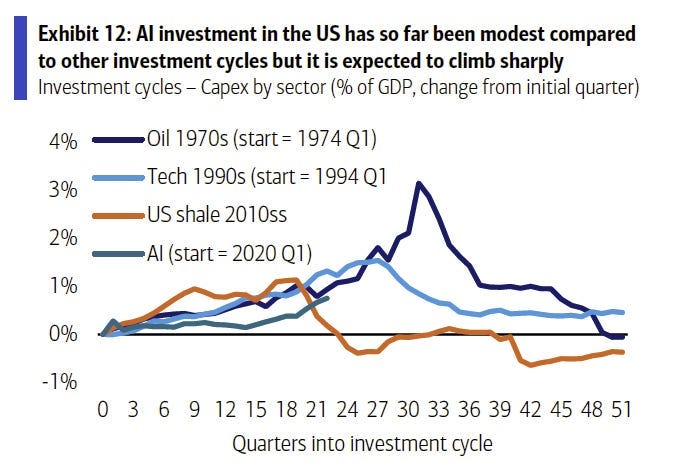
Second, depreciation: Commerce Department statisticians ding a company for wearing out its equipment at what replacement actually costs — the adjustment is built into the national accounts series — while a company has some latitude with how they apply depreciation expense. “Auditors” might look at it more conservatively. With S&P 500 capital spending up 33% year over year in the first quarter on Bank of America’s reckoning, the fastest since 2001, the depreciation numbers are going to be buried over many future quarters… or in write-downs when that method of reporting is preferred.
Neither of these is fraud, or anything close. But both mean the as-reported earnings that justified the sky-high multiples were better-looking than the cash behind them. This is the kind of thing a cheerleader (or trader) may not worry about, but it is a consideration for a longer-term, value-conscious investor. There are times when trading and not getting caught up in the accounting minutiae work better, and times when deeper analysis of the numbers makes more sense.
This letter is general commentary — the wide-angle view. It is not a portfolio. What we do for the families we work with is the opposite of “wide-angle”: we make portfolios built around one household’s circumstances, taxes, timelines, and appetite for exactly the kind of volatility described above. We keep that roster of clients deliberately small, because that sort of attention doesn’t scale. If you’d like to talk about what it would look like for you, Aubrey Ford will make the time.
Fortress Balance Sheets?
This year the large cloud platforms have borrowed $194 billion, which on Jefferies’ compilation makes them the biggest single source of investment-grade debt in America, ahead of the entire energy sector at roughly $55 billion. For a decade these companies never needed the bond market; they are now its largest customer.
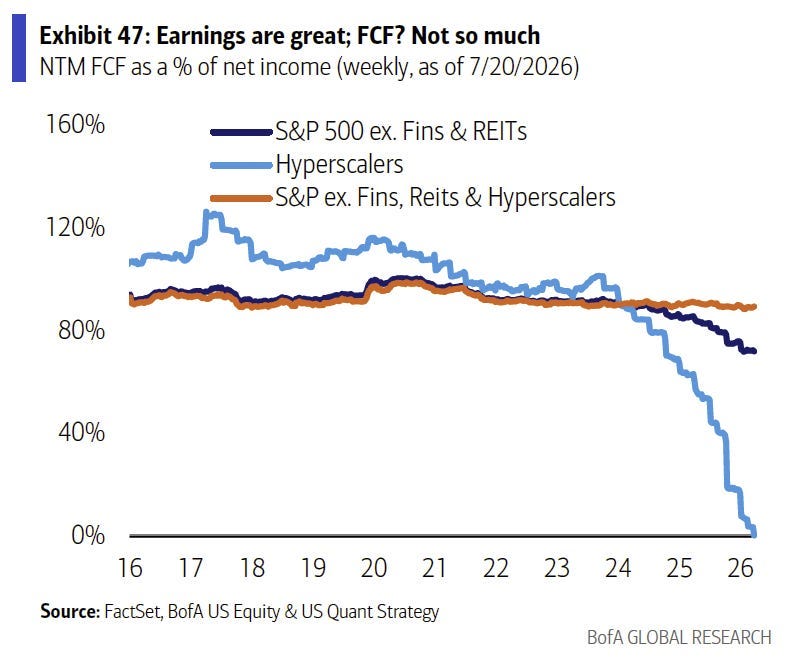
Equity markets price possibility while credit markets price obligation, and if Mr Market’s sense of “possibility” can expand robustly when a good story is being told, “obligation” really doesn’t care about the story (“Show me the money!”). In the first three weeks of July, Jefferies writes that spreads between 10-year corporate paper and 10-year Treasuries have widened thirteen to seventeen basis points across three of the largest issuers. Oracle debt was cut on July 9 to one notch above high yield (aka “junk”). At one specialist cloud lessor, five-year default insurance moved from roughly 450 to near 700, though still below where it sat in December.
Sign of an oncoming capex implosion? Harbinger of suppressed bond volatility that will adjust abruptly once the suppression fails? Nah — we think it’s less dramatic than that. A borrower’s cost of capital rising by under a fifth of a percentage point is not distress, it’s just the form discipline takes in a free market. Perhaps, to sum up, investors taking a more “auditing” approach is not a threat to a good business; but it can cause a repricing of irrational multiples.
Comparing and Scoring AI Models is Really About Measuring Competitive Moats
Moonshot AI announced Kimi K3 in mid-July and published the weights on July 27, making it the largest open-weight model yet released. Artificial Analysis, an independent benchmarker, scores it within a few points of the strongest American models. Chinese models processed 36.4 trillion tokens on the OpenRouter aggregator in the week to July 19 — up from 4.4 trillion in late April — against 7.4 trillion for the leading American models. The average price paid for a million tokens, on Silicon Data’s index, has fallen about a quarter since peaking in late May.
Alarming? Not really; this is what every general-purpose technology has ever done. Capability diffuses, price declines, and the surplus migrates from the producers to the users — which is to say, to almost every other company in the index. Cheaper tokens mean more tokens and therefore more demand for memory chips, on Jevons’ old observation that efficiency gains raise total consumption (“Jevons’ Paradox,” well-known to us in Southern California as we ponder why building more highway lanes leads to more traffic congestion). We think the logic generalizes well beyond memory, and note that it is bullish for a far wider set of businesses than the dozen everybody owns, including all the new businesses that AI will enable that don’t even exist yet.
Cheap inference is bad for whoever sells inference and good for everyone who buys it, and there are vastly more buyers.
Situational Awareness, Margin Debt, and the Gamblers
Situational Awareness, the AI-thesis fund launched in late 2024 with roughly $225 million, had grown into the tens of billions and was reportedly up several hundred percent this year through June. On July 24 its founder, Leopold Aschenbrenner, wrote to investors that the selloff was among the best buying opportunities since early 2025. But six days later the entire public book (i.e, holdings of publicly traded securities) is gone, whatever was left after huge losses in recent weeks has been reportedly sold to Citadel, which is owned by Ken Griffin.
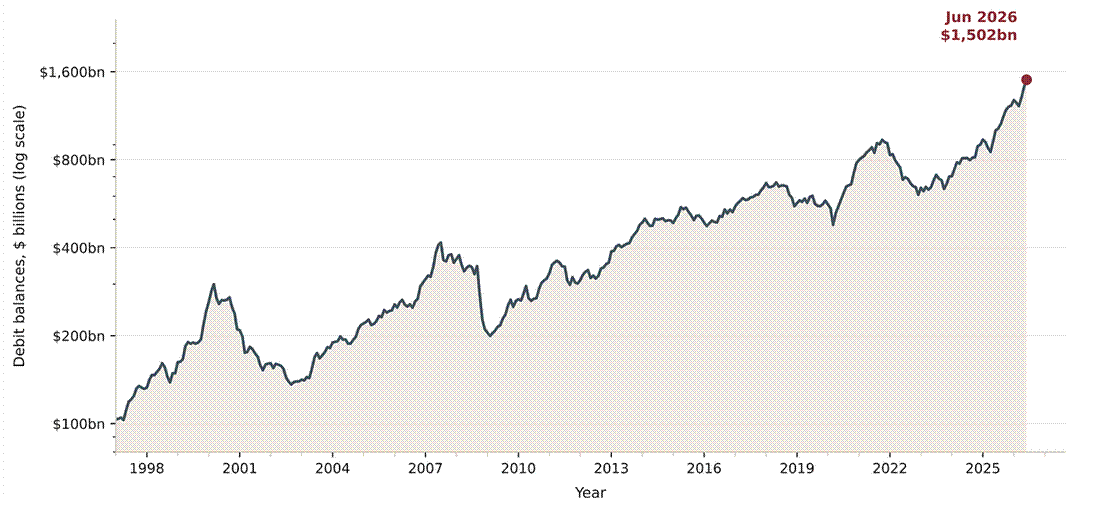
This is an illustration of what happens when a gambling mentality fueled by a bull market takes command. FINRA margin debt set another record in June at roughly $1.5 trillion, up about half from a year earlier, a pace matched only three times since that series began in 1997: late 1999, mid-2007 and spring 2021.
Korea is, of course, also illustrative; single-stock leveraged funds launched there in late May, retail bought some $9.4 billion of them, and the regulator has since suspended new listings and tripled the minimum account balance for holding them. Those products also helped drive the memory-chip surge that has now reversed — and the same memory names sat in the Aschenbrenner fund’s long book of positions.
Take it all as indicative of what speculation can do when it gets greedy, and what the unwind can look like when the mood changes. For our part, we find ourselves scanning the wreckage and looking for opportunity — while acknowledging that in the end, what really matters is reaching a sane assessment of value and buying at a price that makes sense.
Scanning For Opportunity
While we look for opportunities, recent history is enough to make us modest about timing; April’s capital spending increases were applauded, July’s were sold, and three months proved sufficient for the market to change its mind entirely.
But the opportunity in a repricing is that it can briefly separate price from quality just a little bit (and sometimes more than just a little bit). Enthusiasm bids everything up together, which is precisely when it seems pointless trying to tell a durable business from a fashionable one. A market applying scrutiny does that work for you, and it does it fastest in exactly the assets we want to own — real infrastructure, real power, real balance sheets.
Metals are on their own cycle, and a different one. After roughly a tripling from 2023 into early 2026, a pause is not a surprise. Part of what is happening underneath is a change in who is buying what: countries that spent recent years accumulating gold are now paying a great deal more for oil, and a national budget only stretches so far. The war in the Middle East has run longer than most people expected, which keeps the energy bill elevated and the macroeconomic calculus unsettled.
Which brings us to what we are actually doing. Markets have been squirrely these past couple of months. The gambling element we’ve written about above — the margin debt, the one-day options, the fast money that shoves whole sectors around for reasons having nothing to do with the businesses inside them — has been unusually busy, and that is not a tape that rewards eagerness. So we are building the buy list and waiting to use it.
Thanks for listening; we welcome your calls and questions.
General Disclosures About This Newsletter
The publisher of this newsletter is Guild Investment Management, Inc. (GIM or Guild), an investment advisor registered with the Securities and Exchange Commission. GIM manages the accounts of high net worth individuals, trusts and estates, pension and profit sharing plans, and corporations, among other clients.
Your receipt of this newsletter does not create a personal investment advisory relationship with GIM although some recipients may also be advisory clients of GIM. GIM has written investment advisory agreements with all its personal advisory clients, which sets forth the nature of that relationship.
The newsletter makes general observations about markets and business and financial trends and may provide advice about specific companies and specific investments. It does not give personal investment advice tailored to the needs, objectives, and circumstances of individual readers. Whether investment ideas and recommendations are suitable for individual readers depends substantially on the personal and financial situation of that reader, which GIM, as the publisher of the newsletter, makes no effort to investigate.
GIM attempts to provide accurate content in its newsletters to the extent such content is factual rather than analysis and opinion, but GIM relies primarily on information compiled or reported by third parties and does not generally attempt to independently verify or investigate such information. Moreover, some content and some of the assumptions, formulas, algorithms and other data that affect the content may be inaccurate, outdated, or otherwise flawed. GIM does not guarantee or take responsibility for the accuracy of such information.
Please note that investing in stocks, other securities, and commodities is inherently risky, and you should rely on your personal financial advisors and conduct your own due diligence in connection with any investment decision.
A Special Comment for Guild’s Clients
If you are an investment advisory client of GIM who is receiving this newsletter, please note that the fact that a general recommendation is made of a particular security, commodity, or investment area to its newsletter subscribers does not mean that investment is suitable for you or should be purchased by you. For example, GIM may already have purchased such securities on your behalf or purchased securities in the same industry (and an increase in the position for you may represent too much concentration in one security or industry), or GIM may believe the investment is not suitable for you based on your risk tolerance or other factors. If you have questions about the recommendations in this newsletter in relation to your account at GIM, please contact Tony Danaher, Rudi von Abele, or Aubrey Ford.
Conflicts of Interest
As of the date of this newsletter, GIM’s investment advisory clients or GIM’s principals owned positions in areas that are the subject of current recommendations, commentary, analysis, opinions, or advice, contained in this newsletter.
GIM and its principals have certain conflicts of interest in its relations with its investment advisory clients and its newsletter subscribers resulting from GIM or its principals holding positions for its clients or themselves which are also recommended to its clients. GIM may change the positions of its clients or GIM’s principals may change their positions (increasing, decreasing, and eliminating them) based on GIM’s best judgment at any given time, including the time of publication of the newsletter. Factors that lead GIM to change or eliminate its positions may include general market developments, factors specific to the issuer, or the needs of GIM or its advisory clients. From time to time GIM’s investing goals on behalf of its investment advisory clients or the personal investing goals of GIM’s principals and their risk tolerance may be different from those discussed in the newsletter, and the investment decisions made by GIM for its advisory clients or the investment decisions of its principals may vary from (and may even be contrary to) the advice and recommendations in the newsletter.
In addition, GIM or its principals may reduce or eliminate their positions in an investment that is recommended in the newsletter prior to notifying the newsletter subscribers of such a reduction or elimination. The publication by GIM of a “target price” or “stop loss” for a particular security or other asset does not necessarily represent the price at which GIM intends to sell or will sell any such assets for its advisory clients or the price at which GIM’s principals intend to sell any such assets.
As a consequence of the conflict of interest, GIM’s clients or principals may benefit if newsletter subscribers purchase assets recommended by GIM since it could increase the value of the assets already held by GIM’s investment advisory clients or GIM’s principals. On the other hand, GIM’s principals and clients may suffer a detriment if they seek to acquire additional shares in securities that have been recommended and the price of the securities has increased as a result of purchases by newsletter subscribers.
To help mitigate these conflicts, GIM seeks to avoid recommending the securities of individual companies where GIM or its principals have an ownership position and where the issuer is small or its securities are thinly traded. That way sales by GIM in advance of possible sales by newsletter subscribers would not be likely to cause any significant decrease in the sale price to newsletter subscribers. GIM has a fiduciary relationship with its investment advisory clients and cannot agree on behalf of such clients to refrain from purchases or sales of a security mentioned in the newsletter for a period of time before or after recommendations for purchases or sales are made to its newsletter subscribers.
GIM encourages you to do independent research on the securities or other assets discussed or recommended in the newsletter prior to making any investment decisions and to be especially cautious of investments in small, thinly-traded companies, which are usually the most risky investments that you can make.
Disclaimer of Liability
GIM disclaims any liability for investment decisions based upon recommendations, information, or opinions in its newsletters. GIM is not soliciting you to execute any trade. Nothing contained in GIM’s newsletters is intended to be, nor shall it be construed as an offer to buy or sell securities or to give individual investment advice. The information in the newsletter is not intended for distribution to, or use by, any person or entity in any jurisdiction or country where such distribution or use would be contrary to law or regulation, or which would subject GIM to any registration requirement within such jurisdiction or country.
COPYRIGHT NOTICE
Guild’s current and past market commentaries are protected by U.S. and international copyright laws. All rights reserved. You must not copy, frame, modify, transmit, further distribute, or use the market commentaries, without the prior written consent of Guild. This email or any download from a secure website is meant for only the intended recipient of the transmission, and may be a communication privileged by law. If you received this email in error, any use, dissemination, distribution, or copying of this email is similarly prohibited. Please notify us immediately of the error by return email and please delete this message from your system. Although this email and any attachments are believed to be free of any virus or other defect that might affect any computer system into which it is received and opened it is the responsibility of the recipient to ensure that it is virus free and no responsibility is accepted by Guild Investment Management for any loss or damage arising in any way from its use.