
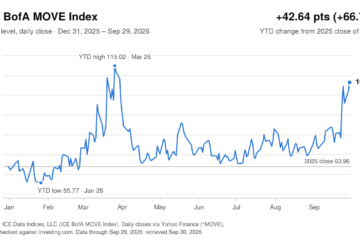
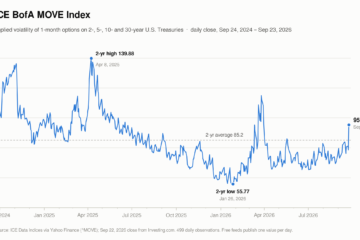
Nearly every economy on earth is growing, and American companies are earning far more than anyone expected in January. Analysts now see S&P 500 earnings per share rising 29% this year over last, up from about 13% when the year began. Stocks have not kept pace; the S&P 500 sits roughly where it stood at the start of June, and on Tuesday the 10-year Treasury yield closed above 5% for the first time since 2007.
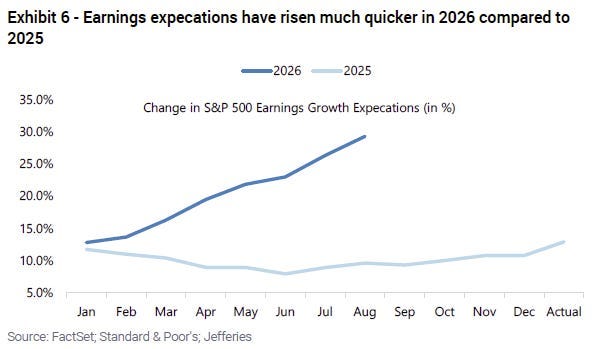
We side with the earnings, with one caveat. A world that grows all at once burns more fuel, and unless that fuel gets cheaper, the growth already built into stock prices makes for a steeper climb in 2027.
In Unison
Sean Darby, Mizuho’s Hong Kong-based equity strategist, calls the moment “synchronicity.” International Monetary Fund data show almost no economy shrinking from a year earlier. Governments are spending, central banks have remained accommodative, and nobody in power wants a recession; by Mizuho’s count, the United States has spent just two months in one since 2017.
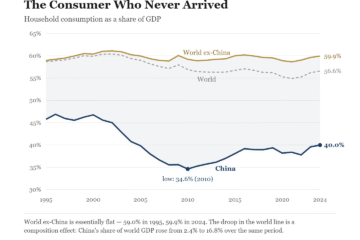
The upswing is oddly built. It has arrived without China or Europe, for example, growing anywhere near their “normal” pace (though what is “normal” may be under revision in both cases — and even Europe has some constructive pockets), and without the consumer carrying their usual load. Industrial companies, commodity producers, and banks have improved alongside the AI build-out. Higher bond yields have not derailed any of it, Darby writes — before adding the word “yet.”
The world is growing in unison, with factories and mines doing more of the pulling than shoppers.
The Earnings
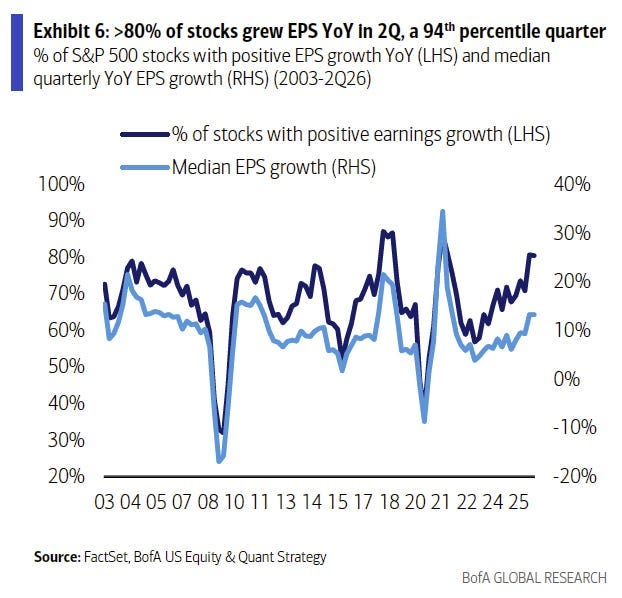
America’s corporate profit picture still sits in the driver’s seat. BofA’s equity strategists count second-quarter earnings per share up 32% from a year earlier, excluding one-time investment gains, against the 22% analysts expected. More than 80% of the index’s companies grew earnings, a breadth that beats about 94% of quarters since 2003.
This letter is general commentary — the wide-angle view. It is not a portfolio. What we do for the families we work with is the opposite of “wide-angle”: we make portfolios built around one household’s circumstances, taxes, timelines, and appetite for exactly the kind of volatility described above. We keep that roster of clients deliberately small, because that sort of attention doesn’t scale. If you’d like to talk about what it would look like for you, Aubrey Ford will make the time.
Perhaps the consumer is not the headwind people expected him/her to be. Core retail sales, which leave out cars, gasoline, and building materials, rose 1.4% in August from July, almost three times the consensus forecast, though about a third of that was a rebound from July’s early Prime Day. Goldman Sachs now tracks third-quarter GDP growth at a 3.0% annualized rate.
So, while the economy and profits grow, many key stock prices have been tracking sideways, causing Goldman’s trading desk to call the market’s mood “indigestion”. The past years’ biggest winners have been stuck in trading ranges, and market cap weighted indexes are treading water… while profit forecasts climb. The result is a good one from our perspective. Investors now pay less for each dollar of expected earnings than they did in June. Three months of flat prices on rising profits have made American stocks cheaper.
The Fuel Bill
Francisco Blanch and BofA’s commodity team point out that crude oil has held up through what they call the largest crude supply disruption in history. Rerouted pipelines, U.S. Navy escorts through the Strait of Hormuz, reserve releases and extra Russian crude kept barrels moving, and Brent, the international benchmark, stayed below $100 for a while. But it looks like the resultant price relief seems to be spent.
Refined fuel has had no such cushion. Ukrainian attacks on Russian refineries have cut Russia’s fuel exports from an average of 1.3 million barrels a day earlier in the year to 0.4 million over the past two months. Diesel and gasoline inventories have fallen close to their operating minimums, and prices have pushed toward records. In Europe, consumption of diesel and heating oil is down 12% from a year ago, which is what rationing by price looks like. At home, a gallon of diesel topped $6 on average for the first time last week, according to AAA.
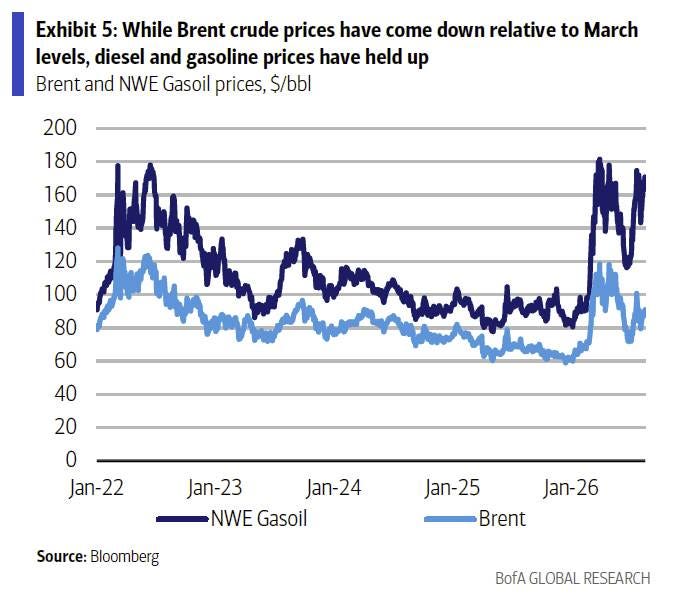
The split shows up in American inflation data. Consumer prices rose 3.4% in the twelve months through August; excluding food and energy, they rose 2.4%, the slowest pace since early 2021, though the Fed’s preferred gauge (CPE) is running warmer. Over the same twelve months, fuel oil rose 52% and gasoline 27%.
The forecasts count on the shortage passing. BofA’s baseline, which assumes a deal with Iran reopens Hormuz, has Brent averaging $83 a barrel in the second half of this year and $75 in 2027. The scenario the team marks as likely, continued skirmishing, has Brent around $95 for the rest of 2026 and $100 next year. Three days after the BofA note went out, drones struck Saudi Arabia’s East-West pipeline, the kingdom’s 7-million-barrel-a-day route around Hormuz. The Saudis shut it, and Brent traded near $105 on Wednesday.
Stock market forecasts are rising along with earnings expectations, but most of them assume gentler energy impacts to growth. BofA’s equity strategists assume oil averages $74 a barrel in 2027, 12% below their figure for this year, while the bank’s commodity team expects world oil demand, down about 2 million barrels a day this year, to grow by 4.3 million next year if the supply is there. A global economy trying to run at full speed needs that oil, and needs it cheaper; growth raises its own fuel bill.
Corporate profit growth continuing is great for the market, but not if it is concentrated in the sector benefitting from higher energy prices.
A Predictable Response to Higher Growth from the Fed
On Wednesday, the Federal Reserve raised its benchmark short-term interest rate by a quarter point, to a range of 3.75% to 4%, its first increase since 2023. The vote was unanimous. The statement describes an economy expanding at a solid pace, with strong productivity growth and robust capital investment, and inflation that remains elevated.
The projections released alongside the decision point to rates going a little higher still. The median official expects one more quarter-point increase by year-end and no cuts in 2027; in June, the median projection for the end of 2027 was half a point lower. The same projections have the economy growing 2.4% next year, a touch faster than this year, and overall inflation falling from 3.7% to 2.3%, below the 2.5% they expect for core inflation. Overall inflation runs below core only when food and energy prices rise more slowly than everything else.
The Hurdle
At roughly 21.5 times expected earnings for the next twelve months, against a long-run average near 19, the S&P 500 is priced for those more optimistic forecasts to arrive. If oil fails to cooperate, 2027 can disappoint without anything breaking, just because the arithmetic gets harder.
Growth is measured against the prior year, and 2026 had help that will not recur. Markups on Amazon’s and Alphabet’s investment stakes, chiefly in Anthropic and SpaceX, lifted reported second-quarter earnings growth from 32% to 50%. By BofA’s math, gains like these cut consensus 2027 earnings growth from about 20% to the mid-teens. Goldman’s economists expect consumer spending growth to slow in the fourth quarter as the lift from this year’s unusually large tax refunds fades. BofA’s research also finds that oil prices tend to reach consumer spending with a lag of a few quarters, which carries this summer’s fuel bill into next year.
This is how a plateau forms. BofA expects earnings growth to cool from 33% this year to 12% next, still above trend. In twelve-month periods since 1936 when earnings growth ran above trend but was slowing, the S&P 500 returned an average of 7.8% over those same months, against 12.4% across all periods. How will the markets respond if 2027 earnings growth rate turns out to be in the single digits?
Higher oil prices also work on both parts of stock prices, squeezing profits directly for some businesses, and through higher inflation and bond yields, which compress the multiple that investors will pay for each dollar of them. Even Jefferies’ bullish strategists call a sustained rise in long-term yields the market’s biggest risk.
The chart below shows Brent spot rather than futures prices; as we noted a few weeks ago, “The key with energy prices is often not the quoted futures price, but the price on the ground when and where the energy is needed.”
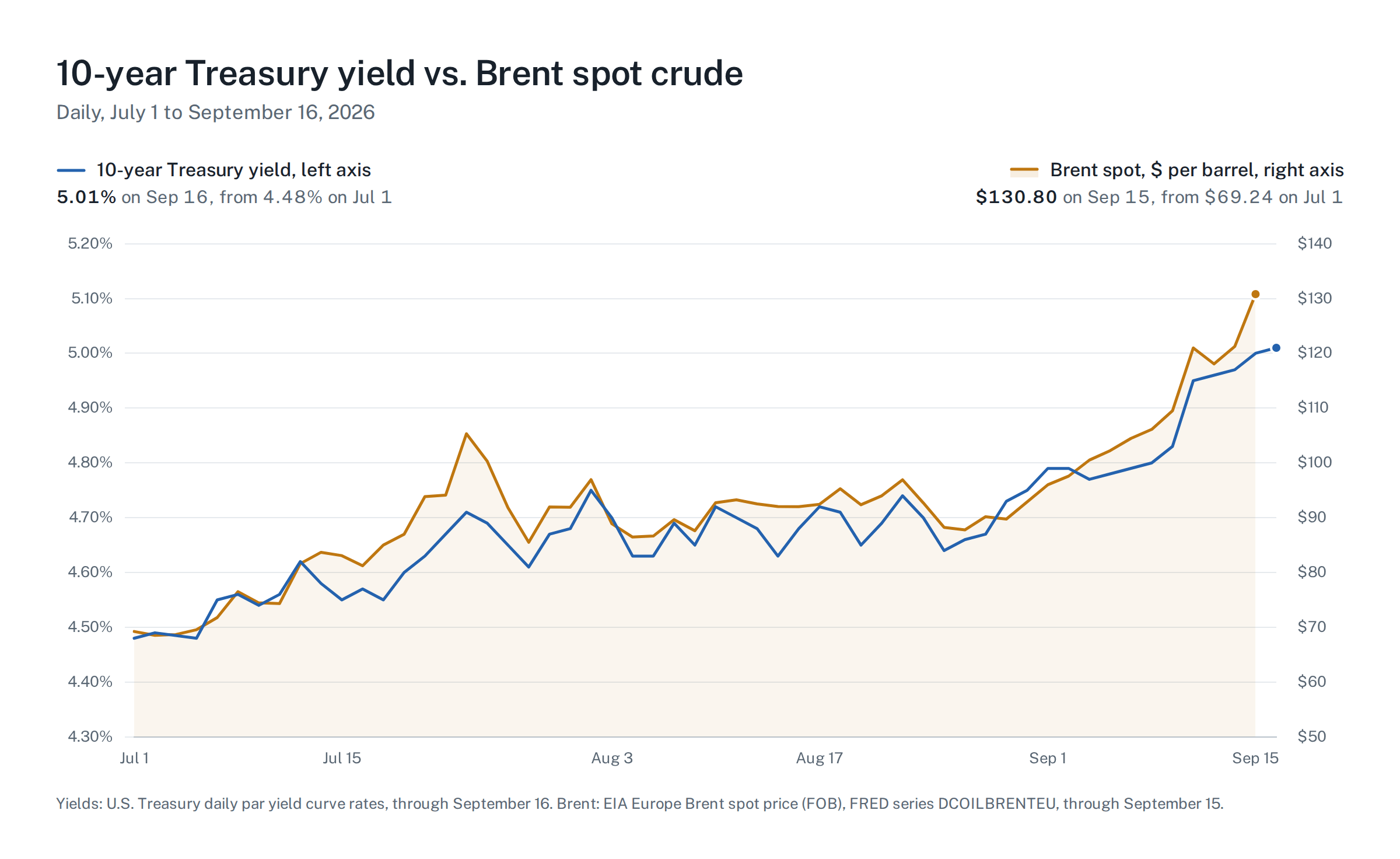
We still lean bullish on the United States. The routes to cheaper oil are real: any sight of a deal between Washington and Tehran, a ceasefire between Russia and Ukraine, Venezuelan production improving, and in time more barrels from producers inside and outside OPEC. BofA believes a deal or a ceasefire could reverse prices quickly. Our summer posture, “long America and wary of the tape,” still fits, and lately the tape has supplied the wariness on its own. We might watch the price of diesel to help decide how much of 2027 is worth paying for today. Without cheaper oil, this year’s earnings growth increases the height of next year’s hurdle.
Thanks for listening; we welcome your calls and questions.
General Disclosures About This Newsletter
The publisher of this newsletter is Guild Investment Management, Inc. (GIM or Guild), an investment advisor registered with the Securities and Exchange Commission. GIM manages the accounts of high net worth individuals, trusts and estates, pension and profit sharing plans, and corporations, among other clients.
Your receipt of this newsletter does not create a personal investment advisory relationship with GIM although some recipients may also be advisory clients of GIM. GIM has written investment advisory agreements with all its personal advisory clients, which sets forth the nature of that relationship.
The newsletter makes general observations about markets and business and financial trends and may provide advice about specific companies and specific investments. It does not give personal investment advice tailored to the needs, objectives, and circumstances of individual readers. Whether investment ideas and recommendations are suitable for individual readers depends substantially on the personal and financial situation of that reader, which GIM, as the publisher of the newsletter, makes no effort to investigate.
GIM attempts to provide accurate content in its newsletters to the extent such content is factual rather than analysis and opinion, but GIM relies primarily on information compiled or reported by third parties and does not generally attempt to independently verify or investigate such information. Moreover, some content and some of the assumptions, formulas, algorithms and other data that affect the content may be inaccurate, outdated, or otherwise flawed. GIM does not guarantee or take responsibility for the accuracy of such information.
Please note that investing in stocks, other securities, and commodities is inherently risky, and you should rely on your personal financial advisors and conduct your own due diligence in connection with any investment decision.
A Special Comment for Guild’s Clients
If you are an investment advisory client of GIM who is receiving this newsletter, please note that the fact that a general recommendation is made of a particular security, commodity, or investment area to its newsletter subscribers does not mean that investment is suitable for you or should be purchased by you. For example, GIM may already have purchased such securities on your behalf or purchased securities in the same industry (and an increase in the position for you may represent too much concentration in one security or industry), or GIM may believe the investment is not suitable for you based on your risk tolerance or other factors. If you have questions about the recommendations in this newsletter in relation to your account at GIM, please contact Tony Danaher, Rudi von Abele, or Aubrey Ford.
Conflicts of Interest
As of the date of this newsletter, GIM’s investment advisory clients or GIM’s principals owned positions in areas that are the subject of current recommendations, commentary, analysis, opinions, or advice, contained in this newsletter.
GIM and its principals have certain conflicts of interest in its relations with its investment advisory clients and its newsletter subscribers resulting from GIM or its principals holding positions for its clients or themselves which are also recommended to its clients. GIM may change the positions of its clients or GIM’s principals may change their positions (increasing, decreasing, and eliminating them) based on GIM’s best judgment at any given time, including the time of publication of the newsletter. Factors that lead GIM to change or eliminate its positions may include general market developments, factors specific to the issuer, or the needs of GIM or its advisory clients. From time to time GIM’s investing goals on behalf of its investment advisory clients or the personal investing goals of GIM’s principals and their risk tolerance may be different from those discussed in the newsletter, and the investment decisions made by GIM for its advisory clients or the investment decisions of its principals may vary from (and may even be contrary to) the advice and recommendations in the newsletter.
In addition, GIM or its principals may reduce or eliminate their positions in an investment that is recommended in the newsletter prior to notifying the newsletter subscribers of such a reduction or elimination. The publication by GIM of a “target price” or “stop loss” for a particular security or other asset does not necessarily represent the price at which GIM intends to sell or will sell any such assets for its advisory clients or the price at which GIM’s principals intend to sell any such assets.
As a consequence of the conflict of interest, GIM’s clients or principals may benefit if newsletter subscribers purchase assets recommended by GIM since it could increase the value of the assets already held by GIM’s investment advisory clients or GIM’s principals. On the other hand, GIM’s principals and clients may suffer a detriment if they seek to acquire additional shares in securities that have been recommended and the price of the securities has increased as a result of purchases by newsletter subscribers.
To help mitigate these conflicts, GIM seeks to avoid recommending the securities of individual companies where GIM or its principals have an ownership position and where the issuer is small or its securities are thinly traded. That way sales by GIM in advance of possible sales by newsletter subscribers would not be likely to cause any significant decrease in the sale price to newsletter subscribers. GIM has a fiduciary relationship with its investment advisory clients and cannot agree on behalf of such clients to refrain from purchases or sales of a security mentioned in the newsletter for a period of time before or after recommendations for purchases or sales are made to its newsletter subscribers.
GIM encourages you to do independent research on the securities or other assets discussed or recommended in the newsletter prior to making any investment decisions and to be especially cautious of investments in small, thinly-traded companies, which are usually the most risky investments that you can make.
Disclaimer of Liability
GIM disclaims any liability for investment decisions based upon recommendations, information, or opinions in its newsletters. GIM is not soliciting you to execute any trade. Nothing contained in GIM’s newsletters is intended to be, nor shall it be construed as an offer to buy or sell securities or to give individual investment advice. The information in the newsletter is not intended for distribution to, or use by, any person or entity in any jurisdiction or country where such distribution or use would be contrary to law or regulation, or which would subject GIM to any registration requirement within such jurisdiction or country.
COPYRIGHT NOTICE
Guild’s current and past market commentaries are protected by U.S. and international copyright laws. All rights reserved. You must not copy, frame, modify, transmit, further distribute, or use the market commentaries, without the prior written consent of Guild. This email or any download from a secure website is meant for only the intended recipient of the transmission, and may be a communication privileged by law. If you received this email in error, any use, dissemination, distribution, or copying of this email is similarly prohibited. Please notify us immediately of the error by return email and please delete this message from your system. Although this email and any attachments are believed to be free of any virus or other defect that might affect any computer system into which it is received and opened it is the responsibility of the recipient to ensure that it is virus free and no responsibility is accepted by Guild Investment Management for any loss or damage arising in any way from its use.

0 Comments