
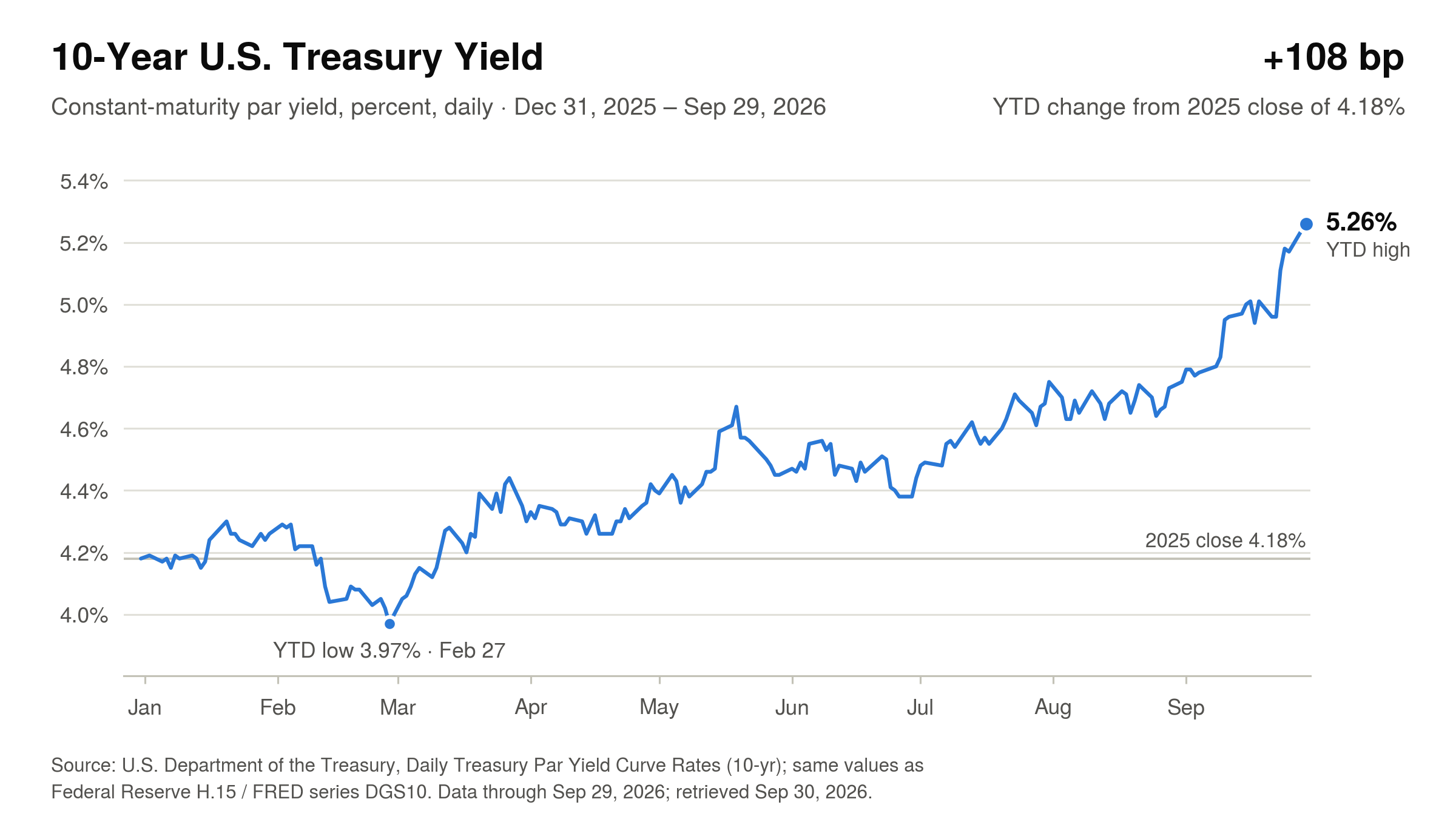
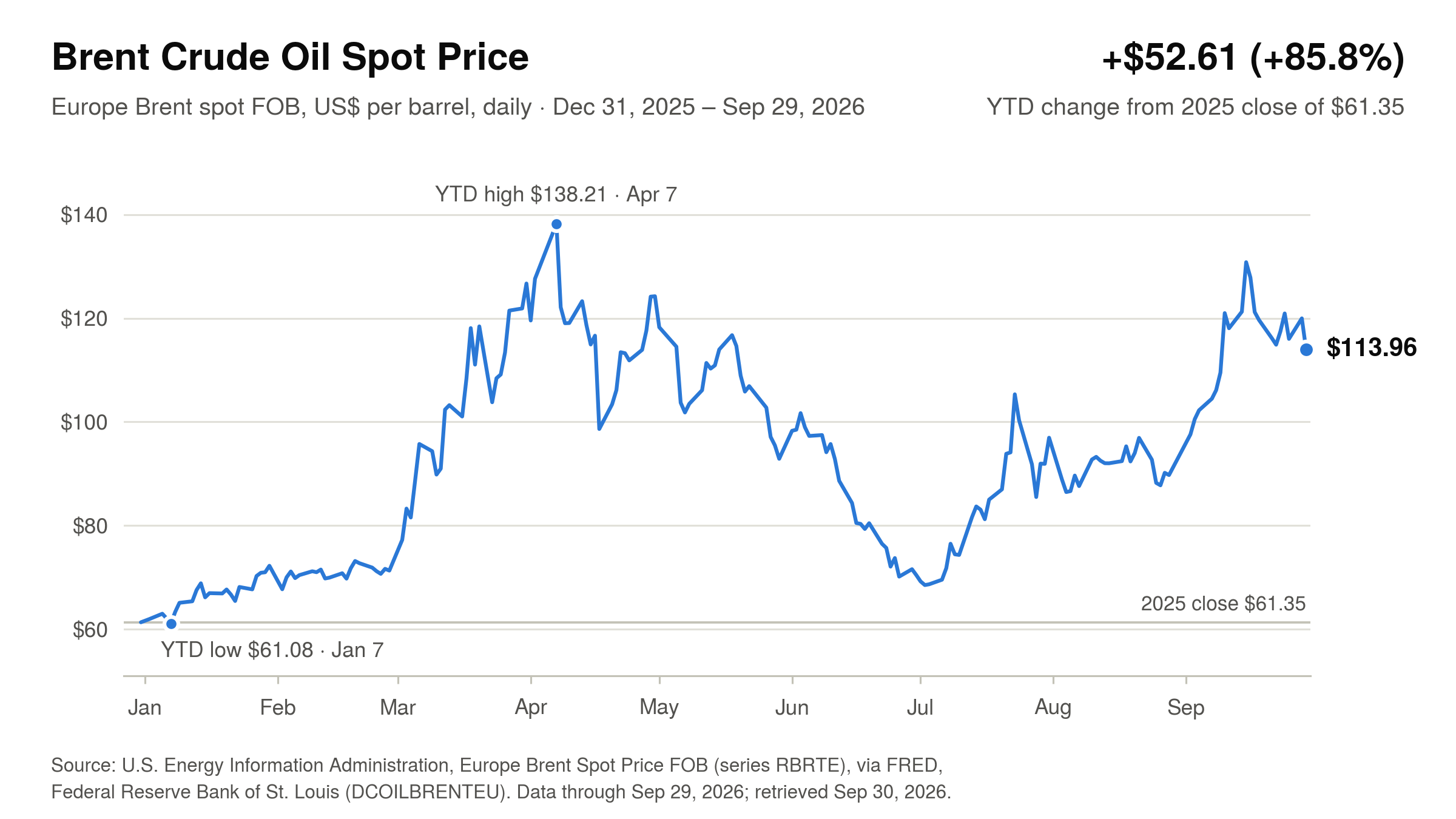
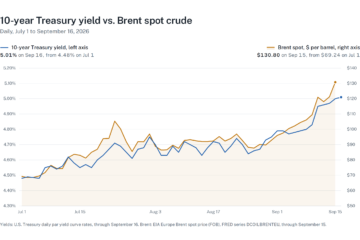
The midterms will fill the void between now and the start of earnings season, but they are not among the three things that at the moment, perhaps, are most influential in strengthening or hurting the attractiveness of stocks. We’d say those three things are the bond market, earnings, and oil (or maybe to get more granular, diesel). In September the 10-year Treasury yield reached its highest level since 2007; Brent crude, the global oil benchmark, topped $105 a barrel; and analysts have raised the bar for third-quarter profits.
Wall Street strategists specialize in carefully nuanced forecasts, but we are not really in the forecasting game. Rather, we ask, What’s driving the current picture, and what would change it? and work to build portfolios that can hold up no matter which strategist turns out to be right this time.
As Morgan Stanley’s policy strategists note, tariffs, trade, deregulation, immigration and export controls are under the purview of the White House, and despite the outsized presence of Donald Trump in political and media consciousness, he’s not actually directly on the ballot. Prediction markets currently price a Democratic sweep of Congress at about 61%, a split Congress at 31% and a Republican hold at 7%.
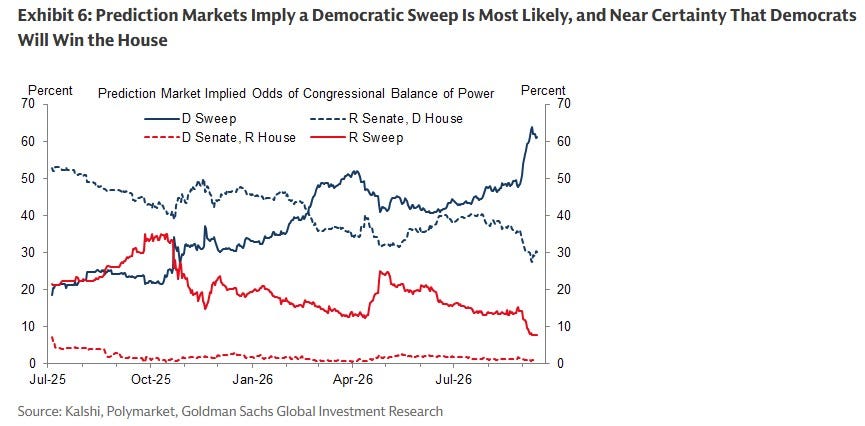
A surprise result may tempt investors to treat it as a signal for 2028, but that would be far from a done deal. Midterm results typically haven’t produced outsized winners or losers over the following three to six months, despite all the media attention they garner when they’re happening.
The voting does matter for the AI build-out, but that’s mostly something happening in state capitols. The levers that make or break a data center are held by governors, legislatures and, in ten states, elected utility commissioners. In key races, the debate is now whether to pause expansion or impose various conditions. A slower build-out would actually confirm our view that AI’s binding constraint is now physical, and favor existing compute capacity and on-site power — those who have it, those who supply it, and those who build its infrastructure.
Local ballot results could rewrite a few terms of the data-center build-out in certain locations, but the trend as a whole is a Goliath. Capacity that gets NIMBYed in one place will migrate elsewhere, and we note that the fickle nature of the public sentiment that has recently seemed to turn so sour could turn back in the other direction just as easily: we won’t hazard a guess about whether public sentiment is being shaped with political goals in mind. Keep your eyes on the larger trend and the larger technological story.
One: The Bond Market
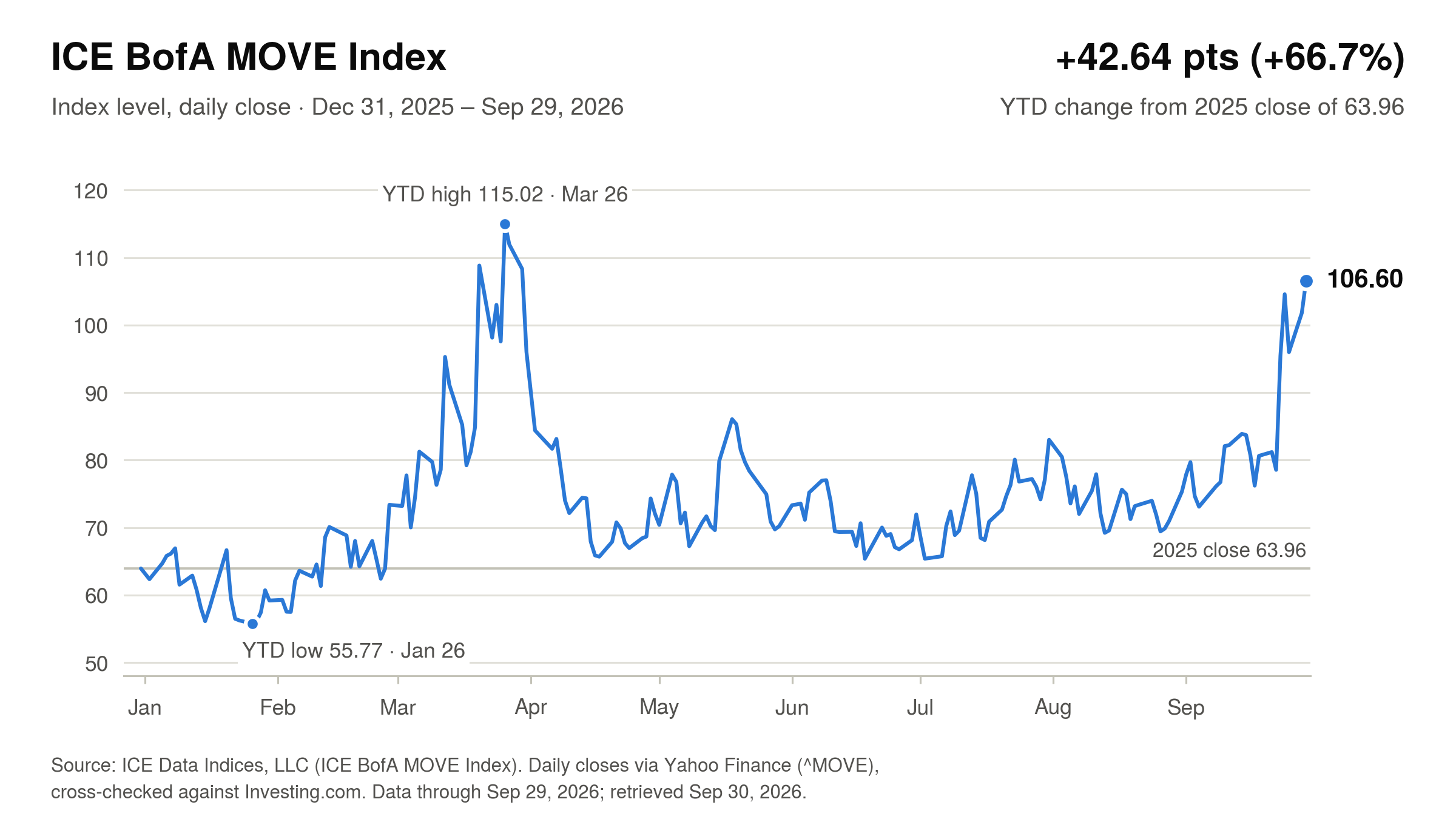
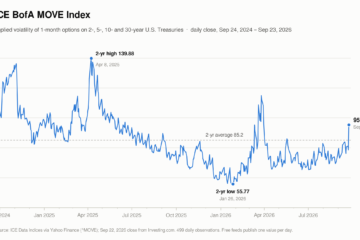
The MOVE index, the bond market’s fear gauge, tracks how much options traders expect Treasury yields to swing. It jumped roughly a third in September, to levels last seen in March, as the 10-year US Treasury bond yield climbed from 4.79% to 5.24% and the Fed raised rates for the first time since July 2023. On the other hand, the VIX, its counterpart for stocks, has barely stirred out of a drowsiness seemingly inspired by the relentless upward march of earnings.
So far the climb reflects solid growth, costlier oil, and a Fed intent on taming inflation. Really, that’s not a climb to be feared. The kind to fear is disorderly: yields rising because buyers step back (the kind of thing that since the GFC has tended to evoke policymaker panic and intervention). Still, even orderly yields’ rise does gradually change the valuation arithmetic. The S&P 500 trades at 19.2 times the profits analysts expect over the next twelve months. Turned upside down, that is an “earnings yield” of about 5.2% — roughly what a 10-year Treasury now pays.
When a Treasury pays about what stocks earn, growth has to do all the work, so attention to the growth gets sharper and the questions about it get more pointed.
Two: The Earnings Bar
“Strong” earnings are graded on a curve, and right now, that curve is set by yields and oil. Analysts usually lower the bar as a quarter progresses, trimming estimates by 2% to 2.5% on average. This time they raised it: FactSet’s consensus now calls for third-quarter S&P 500 profits to rise 29.1% from a year earlier.
Beating that is necessary, but might not be not sufficient. With bonds this competitive, the market also needs (1) companies’ own forecasts to hold up into 2027, when analysts expect growth to slow to about 15%; (2) margins (outside the energy sector) to hold up despite pricier fuel; and (3) growth expanding beyond the two engines doing much of the lifting, chipmakers and suppliers to the AI buildout, and an oil windfall.
The higher yields and oil climb, the higher the bar that earnings must clear for Mr Market to assess them as sufficiently “strong.”
Three: Oil and the Middle East
Brent was up about 19% in September, yet U.S. crude trades well below it: much of the oil Americans consume is produced at home and never has to pass through Hormuz or make the long voyage from the Middle East or other distant suppliers.
As we write, crude through Hormuz is back near prewar volume on a seven-day basis, about 13.5 million barrels per day. That recovery rests on U.S.-escorted dark shuttles and includes Saudi barrels rerouted from the damaged East-West Pipeline, while refined products are still under a fifth of normal and tanker attacks continue. With inventories and the SPR nearly drawn down and no diplomatic settlement, Brent holds well above $100, and prompt physical barrels are priced well above deferred futures.
The first risk is escalation: The Wall Street Journal reports, citing U.S. officials, that the President expects to resume bombing Iran after the election. (Take any such pronouncement with an abundance of salt, of course: if he really meant it, why would he broadcast it?)
The second risk is duration: a seven-month war keeps a premium in oil that seeps into inflation expectations, and policymakers dread this seepage, since “expectations” are so hard to manage and shift.
The third risk is physical scarcity, and Europe is most exposed. Its gas storage is about 71% full, roughly 16 points below the five-year norm for late September, and Washington is weighing curbs on American diesel exports, which recently supplied about half of Europe’s diesel imports. A cold winter would test both; perhaps Europe needs to get religion and start praying for a mild winter.
This letter is general commentary — the wide-angle view. It is not a portfolio. What we do for the families we work with is the opposite of “wide-angle”: we make portfolios built around one household’s circumstances, taxes, timelines, and appetite for exactly the kind of volatility described above. We keep that roster of clients deliberately small, because that sort of attention doesn’t scale. If you’d like to talk about what it would look like for you, Aubrey Ford will make the time.
The Wobble
The loop also runs in reverse: a reopened strait would ease oil, inflation and yields. The calendar helps, too. Morgan Stanley notes that seasonal headwinds typically fade in October, and that stocks have averaged roughly 22% in the twelve months after a midterm and 19% in a president’s third year.
We would treat a midterm-driven dip (or a typical, seasonal October wobble) as an opportunity to put your buy list to work… provided the bond market stays orderly, the oil shock stops short of physical shortage, and earnings clear a bar the market considers fair. Resilience comes from owning what pays off on different turns of the loop: energy producers if oil stays high, power generation and grid equipment whichever way the NIMBY contests go, and businesses that fund growth from their own cash rather than at today’s rates.
A dip born at the ballot box is an opportunity; one born in the bond market or the Strait of Hormuz probably deserves a more cautious response.
A Brief Cybersecurity Note
We, like most of our clients, grew up in a pre-internet age. Some recent incidents made us put together a helpful cheat sheet that can be kept by the computer for helping navigate the dangers posed by phishing emails and other similar scams.
Americans reported nearly $21 billion in losses to the FBI’s Internet Crime Complaint Center last year, including $7.7 billion reported by people over 60. Phishing, a fake email or text posing as someone you trust, was among the most frequently reported complaints.
The encouraging news is that the best defenses are low-tech, and we have put them on a one-page cheat sheet you can download below. Three rules do most of the work.
- Slow down: urgency is the scammer’s main tool. Check by phone, at a number you already have, before sending money or changing bank details, even when the request seems to come from someone you know, including us. Voices can now be cloned, so the call should be one you place, not one you take. And a request for gift cards is always a scam.
- Never share a password or a sign-in code. If a code arrives that you didn’t ask for, tap Deny; someone may already have your password.
- Signs of a virus or ransomware, which locks your files until you pay, include a demand for payment, files that won’t open or a cursor moving on its own. If you see them, get the computer offline, leave it switched on (shutting down can erase clues), touch nothing else, and call for help from your phone.
Scammers prefer that you act in haste; stopping, thinking, and making a call to a number you already have can take away their edge.
Thanks for listening; we welcome your calls and questions.
General Disclosures About This Newsletter
The publisher of this newsletter is Guild Investment Management, Inc. (GIM or Guild), an investment advisor registered with the Securities and Exchange Commission. GIM manages the accounts of high net worth individuals, trusts and estates, pension and profit sharing plans, and corporations, among other clients.
Your receipt of this newsletter does not create a personal investment advisory relationship with GIM although some recipients may also be advisory clients of GIM. GIM has written investment advisory agreements with all its personal advisory clients, which sets forth the nature of that relationship.
The newsletter makes general observations about markets and business and financial trends and may provide advice about specific companies and specific investments. It does not give personal investment advice tailored to the needs, objectives, and circumstances of individual readers. Whether investment ideas and recommendations are suitable for individual readers depends substantially on the personal and financial situation of that reader, which GIM, as the publisher of the newsletter, makes no effort to investigate.
GIM attempts to provide accurate content in its newsletters to the extent such content is factual rather than analysis and opinion, but GIM relies primarily on information compiled or reported by third parties and does not generally attempt to independently verify or investigate such information. Moreover, some content and some of the assumptions, formulas, algorithms and other data that affect the content may be inaccurate, outdated, or otherwise flawed. GIM does not guarantee or take responsibility for the accuracy of such information.
Please note that investing in stocks, other securities, and commodities is inherently risky, and you should rely on your personal financial advisors and conduct your own due diligence in connection with any investment decision.
A Special Comment for Guild’s Clients
If you are an investment advisory client of GIM who is receiving this newsletter, please note that the fact that a general recommendation is made of a particular security, commodity, or investment area to its newsletter subscribers does not mean that investment is suitable for you or should be purchased by you. For example, GIM may already have purchased such securities on your behalf or purchased securities in the same industry (and an increase in the position for you may represent too much concentration in one security or industry), or GIM may believe the investment is not suitable for you based on your risk tolerance or other factors. If you have questions about the recommendations in this newsletter in relation to your account at GIM, please contact Tony Danaher, Rudi von Abele, or Aubrey Ford.
Conflicts of Interest
As of the date of this newsletter, GIM’s investment advisory clients or GIM’s principals owned positions in areas that are the subject of current recommendations, commentary, analysis, opinions, or advice, contained in this newsletter.
GIM and its principals have certain conflicts of interest in its relations with its investment advisory clients and its newsletter subscribers resulting from GIM or its principals holding positions for its clients or themselves which are also recommended to its clients. GIM may change the positions of its clients or GIM’s principals may change their positions (increasing, decreasing, and eliminating them) based on GIM’s best judgment at any given time, including the time of publication of the newsletter. Factors that lead GIM to change or eliminate its positions may include general market developments, factors specific to the issuer, or the needs of GIM or its advisory clients. From time to time GIM’s investing goals on behalf of its investment advisory clients or the personal investing goals of GIM’s principals and their risk tolerance may be different from those discussed in the newsletter, and the investment decisions made by GIM for its advisory clients or the investment decisions of its principals may vary from (and may even be contrary to) the advice and recommendations in the newsletter.
In addition, GIM or its principals may reduce or eliminate their positions in an investment that is recommended in the newsletter prior to notifying the newsletter subscribers of such a reduction or elimination. The publication by GIM of a “target price” or “stop loss” for a particular security or other asset does not necessarily represent the price at which GIM intends to sell or will sell any such assets for its advisory clients or the price at which GIM’s principals intend to sell any such assets.
As a consequence of the conflict of interest, GIM’s clients or principals may benefit if newsletter subscribers purchase assets recommended by GIM since it could increase the value of the assets already held by GIM’s investment advisory clients or GIM’s principals. On the other hand, GIM’s principals and clients may suffer a detriment if they seek to acquire additional shares in securities that have been recommended and the price of the securities has increased as a result of purchases by newsletter subscribers.
To help mitigate these conflicts, GIM seeks to avoid recommending the securities of individual companies where GIM or its principals have an ownership position and where the issuer is small or its securities are thinly traded. That way sales by GIM in advance of possible sales by newsletter subscribers would not be likely to cause any significant decrease in the sale price to newsletter subscribers. GIM has a fiduciary relationship with its investment advisory clients and cannot agree on behalf of such clients to refrain from purchases or sales of a security mentioned in the newsletter for a period of time before or after recommendations for purchases or sales are made to its newsletter subscribers.
GIM encourages you to do independent research on the securities or other assets discussed or recommended in the newsletter prior to making any investment decisions and to be especially cautious of investments in small, thinly-traded companies, which are usually the most risky investments that you can make.
Disclaimer of Liability
GIM disclaims any liability for investment decisions based upon recommendations, information, or opinions in its newsletters. GIM is not soliciting you to execute any trade. Nothing contained in GIM’s newsletters is intended to be, nor shall it be construed as an offer to buy or sell securities or to give individual investment advice. The information in the newsletter is not intended for distribution to, or use by, any person or entity in any jurisdiction or country where such distribution or use would be contrary to law or regulation, or which would subject GIM to any registration requirement within such jurisdiction or country.
COPYRIGHT NOTICE
Guild’s current and past market commentaries are protected by U.S. and international copyright laws. All rights reserved. You must not copy, frame, modify, transmit, further distribute, or use the market commentaries, without the prior written consent of Guild. This email or any download from a secure website is meant for only the intended recipient of the transmission, and may be a communication privileged by law. If you received this email in error, any use, dissemination, distribution, or copying of this email is similarly prohibited. Please notify us immediately of the error by return email and please delete this message from your system. Although this email and any attachments are believed to be free of any virus or other defect that might affect any computer system into which it is received and opened it is the responsibility of the recipient to ensure that it is virus free and no responsibility is accepted by Guild Investment Management for any loss or damage arising in any way from its use.

0 Comments