
On one point, the competing analysts of Wall Street agree: this is a banner year for corporate profits, with S&P 500 earnings on track to rise by roughly a third. On what comes next, they part ways. (Strategists tend to be moderate in their targets, so we wouldn’t expect anyone to be talking about outlandishly large moves.) One camp sees the index finishing the year a few percent north of today’s level; another sees it roughly 5% below. And both, in the middle of two wars, have had to pencil in a price for oil.
So neither camp is predicting disaster. They simply weigh different things. Here, side by side, are two broad ways market participants are currently thinking about the path forward through year-end. We’ll tell you where they stand and then offer some thoughts of our own.
The Optimists
The optimists’ rule is simple: follow the profits. Three factors drive their view.
- First, earnings. Profits are growing about four times as fast as their long-run average this year, and the optimists expect roughly 20% more growth in 2027.
- Second, artificial intelligence. Companies tied to AI spending now make up nearly half the market’s value, and their profits are growing fastest. AI is also visibly boosting performance for more of its adopters.
- Third, inflation that stocks can live with. The optimists see today less like the 1970s and more like the late 1980s or mid-2000s, when prices ran hot and stocks still did well.
These optimists’ main worry is interest rates: when long-term rates climb sharply, investors are willing to pay less for each dollar of profit. Their case in one line: when profits grow this fast, betting against stocks tends to be a fool’s errand.
The Cautious
- The cautious camp doesn’t dispute the profits. “Earnings are not the problem,” as BofA’s Savita Subramaniam says. Four other factors drive their view.
- First, price. They argue that today’s profits run well above their long-term trend, flattered in places by big one-time gains. Value the market on more normal earnings, and stocks may look expensive after all.
- Second, inflation. They fear the current year is rhyming with the 1970s rather than the 90s: stubborn inflation, a weaker dollar, Fed rate hikes, and an oil shock.
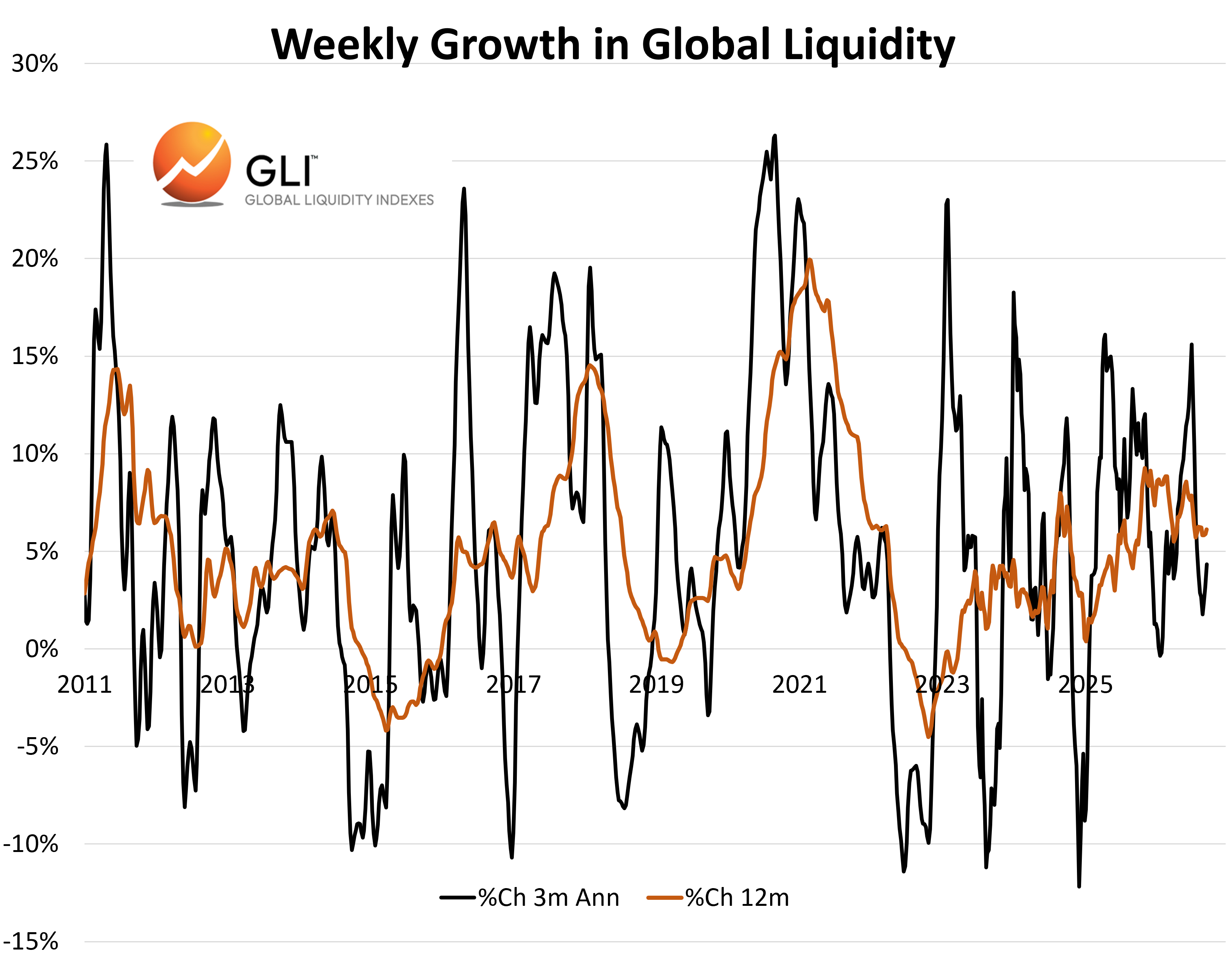
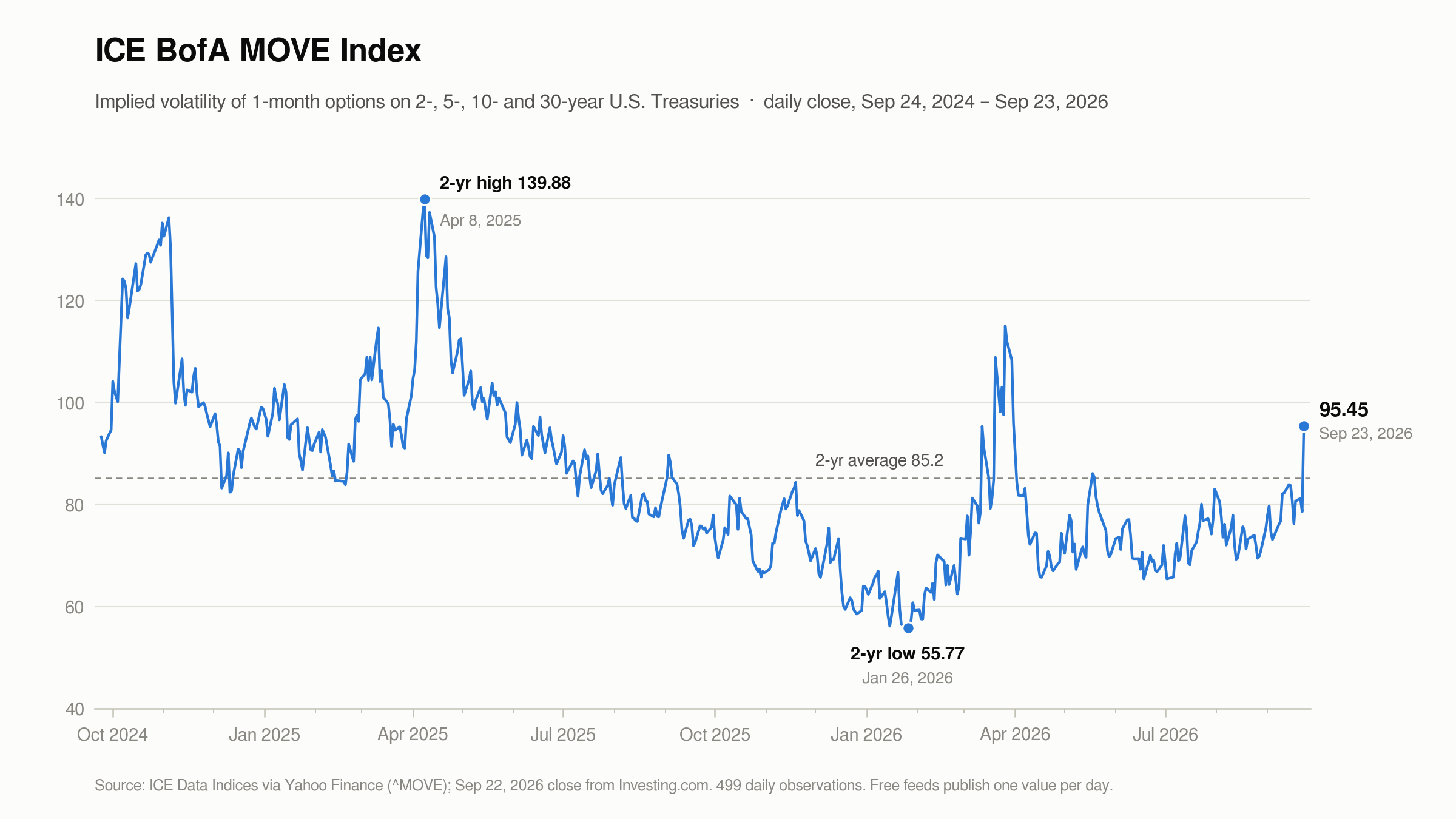
- Third, liquidity. For years, easy money did more than profits to lift stock prices. That support is fading; in their words, liquidity has gone from “full gush” to “a trickle.” One closely watched liquidity tracker, from Michael Howell over at Capital Wars, finds the global pool still at a record, but propped up by unusually calm bond markets while central banks add little. A bond-market scare would shrink it. (See our closing note below about the MOVE Index.)
- Fourth, timing. The market has had one 5% dip this year against a typical three, and September and October are historically its weakest months.
Yet even the cautious camp calls the long-term bull case, built on rising productivity, “intact.” This is caution about price, not a call for a bear market. The cautious camp is cautious about stock prices and multiples rather than profits.
Where They Meet, and Where They Split
Both expect strong profit growth again next year: ~20% for the optimists, closer to ~10% for the cautious. Both expect gains to spread beyond the handful of tech giants. Both see rising borrowing costs as a central threat. And both expect a bumpy autumn. Research shows stocks slipping about 4%, on average, in the three months after the Fed starts raising rates, which it did on September 16 for the first time since 2023.
The real split is over what drives stock prices. The optimists say profits, and profits are strong. The cautious say price and money, and both are turning less friendly. They also read history differently: the optimists see the late 1980s, the cautious the 1970s.
A Caveat on Earnings
While we can cite earnings strength as a key reason a stock market collapse is unlikely, we have been in the business long enough to know that corporate profit growth can quickly reverse course. In 2005 and 2006 we had tremendous profit growth. 1999 did too. In each case, the ensuing 24 months saw profits decline over 50%.
This letter is general commentary — the wide-angle view. It is not a portfolio. What we do for the families we work with is the opposite of “wide-angle”: we make portfolios built around one household’s circumstances, taxes, timelines, and appetite for exactly the kind of volatility described above. We keep that roster of clients deliberately small, because that sort of attention doesn’t scale. If you’d like to talk about what it would look like for you, Aubrey Ford will make the time.
Wild Cards
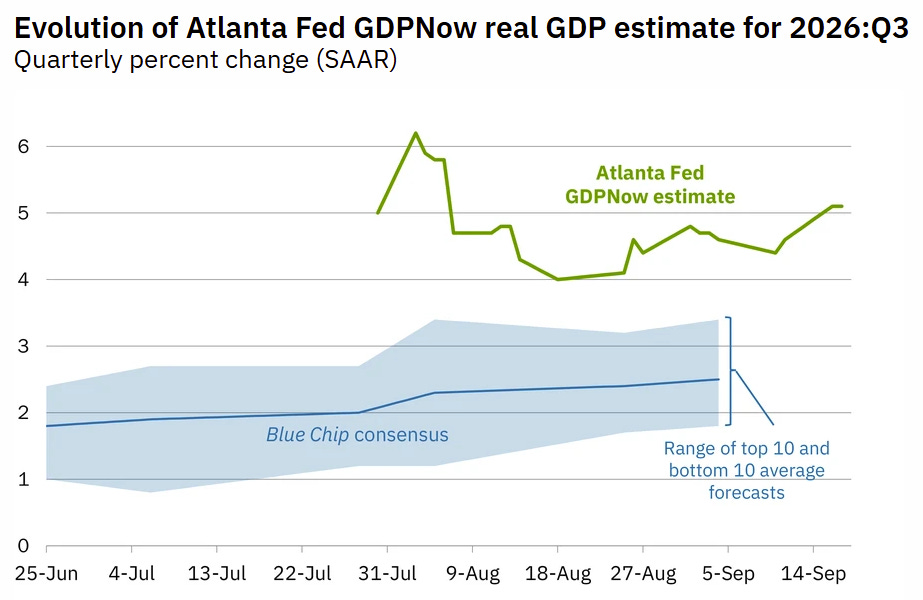
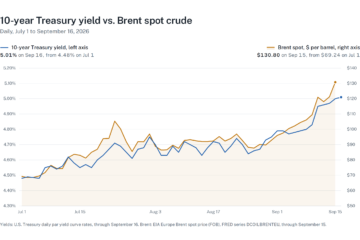
The Atlanta Fed’s GDPNow model, a running estimate built from incoming “high-frequency” data, has the economy growing this quarter at a pace equal to 5.1% a year, more than double the Fed’s 2.3% forecast for 2026. That’s a note in the optimists’ favor. It also gave the Fed room to raise rates, and it is part of why the 10-year Treasury yield, the benchmark for global borrowing, has climbed from just under 4% on the eve of the Iran war to about 5%. That worries the cautious, though of course, there is also the more bullish view that the cost of money should rise during a period of robust demand for capital and accelerating industrial expansion, such as the economy is presently experiencing.
On Tuesday, President Trump told the United Nations he faces a “big decision” on Iran: whether to strike a deal, possibly after the midterms, or to “annihilate the Islamic Republic.” Oil swung about 3% within the day. After meeting Trump the same day, Volodymyr Zelensky said Ukraine is ready for a mutual halt to strikes on energy targets; Moscow wants sanctions relief attached. And Xi Jinping’s state visit this week puts trade, AI, Iran, and Taiwan on the table. Beijing wants Hormuz reopened, though expectations for a breakthrough are low. There is little common ground on macro issues between the parties from which to anchor any lasting agreements.
Oil has followed every headline. Brent crude, the global benchmark, averaged about $117 a barrel in April, $84 in July and $112 in the second week of September. And crude is only part of the bill. Traffic through Hormuz is at a six-month high, but diesel, the fuel that moves goods, still hit a record $6.53 a gallon this week, and shipping and insurance costs remain steep. Lower crude prices in the paper markets does have to translate to lower energy costs at the location (and in the form) the fuel is actually needed.
Still, every forecaster of broad stock and bond market behavior must incorporate a number into their analysis. Interestingly, the optimistic Jefferies strategist expects oil to stay high for longer. The more cautious BofA strategist’s earnings math assumes oil averages $84 this year and $74 next, well below today’s price near $100, even as it warns of a 1970s-style oil shock.
Our view is that there are few reliable trends here. The conduct and consequences of the wars in the Middle East and Ukraine cannot be penciled out with any confidence.
This is exactly where experienced professional management such as ours can help you. Not by pretending to know what a barrel will cost next year, but by building portfolios that don’t depend on guesswork: owning the profit growth both camps agree on, holding commodities and other real assets that have tended to hold up when inflation and oil shocks linger, and keeping a close eye on earnings, interest rates, inflation, and the prices of food, electricity, diesel — among many other things, including the MOVE Index that tracks bond volatility, which as we noted above is a critical factor for overall liquidity levels.
And most importantly, we do not have to attach ourselves to predictions about particular outcomes. In our experience, it is more important to know how to prepare, and have strategies for the wider range of possible outcomes.
Thanks for listening; we welcome your calls and questions.
General Disclosures About This Newsletter
The publisher of this newsletter is Guild Investment Management, Inc. (GIM or Guild), an investment advisor registered with the Securities and Exchange Commission. GIM manages the accounts of high net worth individuals, trusts and estates, pension and profit sharing plans, and corporations, among other clients.
Your receipt of this newsletter does not create a personal investment advisory relationship with GIM although some recipients may also be advisory clients of GIM. GIM has written investment advisory agreements with all its personal advisory clients, which sets forth the nature of that relationship.
The newsletter makes general observations about markets and business and financial trends and may provide advice about specific companies and specific investments. It does not give personal investment advice tailored to the needs, objectives, and circumstances of individual readers. Whether investment ideas and recommendations are suitable for individual readers depends substantially on the personal and financial situation of that reader, which GIM, as the publisher of the newsletter, makes no effort to investigate.
GIM attempts to provide accurate content in its newsletters to the extent such content is factual rather than analysis and opinion, but GIM relies primarily on information compiled or reported by third parties and does not generally attempt to independently verify or investigate such information. Moreover, some content and some of the assumptions, formulas, algorithms and other data that affect the content may be inaccurate, outdated, or otherwise flawed. GIM does not guarantee or take responsibility for the accuracy of such information.
Please note that investing in stocks, other securities, and commodities is inherently risky, and you should rely on your personal financial advisors and conduct your own due diligence in connection with any investment decision.
A Special Comment for Guild’s Clients
If you are an investment advisory client of GIM who is receiving this newsletter, please note that the fact that a general recommendation is made of a particular security, commodity, or investment area to its newsletter subscribers does not mean that investment is suitable for you or should be purchased by you. For example, GIM may already have purchased such securities on your behalf or purchased securities in the same industry (and an increase in the position for you may represent too much concentration in one security or industry), or GIM may believe the investment is not suitable for you based on your risk tolerance or other factors. If you have questions about the recommendations in this newsletter in relation to your account at GIM, please contact Tony Danaher, Rudi von Abele, or Aubrey Ford.
Conflicts of Interest
As of the date of this newsletter, GIM’s investment advisory clients or GIM’s principals owned positions in areas that are the subject of current recommendations, commentary, analysis, opinions, or advice, contained in this newsletter.
GIM and its principals have certain conflicts of interest in its relations with its investment advisory clients and its newsletter subscribers resulting from GIM or its principals holding positions for its clients or themselves which are also recommended to its clients. GIM may change the positions of its clients or GIM’s principals may change their positions (increasing, decreasing, and eliminating them) based on GIM’s best judgment at any given time, including the time of publication of the newsletter. Factors that lead GIM to change or eliminate its positions may include general market developments, factors specific to the issuer, or the needs of GIM or its advisory clients. From time to time GIM’s investing goals on behalf of its investment advisory clients or the personal investing goals of GIM’s principals and their risk tolerance may be different from those discussed in the newsletter, and the investment decisions made by GIM for its advisory clients or the investment decisions of its principals may vary from (and may even be contrary to) the advice and recommendations in the newsletter.
In addition, GIM or its principals may reduce or eliminate their positions in an investment that is recommended in the newsletter prior to notifying the newsletter subscribers of such a reduction or elimination. The publication by GIM of a “target price” or “stop loss” for a particular security or other asset does not necessarily represent the price at which GIM intends to sell or will sell any such assets for its advisory clients or the price at which GIM’s principals intend to sell any such assets.
As a consequence of the conflict of interest, GIM’s clients or principals may benefit if newsletter subscribers purchase assets recommended by GIM since it could increase the value of the assets already held by GIM’s investment advisory clients or GIM’s principals. On the other hand, GIM’s principals and clients may suffer a detriment if they seek to acquire additional shares in securities that have been recommended and the price of the securities has increased as a result of purchases by newsletter subscribers.
To help mitigate these conflicts, GIM seeks to avoid recommending the securities of individual companies where GIM or its principals have an ownership position and where the issuer is small or its securities are thinly traded. That way sales by GIM in advance of possible sales by newsletter subscribers would not be likely to cause any significant decrease in the sale price to newsletter subscribers. GIM has a fiduciary relationship with its investment advisory clients and cannot agree on behalf of such clients to refrain from purchases or sales of a security mentioned in the newsletter for a period of time before or after recommendations for purchases or sales are made to its newsletter subscribers.
GIM encourages you to do independent research on the securities or other assets discussed or recommended in the newsletter prior to making any investment decisions and to be especially cautious of investments in small, thinly-traded companies, which are usually the most risky investments that you can make.
Disclaimer of Liability
GIM disclaims any liability for investment decisions based upon recommendations, information, or opinions in its newsletters. GIM is not soliciting you to execute any trade. Nothing contained in GIM’s newsletters is intended to be, nor shall it be construed as an offer to buy or sell securities or to give individual investment advice. The information in the newsletter is not intended for distribution to, or use by, any person or entity in any jurisdiction or country where such distribution or use would be contrary to law or regulation, or which would subject GIM to any registration requirement within such jurisdiction or country.
COPYRIGHT NOTICE
Guild’s current and past market commentaries are protected by U.S. and international copyright laws. All rights reserved. You must not copy, frame, modify, transmit, further distribute, or use the market commentaries, without the prior written consent of Guild. This email or any download from a secure website is meant for only the intended recipient of the transmission, and may be a communication privileged by law. If you received this email in error, any use, dissemination, distribution, or copying of this email is similarly prohibited. Please notify us immediately of the error by return email and please delete this message from your system. Although this email and any attachments are believed to be free of any virus or other defect that might affect any computer system into which it is received and opened it is the responsibility of the recipient to ensure that it is virus free and no responsibility is accepted by Guild Investment Management for any loss or damage arising in any way from its use.

0 Comments