As we wrote last week, the Treasury said on August 19 that it would at least double its buyback operations in the ten-to-thirty-year sector, from $2 billion to at least $4 billion apiece. Long yields fell on the news… and climbed straight back. Secretary Bessent called it a “Treasury Twist.” The program runs from September 9 to November 4, the day of the midterms. The following arithmetic shows the character of the announcement as a species of jawboning: roughly $40 trillion of debt against $4 billion per operation. The market can do that division, which is why the bounce in bond prices only lasted a day. Other asset prices jumped on the news too, but some of the rallies look like they will last more than a day.
Headline-driven market wiggles aside, many of the largest asset classes into which people have crowded into over the years have been gyrating in wide patterns these past few months, but currently sport directionless charts. Meanwhile we are seeing other areas choose a direction; and that direction is upward and to the right.
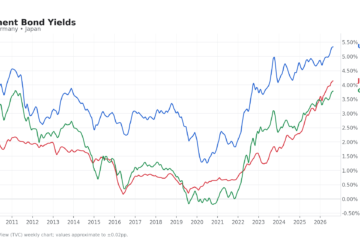
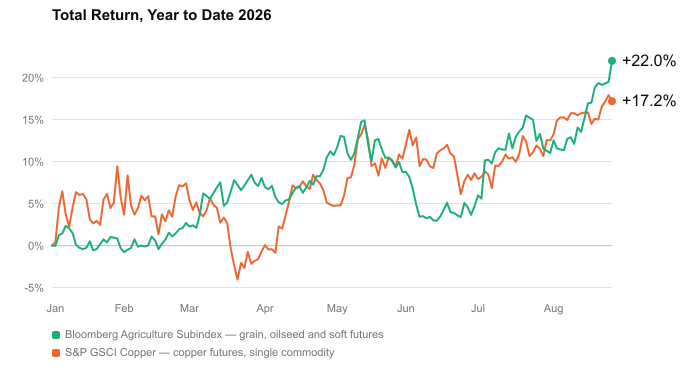
Copper is up ~17% this year to a new all-time high. 30-year Treasury yields have climbed to 5.2%, a level not seen since 2007. Those two disparate data elements are both trending higher, and even though they’re very different, there is a relationship that makes sense. Longer-dated bonds and long-duration equities are both claims on distant cash flows and they both get repriced based on movements in the same discount rate. That discount rate investors are applying to these assets’ future cash flows is driving up their cost of money today, and driving down the present value of the future money you expect to get back from those assets.
When a market begins doubting the certainty of the fiscal and monetary path — and is driving long yields to near two-decade highs — it signifies concern about the longer term. When doubts arise, capital moves, but it does not simply rotate between bonds, stocks, and cash; some of it leaves the discounted-cash-flow universe altogether. A ton of copper today, is not a claim on anything and it is no one’s liability. It has no duration, no terminal value, no multiple to compress. Copper’s price can certainly fluctuate based on the cost of money, but it has growing consumption demand, it has utility, and it is harder to debase than said “money.” We know what it costs today. Who knows what it might cost when you need it in a few years?
Treading Water — Traditional Allocation “No Brainers”
Through August 26, Technology, Communication Services, Consumer Discretionary, and Industrials — close to two-thirds of the S&P 500 by market capitalization — have gone nowhere since spring. Technology may be up 26% for the year, but it peaked near 38% on June 2 and has spent the summer digesting that run. Industrials have held up year to date, but have only added roughly two percentage points in six months. The other two sit below where they began the year. The broad market is near its highs, but much of that is the work of a few particular pockets. Health Care, Financials, and Energy all have made new 2026 highs this month. These outperformers only represent about 25% of the equity market.
For active market participants, trends pay; digestion, not so much. An index can look healthy even while inside of it, two-thirds has quietly stalled — as is happening now.
Trending — Certain Commodities
Back in June, Goldman Sachs listed a flight to real assets when fiscal sustainability risks arise as one of three distinct circumstances in which commodities diversify equity and bond risk. The other two are commodity supply shocks, and structural demand meeting a supply side that cannot grow to meet it. All three of these are active in various parts of the commodity complex: debt, war, and the AI buildout.
The aforementioned copper has continued to march higher, and has become a poster child for the convergence of AI and the hard assets required for AI expansion.
Goldman expects grid and power infrastructure — data centers, electrification, defense — to drive more than 60% of copper demand growth between 2025 and 2030, while ore grades keep falling and mines keep getting deeper. On their reading, copper demand has turned strategic where it used to be cyclical, which makes it less sensitive to a slowdown than construction or white goods. The metal touched a new all-time high just as we were preparing this piece.
This letter is general commentary — the wide-angle view. It is not a portfolio. What we do for the families we work with is the opposite of “wide-angle”: we make portfolios built around one household’s circumstances, taxes, timelines, and appetite for exactly the kind of volatility described above. We keep that roster of clients deliberately small, because that sort of attention doesn’t scale. If you’d like to talk about what it would look like for you, Aubrey Ford will make the time.
Energy
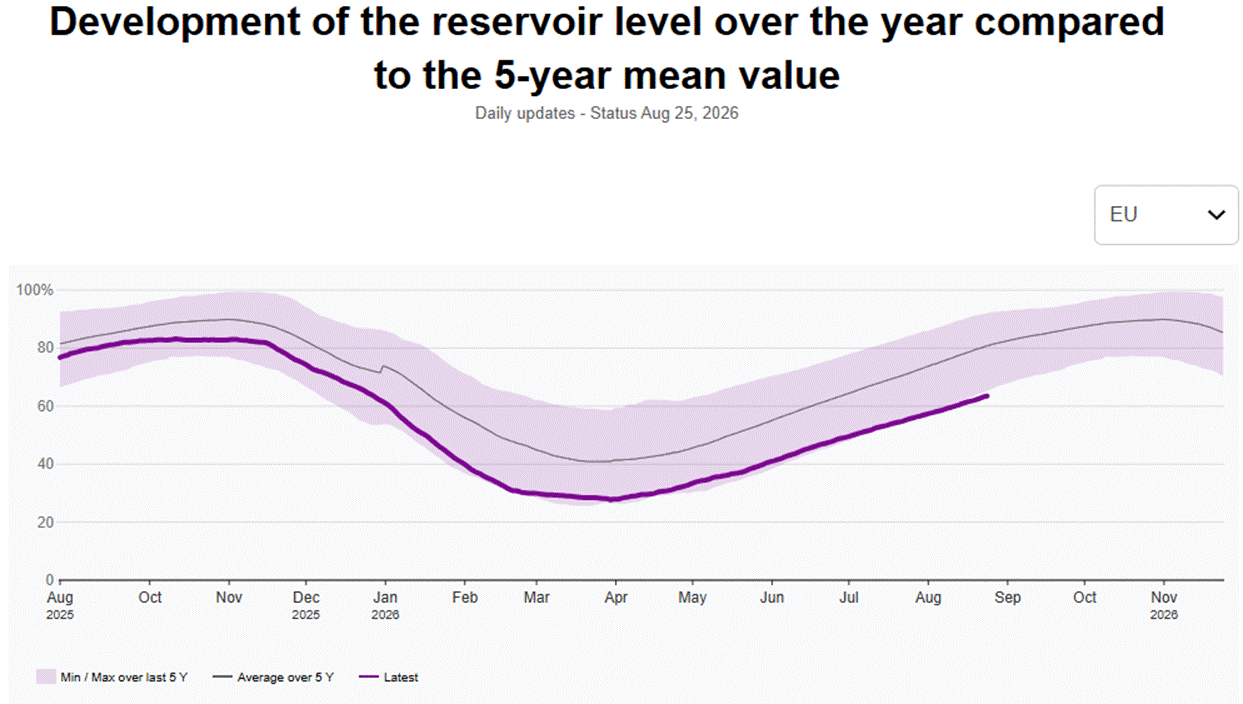
The first leg was the Hormuz closure; the sector was up 40% by late March. It gave back more than half of that into July as a reopening was priced in. The second leg, a 21% gain from July 1 to a new high on August 20 (since which it has retraced a little), is the market acknowledging that the reopening hasn’t yet really happened — transits remain far below the pre-war norm, the IEA is warning on the pace of stockpile depletion, and the working assumption has shifted to a disruption that runs more deeply into 2027. The key with energy prices is often not the quoted futures price, but the price on the ground when and where the energy is needed.
Once again, Europe could be facing some difficult times if we get anything worse than a warm winter. We hope a future letter on how bad things are getting will not be warranted.
For portfolios that we manage, we have not heard cogent arguments as to why we should be selling energy investments, even if prices are not trending enough to be making new highs. The cash flows from businesses throughout the energy sector are very much trending.
Food
For different reasons altogether, agricultural commodities have also been trending up. The broad agricultural basket illustrated above is up 22% for the year. The Black Sea supplied the headline: J.P. Morgan puts July’s strikes on Chornomorsk at roughly a third of that port’s seaborne grain capacity. What makes it a trend rather than a headline, however, is the planting calendar. Hormuz carried about a third of the world’s seaborne fertilizer (NB, we wrote about this months ago), and the risk rises in the autumn purchasing window for the 2027 crop. American corn and wheat acreage is already down about three percent each, and forecasters see a good chance of a super El Niño by year-end. Geopolitics and weather are conspiring.
Uranium
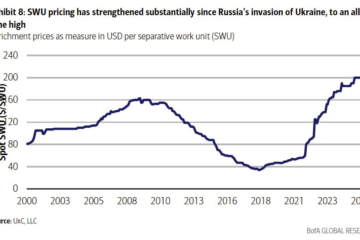
After treading water for a couple years, uranium prices look to have turned: spot is near $90 a pound and roughly 40% above its 2025 low, but still down considerably from the highs of 2024, although the mining equities still lag. (We wrote an extensive piece about the nuclear renaissance last year, and another analysis of the commodity itself a few weeks ago.)
Gold
These past two weeks we brought readers’ attention to how gold was starting to “glow” again. It continues its rally that began in late June. To recap its drivers: it benefits as a form of hedging for bad policy and lack of official credibility (and perhaps some of the ideas thrown around as we approach the U.S. midterms could keep a bid under gold); governmental purchases continue (as we discussed here); it provides non-correlated diversification; and it remains under-owned in global portfolios. In addition, there is growing interest in more gold used to back stablecoins and other digital assets.
Gold always has buyers and sellers, and not all governments are in a position to be net buyers. Some countries use gold sales to raise money for national needs, defense needs, energy needs, food needs, etc. Other governments, such as China, have a need to support (control) their currency. There are many forces acting on the yellow metal, but as with energy, we hear few cogent arguments that have us arriving at the conclusion that gold is a “sell.”
Commodities Are True “Alts”
It has become investment industry practice to allocate to “alternative” assets. However, much of what makes these instruments “alts” might be more related their structure, fees, liquidity, and packaging than to the actual asset exposure inside.
Let’s examine things sold under that label. As we’ve often noted, private equity is equity (stocks). Private credit is credit (bonds). What differs, mostly, is how and how often they’re marked: public prices update continuously, private ones quarterly and by appraisal. Cliff Asness of AQR named the phenomenon “volatility laundering,” and his complaint is with the smoothness itself, which is sold as a feature of alts. But it’s not so much a virtue as it is merely an artifact of the reporting calendar.
Non-correlation is another oft-cited feature. But why would you expect correlation between assets that are priced every day and those that are hardly ever priced, and instead are infrequently “valued”? Their non-correlation is a result of their relative opacity, so it should not be considered a feature in our opinion. Worse, for our purposes: a leveraged private company or leveraged credit fund is an even longer-duration claim than a public one. If we are in a period where discount rates are rising, the last thing an investor in them should want is higher cost of money shrinking the present value of future cash flows that have dubious timing.
By contrast, commodities are less dubious with regard to pricing and timing. They can be sold at any time, or used for a purpose. Commodities also offer the non-correlation (to equities and bonds) that is desired by institutional asset allocators. Yes, commodities have a cyclical element to them. However, with out-of-control debt monetization, rising economic demand for real assets, inflation not being under control, and a new industrial revolution needing a massive technological buildout, the concerns about commodities’ past cyclical patterns may not be top-of-mind. What is top-of-mind is the realization by a growing number of people around the world that “What we will need in the future looks like it’ll cost more than it does today — so let’s make sure we have some.”
A caveat on commodities is that they are not buy-and-hold-forever assets. Buy and hold for price movements. There are no cash flows, and no growth. Owning commodities represents owning things as opposed to owning claims on things. A topic for another letter could be how to start building exposure to commodities. In short, how one invests in commodities is important. For example, futures-based investments can have tax reporting headaches or a funds that bleed on each roll. Then, there are the equities of producers that carry operating leverage, management and financial risk elements, as well as increased equity market beta — they are not the commodity.
Again, a topic for a future letter. In the meantime, you can always call us. Perhaps we can be of assistance.
Thanks for listening; we welcome your calls and questions.
General Disclosures About This Newsletter
The publisher of this newsletter is Guild Investment Management, Inc. (GIM or Guild), an investment advisor registered with the Securities and Exchange Commission. GIM manages the accounts of high net worth individuals, trusts and estates, pension and profit sharing plans, and corporations, among other clients.
Your receipt of this newsletter does not create a personal investment advisory relationship with GIM although some recipients may also be advisory clients of GIM. GIM has written investment advisory agreements with all its personal advisory clients, which sets forth the nature of that relationship.
The newsletter makes general observations about markets and business and financial trends and may provide advice about specific companies and specific investments. It does not give personal investment advice tailored to the needs, objectives, and circumstances of individual readers. Whether investment ideas and recommendations are suitable for individual readers depends substantially on the personal and financial situation of that reader, which GIM, as the publisher of the newsletter, makes no effort to investigate.
GIM attempts to provide accurate content in its newsletters to the extent such content is factual rather than analysis and opinion, but GIM relies primarily on information compiled or reported by third parties and does not generally attempt to independently verify or investigate such information. Moreover, some content and some of the assumptions, formulas, algorithms and other data that affect the content may be inaccurate, outdated, or otherwise flawed. GIM does not guarantee or take responsibility for the accuracy of such information.
Please note that investing in stocks, other securities, and commodities is inherently risky, and you should rely on your personal financial advisors and conduct your own due diligence in connection with any investment decision.
A Special Comment for Guild’s Clients
If you are an investment advisory client of GIM who is receiving this newsletter, please note that the fact that a general recommendation is made of a particular security, commodity, or investment area to its newsletter subscribers does not mean that investment is suitable for you or should be purchased by you. For example, GIM may already have purchased such securities on your behalf or purchased securities in the same industry (and an increase in the position for you may represent too much concentration in one security or industry), or GIM may believe the investment is not suitable for you based on your risk tolerance or other factors. If you have questions about the recommendations in this newsletter in relation to your account at GIM, please contact Tony Danaher, Rudi von Abele, or Aubrey Ford.
Conflicts of Interest
As of the date of this newsletter, GIM’s investment advisory clients or GIM’s principals owned positions in areas that are the subject of current recommendations, commentary, analysis, opinions, or advice, contained in this newsletter.
GIM and its principals have certain conflicts of interest in its relations with its investment advisory clients and its newsletter subscribers resulting from GIM or its principals holding positions for its clients or themselves which are also recommended to its clients. GIM may change the positions of its clients or GIM’s principals may change their positions (increasing, decreasing, and eliminating them) based on GIM’s best judgment at any given time, including the time of publication of the newsletter. Factors that lead GIM to change or eliminate its positions may include general market developments, factors specific to the issuer, or the needs of GIM or its advisory clients. From time to time GIM’s investing goals on behalf of its investment advisory clients or the personal investing goals of GIM’s principals and their risk tolerance may be different from those discussed in the newsletter, and the investment decisions made by GIM for its advisory clients or the investment decisions of its principals may vary from (and may even be contrary to) the advice and recommendations in the newsletter.
In addition, GIM or its principals may reduce or eliminate their positions in an investment that is recommended in the newsletter prior to notifying the newsletter subscribers of such a reduction or elimination. The publication by GIM of a “target price” or “stop loss” for a particular security or other asset does not necessarily represent the price at which GIM intends to sell or will sell any such assets for its advisory clients or the price at which GIM’s principals intend to sell any such assets.
As a consequence of the conflict of interest, GIM’s clients or principals may benefit if newsletter subscribers purchase assets recommended by GIM since it could increase the value of the assets already held by GIM’s investment advisory clients or GIM’s principals. On the other hand, GIM’s principals and clients may suffer a detriment if they seek to acquire additional shares in securities that have been recommended and the price of the securities has increased as a result of purchases by newsletter subscribers.
To help mitigate these conflicts, GIM seeks to avoid recommending the securities of individual companies where GIM or its principals have an ownership position and where the issuer is small or its securities are thinly traded. That way sales by GIM in advance of possible sales by newsletter subscribers would not be likely to cause any significant decrease in the sale price to newsletter subscribers. GIM has a fiduciary relationship with its investment advisory clients and cannot agree on behalf of such clients to refrain from purchases or sales of a security mentioned in the newsletter for a period of time before or after recommendations for purchases or sales are made to its newsletter subscribers.
GIM encourages you to do independent research on the securities or other assets discussed or recommended in the newsletter prior to making any investment decisions and to be especially cautious of investments in small, thinly-traded companies, which are usually the most risky investments that you can make.
Disclaimer of Liability
GIM disclaims any liability for investment decisions based upon recommendations, information, or opinions in its newsletters. GIM is not soliciting you to execute any trade. Nothing contained in GIM’s newsletters is intended to be, nor shall it be construed as an offer to buy or sell securities or to give individual investment advice. The information in the newsletter is not intended for distribution to, or use by, any person or entity in any jurisdiction or country where such distribution or use would be contrary to law or regulation, or which would subject GIM to any registration requirement within such jurisdiction or country.
COPYRIGHT NOTICE
Guild’s current and past market commentaries are protected by U.S. and international copyright laws. All rights reserved. You must not copy, frame, modify, transmit, further distribute, or use the market commentaries, without the prior written consent of Guild. This email or any download from a secure website is meant for only the intended recipient of the transmission, and may be a communication privileged by law. If you received this email in error, any use, dissemination, distribution, or copying of this email is similarly prohibited. Please notify us immediately of the error by return email and please delete this message from your system. Although this email and any attachments are believed to be free of any virus or other defect that might affect any computer system into which it is received and opened it is the responsibility of the recipient to ensure that it is virus free and no responsibility is accepted by Guild Investment Management for any loss or damage arising in any way from its use.