First: Uranium
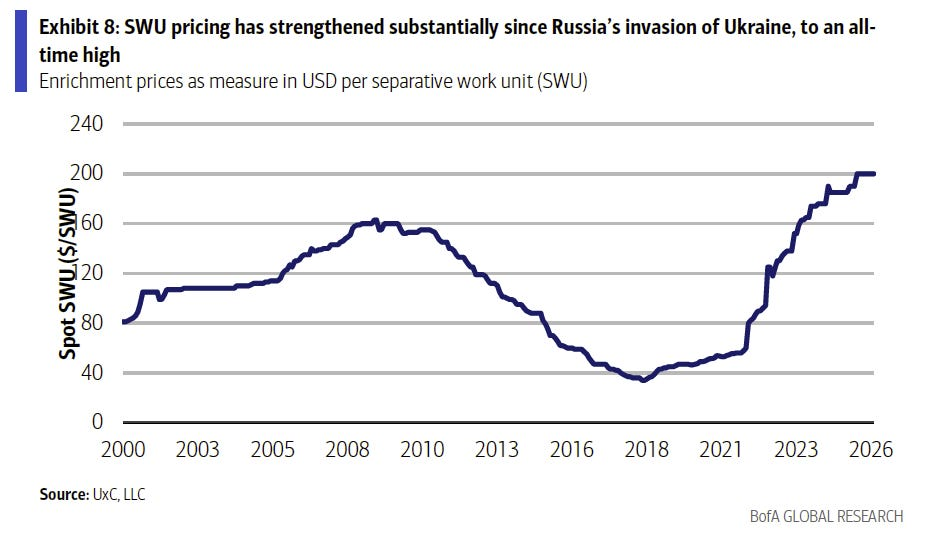
The tightest areas in the uranium supply chain are downstream of the mine. Uranium itself (that is, processed ore) as we write, is at $86.90 per pound, roughly where it’s been since April. The two stages that come next — converting it into a gas, then “enriching” that gas by increasing the proportion of the fissile isotope — are historically expensive, and enrichment is at a record high. As we discuss below, that scarcity in the middle of the chain has the effect of raising demand at the top.
To explain why, first this brief orientation on the journey from ore to fuel.
From Element to Energy
Nuclear fuel reaches a reactor after four separate stages. Miners produce U3O8, the concentrate known as “yellowcake.” Converters turn it into a gas (uranium hexafluoride), because you cannot “sort” the various isotopes of uranium in the solid. Enrichers raise the share of the one uranium isotope that sustains a chain reaction, U-235 — up from the 0.7% found in nature to between 3 and 5%; this “sorting” is sold by the “separative work unit,” or SWU, which prices the effort of separation. Fabricators press the result into pellets.
A pound takes the better part of two years to make that journey, and a reactor that misses its refueling window loses months of output. So utilities tend to buy fuel early, in bulk, on long contracts, with little regard for price. Fuel is a small line-item that could idle a very large asset, which is why buyers are relatively price-insensitive (and sellers know it).
The Overfeeding Trick
Enrichment involves a trade-off: to end up with a given quantity of fuel, you can put more sorting effort into less raw uranium, or less sorting into more. When sorting is cheap, enrichers work the leftovers harder and release the uranium they no longer need back into the market; when sorting is expensive, they reverse it — they “overfeed,” pushing more uranium hexafluoride through the machines to economize on the costly step.
Conversion, the step before, is squeezed too: prices are off their peak but historically elevated, ConverDyn’s Metropolis plant, America’s only commercial converter, is ramping about 20% this year, and Orano’s French facility will manage some 9,000 tonnes against 13,000 last year.
Sorting is now at record prices. So the industry is overfeeding, and a bottleneck downstream of the mine converts directly into demand upstream of it. Bank of America argued last week that this alone makes a new all-time high in uranium feasible — which would mean clearing the 2007 peak near $136 a pound.
This raises the question of why nobody simply builds more enrichment capacity. Four companies do this work at commercial scale — Russia’s Rosatom, the Anglo-Dutch-German consortium Urenco, France’s Orano and China’s CNNC — and every one is government-owned or government-controlled, because the centrifuges that enrich uranium to 5% for a reactor will take it to 90% for a warhead if you keep them spinning. America has no enricher of its own at commercial scale: the single commercial-scale plant on its soil belongs to Urenco, and covers about a third of national demand.
This letter is general commentary — the wide-angle view. It is not a portfolio. What we do for the families we work with is the opposite of “wide-angle”: we make portfolios built around one household’s circumstances, taxes, timelines, and appetite for exactly the kind of volatility described above. We keep that roster of clients deliberately small, because that sort of attention doesn’t scale. If you’d like to talk about what it would look like for you, Aubrey Ford will make the time.
Capacity is being added, at the pace such things move. Urenco’s New Mexico plant turns out 4.3 million SWUs a year, that third of American demand; it is installing another 700,000 by 2027, call it a further five percent of what the country needs, and a further 2.1 million with construction beginning in 2029, first production in 2032 and full output in 2036. This would take the site past 7 million SWUs, better than half of present national demand, a decade from now. Centrus, a minor, not-yet-commercial-scale American-owned enricher, operates a small plant at Piketon, Ohio, and is building new capacity there on the strength of a federal award and contingent utility commitments; it begins to arrive from 2029.
The market’s shock absorber is draining alongside. For two decades a stream of recycled and stockpiled material has filled the gap between what mines produce and what reactors consume; it has fallen from roughly 65 million pounds in 2020 to 22 million this year. Overfeeding is one cause among several — the American-Russian deal that turned Soviet warhead uranium into reactor fuel expired in 2013, government inventory sales have shrunk, and the Japanese stockpiles released after Fukushima are spent.
So global term contracting is running below the level needed to stand still. The benchmark — the volume of publicly reported long-term contracts consistent with fueling the existing fleet — is about 150 million pounds a year. 2024 managed 110 million, 2025 some 116 million, more than half of last year’s total arriving in a single quarter at the end.
The 2028 Wall
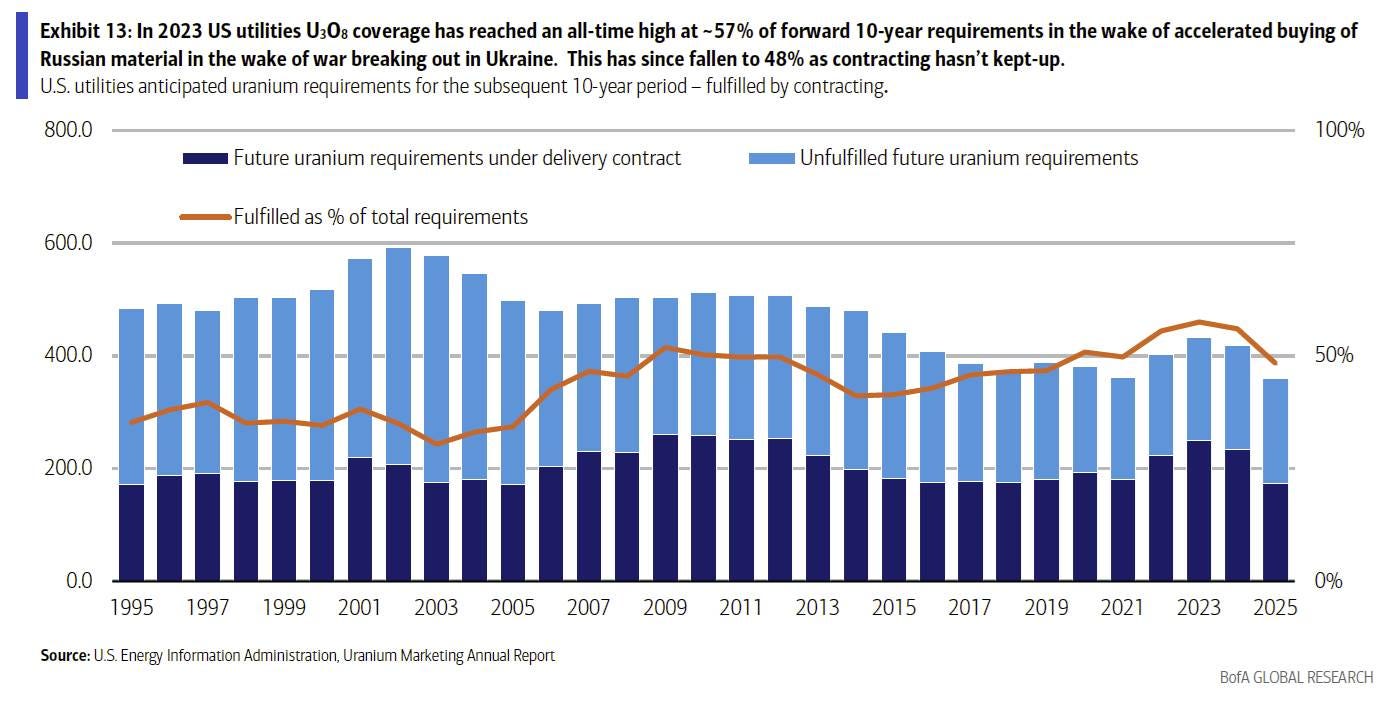
American utilities are even further behind than that global picture suggests. A total ban on Russian uranium products entering the United States takes effect January 1, 2028. Russia supplied roughly a quarter of American enrichment services before the war, and that supply has already effectively gone. Utility behavior shows the anticipation: stockpiles held at U.S. reactors rose 3% last year, to 118 million pounds, while the enriched share of them fell to 44% from a 2023 high of 49% — the fingerprint of a ban on material that used to arrive from Russia already enriched. Seventeen months from a hard deadline, American utilities have locked in only 174 million of the 360 million pounds they expect to need over the next decade.
So, we have a commodity whose buyers are constrained, a conversion and enrichment squeeze that neither capital nor politics can unclog quickly, a vanishing cushion, and purchasers whose refueling dates are fixed years ahead buying into a market too thin to absorb them.
To us, to say it simply, this combination is bullish for the long-term price of the commodity.
Second: Gold
Gold peaked near $5,600 in January, fell almost 30%, and after its worst quarter since 2013, dipped below $4,000 in June. It is now above $4,400. Seasonally, summer months can be an air pocket for gold demand, but that dim period is ending. Data from Seasonax suggests that the latter half of the calendar year is typically when gold starts to glow brightest.
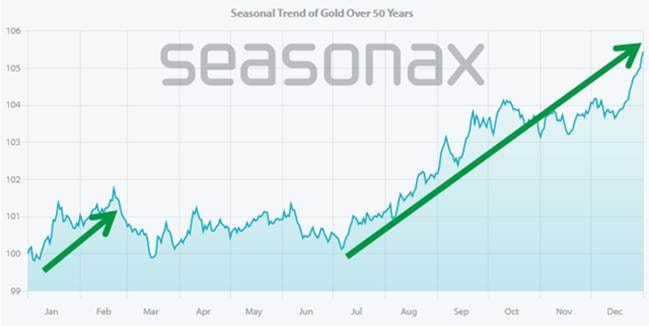
What normally follows runs on a harvest calendar. Indian rural income arrives after the monsoon crop; jewelers restock in September for Dhanteras and Diwali, on November 6th and 8th this year; the autumn wedding season runs into December; and Chinese gift-buying builds toward the Lunar New Year on February 6, 2027. That physical rhythm is why September has been gold’s strongest month for five decades.
This year the rhythm has a problem and a replacement. The problem, is that jewelry demand in the last quarter was the weakest since the pandemic, Indian jewelry purchases fell 15% year-over-year: at these lofty prices the traditional seasonal buyer is incrementally priced out. Also, Indians have experienced fuel price shocks and fuel price volatility that undermines spending on gold.
The replacement to sagging jewelry demand is — the official sector. Central banks bought 289 tonnes, 62% more than a year earlier, while the price fell 16%, and nearly nine in ten reserve managers expect global gold holdings to rise within the year. The first half was quieter than that quarter suggests, at 345 tonnes, it was the weakest since 2022 — a total that owes something to a downward revision of the first-quarter data — with Russia, Turkey, and Azerbaijan selling bullion to plug budget holes.
Get Used to Governments Being the Marginal Buyer
A few events recently are giving this a face.
1) The Bank of Korea — which bought gold from 2011 to 2013, and was pilloried when the price fell, then abstained for thirteen years — has said it will buy again.
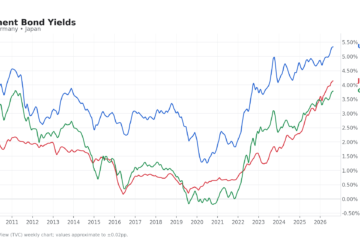
2) An intervention in the dollar-yen came on July 29th, the dollar dropping 4% over the six days to its August 3rd low. Our esteemed friend Larry Jeddeloh of TIS Group reads that as trouble in Japan’s government bond market. Long-term borrowing costs climb when an economy strengthens, and also when lenders grow doubtful about repayment; gold responds to the second case.
3) In July, China made their largest monthly purchase of gold (20 tonnes) in almost three years. The Peoples’ Bank of China also just recently renewed liquidity injections after a four-month lull — that began shortly after the attacks on Iran and the closure of the Strait of Hormuz disrupted oil flows. PBoC easing liquidity again could just be a blip, or it could the start of some new policy directive. Nonetheless, it needs to be watched.
Thanks for listening; we welcome your calls and questions.
General Disclosures About This Newsletter
The publisher of this newsletter is Guild Investment Management, Inc. (GIM or Guild), an investment advisor registered with the Securities and Exchange Commission. GIM manages the accounts of high net worth individuals, trusts and estates, pension and profit sharing plans, and corporations, among other clients.
Your receipt of this newsletter does not create a personal investment advisory relationship with GIM although some recipients may also be advisory clients of GIM. GIM has written investment advisory agreements with all its personal advisory clients, which sets forth the nature of that relationship.
The newsletter makes general observations about markets and business and financial trends and may provide advice about specific companies and specific investments. It does not give personal investment advice tailored to the needs, objectives, and circumstances of individual readers. Whether investment ideas and recommendations are suitable for individual readers depends substantially on the personal and financial situation of that reader, which GIM, as the publisher of the newsletter, makes no effort to investigate.
GIM attempts to provide accurate content in its newsletters to the extent such content is factual rather than analysis and opinion, but GIM relies primarily on information compiled or reported by third parties and does not generally attempt to independently verify or investigate such information. Moreover, some content and some of the assumptions, formulas, algorithms and other data that affect the content may be inaccurate, outdated, or otherwise flawed. GIM does not guarantee or take responsibility for the accuracy of such information.
Please note that investing in stocks, other securities, and commodities is inherently risky, and you should rely on your personal financial advisors and conduct your own due diligence in connection with any investment decision.
A Special Comment for Guild’s Clients
If you are an investment advisory client of GIM who is receiving this newsletter, please note that the fact that a general recommendation is made of a particular security, commodity, or investment area to its newsletter subscribers does not mean that investment is suitable for you or should be purchased by you. For example, GIM may already have purchased such securities on your behalf or purchased securities in the same industry (and an increase in the position for you may represent too much concentration in one security or industry), or GIM may believe the investment is not suitable for you based on your risk tolerance or other factors. If you have questions about the recommendations in this newsletter in relation to your account at GIM, please contact Tony Danaher, Rudi von Abele, or Aubrey Ford.
Conflicts of Interest
As of the date of this newsletter, GIM’s investment advisory clients or GIM’s principals owned positions in areas that are the subject of current recommendations, commentary, analysis, opinions, or advice, contained in this newsletter.
GIM and its principals have certain conflicts of interest in its relations with its investment advisory clients and its newsletter subscribers resulting from GIM or its principals holding positions for its clients or themselves which are also recommended to its clients. GIM may change the positions of its clients or GIM’s principals may change their positions (increasing, decreasing, and eliminating them) based on GIM’s best judgment at any given time, including the time of publication of the newsletter. Factors that lead GIM to change or eliminate its positions may include general market developments, factors specific to the issuer, or the needs of GIM or its advisory clients. From time to time GIM’s investing goals on behalf of its investment advisory clients or the personal investing goals of GIM’s principals and their risk tolerance may be different from those discussed in the newsletter, and the investment decisions made by GIM for its advisory clients or the investment decisions of its principals may vary from (and may even be contrary to) the advice and recommendations in the newsletter.
In addition, GIM or its principals may reduce or eliminate their positions in an investment that is recommended in the newsletter prior to notifying the newsletter subscribers of such a reduction or elimination. The publication by GIM of a “target price” or “stop loss” for a particular security or other asset does not necessarily represent the price at which GIM intends to sell or will sell any such assets for its advisory clients or the price at which GIM’s principals intend to sell any such assets.
As a consequence of the conflict of interest, GIM’s clients or principals may benefit if newsletter subscribers purchase assets recommended by GIM since it could increase the value of the assets already held by GIM’s investment advisory clients or GIM’s principals. On the other hand, GIM’s principals and clients may suffer a detriment if they seek to acquire additional shares in securities that have been recommended and the price of the securities has increased as a result of purchases by newsletter subscribers.
To help mitigate these conflicts, GIM seeks to avoid recommending the securities of individual companies where GIM or its principals have an ownership position and where the issuer is small or its securities are thinly traded. That way sales by GIM in advance of possible sales by newsletter subscribers would not be likely to cause any significant decrease in the sale price to newsletter subscribers. GIM has a fiduciary relationship with its investment advisory clients and cannot agree on behalf of such clients to refrain from purchases or sales of a security mentioned in the newsletter for a period of time before or after recommendations for purchases or sales are made to its newsletter subscribers.
GIM encourages you to do independent research on the securities or other assets discussed or recommended in the newsletter prior to making any investment decisions and to be especially cautious of investments in small, thinly-traded companies, which are usually the most risky investments that you can make.
Disclaimer of Liability
GIM disclaims any liability for investment decisions based upon recommendations, information, or opinions in its newsletters. GIM is not soliciting you to execute any trade. Nothing contained in GIM’s newsletters is intended to be, nor shall it be construed as an offer to buy or sell securities or to give individual investment advice. The information in the newsletter is not intended for distribution to, or use by, any person or entity in any jurisdiction or country where such distribution or use would be contrary to law or regulation, or which would subject GIM to any registration requirement within such jurisdiction or country.
COPYRIGHT NOTICE
Guild’s current and past market commentaries are protected by U.S. and international copyright laws. All rights reserved. You must not copy, frame, modify, transmit, further distribute, or use the market commentaries, without the prior written consent of Guild. This email or any download from a secure website is meant for only the intended recipient of the transmission, and may be a communication privileged by law. If you received this email in error, any use, dissemination, distribution, or copying of this email is similarly prohibited. Please notify us immediately of the error by return email and please delete this message from your system. Although this email and any attachments are believed to be free of any virus or other defect that might affect any computer system into which it is received and opened it is the responsibility of the recipient to ensure that it is virus free and no responsibility is accepted by Guild Investment Management for any loss or damage arising in any way from its use.