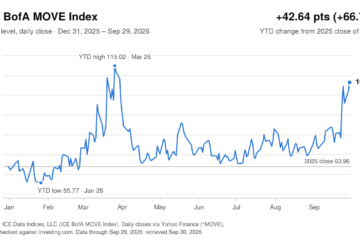
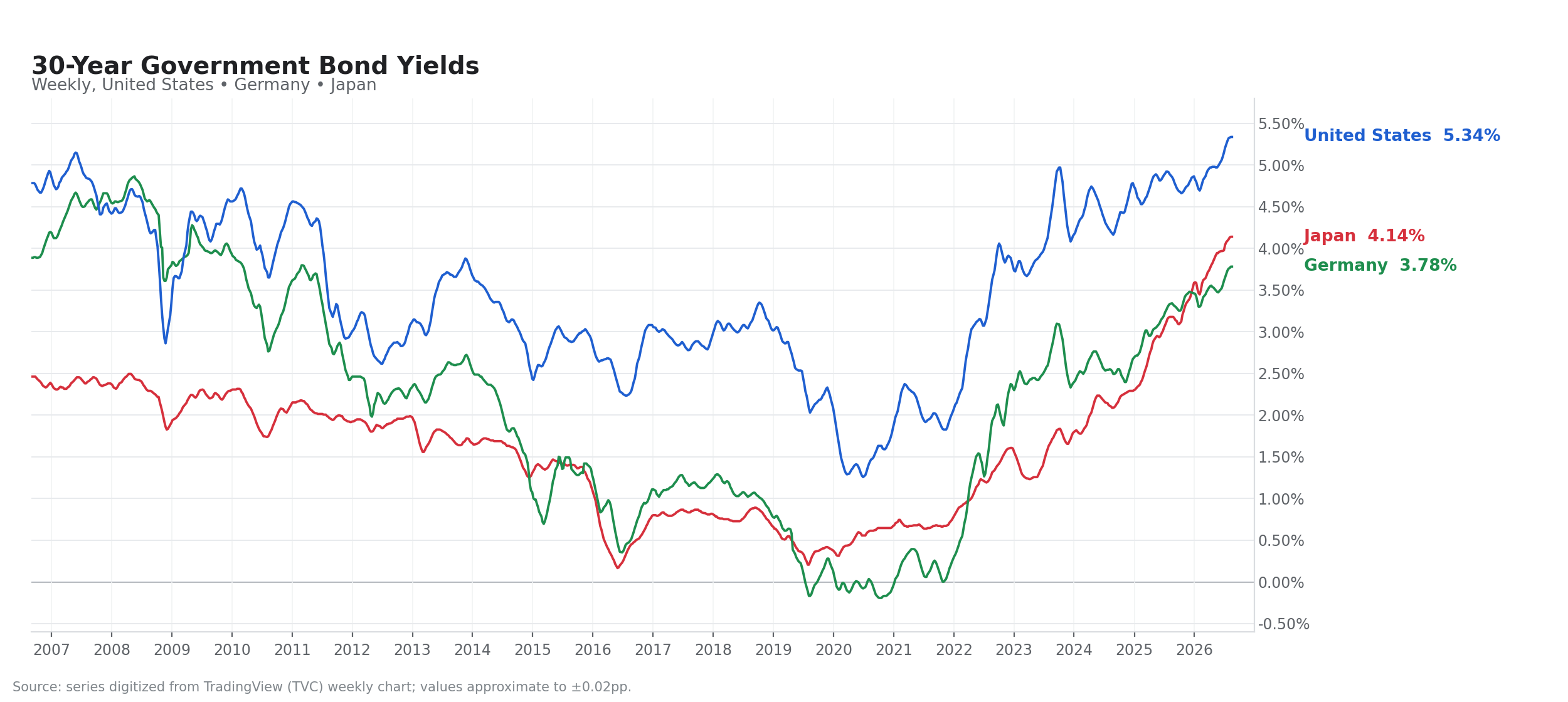
We were planning to write about rates already after watching them climb for months. On Tuesday, as we were wrapping up this piece, yields on thirty-year Treasuries touched 5.339 percent, their highest since 2007. Then on Wednesday morning, the Treasury Department for all intents and purposes said “Enough!” and announced it will at least double its liquidity support buybacks in the ten-to-thirty-year sector, from a $2 billion maximum per operation to at least $4 billion, beginning September 9. Long yields fell roughly eight to ten basis points within the hour. We won’t say “yield curve control” (OK, we said it), but… this is what it looks like when demand for longer-dated Treasuries is being manufactured. (On a related note, outstanding U.S. Federal debt also crossed the $40 trillion threshold — not a particularly significant development in itself, but one which surely contributed to the market’s mood.)
Why? Were Long Bonds Getting Too Competitive?
Even after the bounce in Treasury prices Wednesday, the thirty-year yield is still over 5.2 percent, and to some, that might look competitive with the S&P 500 earnings yield. At roughly twenty times expected earnings over the next twelve months, the equity index offers an earnings yield near 5.0 percent. (An “earnings yield” is a price-to-earnings ratio upside down: what the companies in the index collectively earn, against what they cost.) The math was suggesting that the longest, dullest, most contractually reliable instrument in the world would be paying more in annual cash than could be expected of American stocks, which at 20 times earnings already assume a lot of things have to go right.
Every investor has a rate at which that arithmetic stops being trivia and becomes a decision. We don’t know yours. We do, however, suspect that the number of people who realized that they do have such a number went up sharply this month. All things considered on the geopolitical front, earnings growth has helped stocks hold up pretty well. However, recently, certain areas of the market were looking a little wobbly. From a political perspective, Wednesday’s Treasury action makes some sense. Keeping a lid on yields to preserve the stock markets’ relative attractiveness and maybe stop the wobble (leading up to an important election) can’t hurt, right? If we sound too cynical, we will add that the Treasury buyback program is to run from September 9th to November 4th… ending the day after the midterm elections.
Not Just An American Story
Japan’s ten-year sits near 2.93 percent, its highest in 30 years; France’s is around 4.1 percent, last seen in 2008; Germany’s has climbed back to 2011 levels. The Wall Street Journal’s editorial page reads this as normalization rather than a rout, which is of course correct about the level, but perhaps a little too blasé about the implications (of course, the editors of the Journal are not managing money for clients).
While We Have Been Here (and Even Higher) Before…
The financial economy of 2006 could carry a 5.3 percent long bond because it had been built at similar rates. Ours today? It has been built over eighteen years of the opposite, and the mountains of borrowed money underpinning it were underwritten at borrowing costs that no longer pertain. Tens (if not hundreds) of trillions in debt worldwide has been amassed in a much lower-rate environment. The rising cost of refinancing all those trillions will create some cracks in risk asset markets. To avoid losing money in the “cracks,” some people might settle for the higher “risk-free” rate. A higher risk-free rate not only discounts every future dollar more harshly by compressing what someone is willing to pay today for growth arriving in the future, it more severely punish the valuations of riskier assets… and there are a lot more of them than in 2006.
The Problem Is Not Just Trillions in Treasury Supply
A second enormous issuer is competing for the same duration-hungry money, and it’s wearing a hoodie and sneakers. Amazon, Alphabet, Meta and Oracle sold roughly $194 billion of bonds through July 7, against about $108 billion in all of 2025, per Reuters’ analysis of LSEG data. Nomura counts about $200 billion of tech borrowing so far in 2026, roughly a quarter of the Treasury’s net issuance over the same stretch. This paper is deliberately long-dated, sold to pretty much the same kind of buyers who would otherwise absorb thirty-year government bonds. The AI trade stopped being purely an equity story sometime last year; it is now a fixed-income supply story; every dollar it raises is a dollar no longer bidding for your stocks.
Another Reason For “Blinking”
Housing starts fell 12.4 percent in July to a 1.24 million annual pace, with single-family starts down 15.7 percent from a year ago. Permits rose 5 percent, but nobody’s eager to break ground at a thirty-year mortgage of 6.67 percent. Goldman reads the spring’s consumer strength as a temporary byproduct of the tax refund surge, now spent, and looks for real spending growth of 1 to 1.5 percent in the second half. Higher interest rates are an obvious culprit here.
This letter is general commentary — the wide-angle view. It is not a portfolio. What we do for the families we work with is the opposite of “wide-angle”: we make portfolios built around one household’s circumstances, taxes, timelines, and appetite for exactly the kind of volatility described above. We keep that roster of clients deliberately small, because that sort of attention doesn’t scale. If you’d like to talk about what it would look like for you, Aubrey Ford will make the time.
Geopolitics Not Helping Either
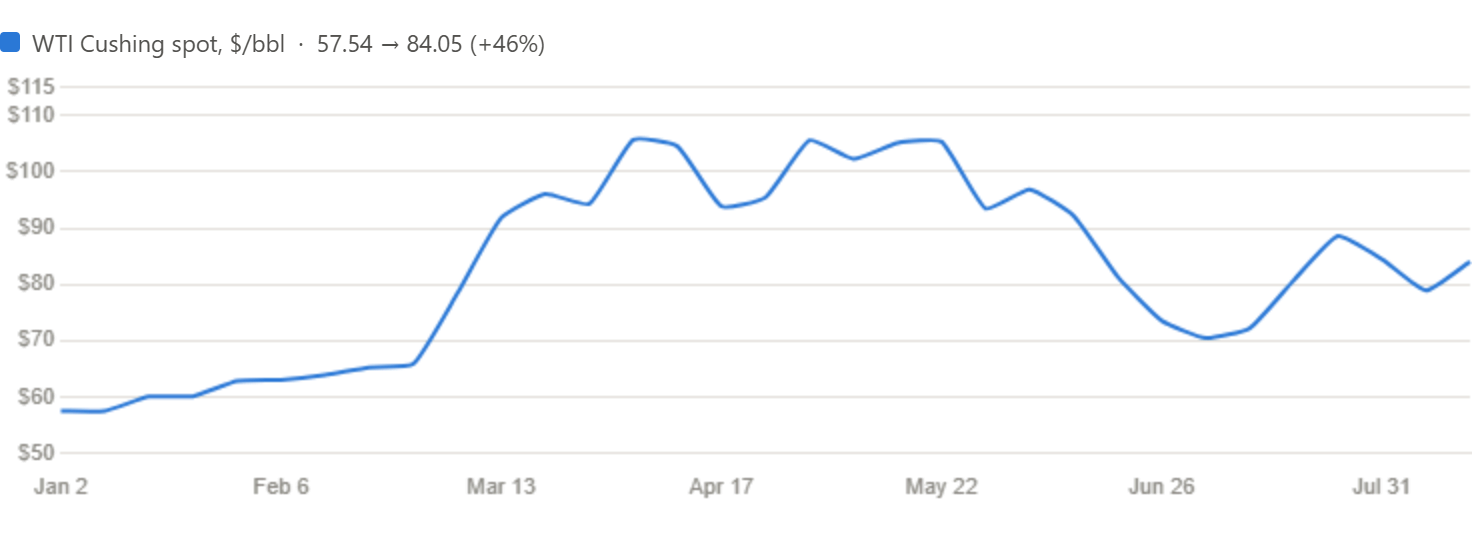
The Strait of Hormuz has been closed or contested since March. Gasoline is back above $4 a gallon nationally. Brent trades near $90, the naval blockade remains, talks have stalled, and Goldman’s commodity strategists expect global visible oil inventories to reach the lowest level in their series if it does not reopen soon. Markets have priced it the way they price most slow-burn conflicts, as if it is contained. It isn’t. It runs through gasoline into the consumer, through energy into core inflation, through inflation into a Federal Reserve that cannot cut, and out the far end into the long bond.
Keeping Markets Orderly Is the Imperative
In a system carrying this much borrowed money, markets will not sit still if rates go too high. To avoid that, policy must respond. (As an aside, we ask, Would you really prefer to have policymakers who didn’t respond, who were deaf to what the market was telling them?)
Washington has been running the quiet version of that fix for a year: tilting issuance toward short bills, buying back older bonds, propping up the yen so Japanese institutions face less pressure to sell their Treasuries. On Wednesday morning it just turned up the volume. Their limited buyback is not quantitative easing, and it is not blatant yield curve control — where a central bank pledges to buy whatever it takes to hold a chosen maturity at a chosen rate. Treasury retires long bonds with money raised elsewhere, mostly by selling short bills, so the debt does not shrink and the government’s maturity profile simply gets shorter. That is price support today, purchased with rollover risk later.
Notice the size, too. Two billion dollars of extra capacity per operation moved the long end nearly ten basis points. That tells you how badly this market wanted to hear that somebody was listening. Also, as we mentioned above it is only scheduled to run through November 4. We know that Fed Chair Kevin Warsh wants a smaller Fed balance sheet and dislikes forward guidance, which is precisely why the job fell to Treasury.
First Reaction? Bid Up Gold
What gold does on the day the long end is no longer permitted to clear on its own terms is the question we keep returning to. We flagged the shifting tenor toward gold last week, when the official sector rather than the jewelry buyer had become the marginal bidder — and gold is up 10% in two weeks. This is information.
What We Are Doing
In all candor, we know that many will focus on the government manipulation story. In our view, bellyaching about manipulation is quite beside the point. Aside from some wry commentary (“if we didn’t laugh, we’d cry”), we don’t bellyache, we act, and you should too.
Opportunistically buy growth equities, own some gold, bitcoin, and other necessities that can appreciate over time. Buy innovation and change. Buy increased productivity wherever you can find it. Use discernment to find opportunities that arrive through the rising volatility — our honest near-term forecast, yet it is not a fundamentally bearish one. Earnings have been extraordinary: the second quarter delivered the largest positive surprise in the twenty years FactSet has measured it.
So, our response is not to sell America; nor is it to pretend the rising rates do not matter. Being active, tactile, agile, and attentive investors, we have no mandate that’s requiring us to underwrite the next thirty years of fiscal policy mistakes or just ride out wild roller-coaster markets.
What not to buy? Longer-dated fixed-return instruments, don’t buy anything that gets you “stuck.” We think you will be more rewarded for being nimble and opportunistic than being stubborn or pretending nothing has changed.
Thanks for listening; we welcome your calls and questions.
General Disclosures About This Newsletter
The publisher of this newsletter is Guild Investment Management, Inc. (GIM or Guild), an investment advisor registered with the Securities and Exchange Commission. GIM manages the accounts of high net worth individuals, trusts and estates, pension and profit sharing plans, and corporations, among other clients.
Your receipt of this newsletter does not create a personal investment advisory relationship with GIM although some recipients may also be advisory clients of GIM. GIM has written investment advisory agreements with all its personal advisory clients, which sets forth the nature of that relationship.
The newsletter makes general observations about markets and business and financial trends and may provide advice about specific companies and specific investments. It does not give personal investment advice tailored to the needs, objectives, and circumstances of individual readers. Whether investment ideas and recommendations are suitable for individual readers depends substantially on the personal and financial situation of that reader, which GIM, as the publisher of the newsletter, makes no effort to investigate.
GIM attempts to provide accurate content in its newsletters to the extent such content is factual rather than analysis and opinion, but GIM relies primarily on information compiled or reported by third parties and does not generally attempt to independently verify or investigate such information. Moreover, some content and some of the assumptions, formulas, algorithms and other data that affect the content may be inaccurate, outdated, or otherwise flawed. GIM does not guarantee or take responsibility for the accuracy of such information.
Please note that investing in stocks, other securities, and commodities is inherently risky, and you should rely on your personal financial advisors and conduct your own due diligence in connection with any investment decision.
A Special Comment for Guild’s Clients
If you are an investment advisory client of GIM who is receiving this newsletter, please note that the fact that a general recommendation is made of a particular security, commodity, or investment area to its newsletter subscribers does not mean that investment is suitable for you or should be purchased by you. For example, GIM may already have purchased such securities on your behalf or purchased securities in the same industry (and an increase in the position for you may represent too much concentration in one security or industry), or GIM may believe the investment is not suitable for you based on your risk tolerance or other factors. If you have questions about the recommendations in this newsletter in relation to your account at GIM, please contact Tony Danaher, Rudi von Abele, or Aubrey Ford.
Conflicts of Interest
As of the date of this newsletter, GIM’s investment advisory clients or GIM’s principals owned positions in areas that are the subject of current recommendations, commentary, analysis, opinions, or advice, contained in this newsletter.
GIM and its principals have certain conflicts of interest in its relations with its investment advisory clients and its newsletter subscribers resulting from GIM or its principals holding positions for its clients or themselves which are also recommended to its clients. GIM may change the positions of its clients or GIM’s principals may change their positions (increasing, decreasing, and eliminating them) based on GIM’s best judgment at any given time, including the time of publication of the newsletter. Factors that lead GIM to change or eliminate its positions may include general market developments, factors specific to the issuer, or the needs of GIM or its advisory clients. From time to time GIM’s investing goals on behalf of its investment advisory clients or the personal investing goals of GIM’s principals and their risk tolerance may be different from those discussed in the newsletter, and the investment decisions made by GIM for its advisory clients or the investment decisions of its principals may vary from (and may even be contrary to) the advice and recommendations in the newsletter.
In addition, GIM or its principals may reduce or eliminate their positions in an investment that is recommended in the newsletter prior to notifying the newsletter subscribers of such a reduction or elimination. The publication by GIM of a “target price” or “stop loss” for a particular security or other asset does not necessarily represent the price at which GIM intends to sell or will sell any such assets for its advisory clients or the price at which GIM’s principals intend to sell any such assets.
As a consequence of the conflict of interest, GIM’s clients or principals may benefit if newsletter subscribers purchase assets recommended by GIM since it could increase the value of the assets already held by GIM’s investment advisory clients or GIM’s principals. On the other hand, GIM’s principals and clients may suffer a detriment if they seek to acquire additional shares in securities that have been recommended and the price of the securities has increased as a result of purchases by newsletter subscribers.
To help mitigate these conflicts, GIM seeks to avoid recommending the securities of individual companies where GIM or its principals have an ownership position and where the issuer is small or its securities are thinly traded. That way sales by GIM in advance of possible sales by newsletter subscribers would not be likely to cause any significant decrease in the sale price to newsletter subscribers. GIM has a fiduciary relationship with its investment advisory clients and cannot agree on behalf of such clients to refrain from purchases or sales of a security mentioned in the newsletter for a period of time before or after recommendations for purchases or sales are made to its newsletter subscribers.
GIM encourages you to do independent research on the securities or other assets discussed or recommended in the newsletter prior to making any investment decisions and to be especially cautious of investments in small, thinly-traded companies, which are usually the most risky investments that you can make.
Disclaimer of Liability
GIM disclaims any liability for investment decisions based upon recommendations, information, or opinions in its newsletters. GIM is not soliciting you to execute any trade. Nothing contained in GIM’s newsletters is intended to be, nor shall it be construed as an offer to buy or sell securities or to give individual investment advice. The information in the newsletter is not intended for distribution to, or use by, any person or entity in any jurisdiction or country where such distribution or use would be contrary to law or regulation, or which would subject GIM to any registration requirement within such jurisdiction or country.
COPYRIGHT NOTICE
Guild’s current and past market commentaries are protected by U.S. and international copyright laws. All rights reserved. You must not copy, frame, modify, transmit, further distribute, or use the market commentaries, without the prior written consent of Guild. This email or any download from a secure website is meant for only the intended recipient of the transmission, and may be a communication privileged by law. If you received this email in error, any use, dissemination, distribution, or copying of this email is similarly prohibited. Please notify us immediately of the error by return email and please delete this message from your system. Although this email and any attachments are believed to be free of any virus or other defect that might affect any computer system into which it is received and opened it is the responsibility of the recipient to ensure that it is virus free and no responsibility is accepted by Guild Investment Management for any loss or damage arising in any way from its use.